Cash for Clunkers Program (2009): Eligibility & History
Note: The Cash for Clunkers program ended in the fall of 2009. This article remains on this site for historical and informational purposes. We have updated the contents for clarity and to remove broken links. There is no current Cash for Clunkers stimulus program.
The House and Senate have both approved a “Cash for Clunkers” program, which is also known as Car Allowance Rebate System (CARS). CARS is intended to stimulate auto sales by offering consumers the opportunity to trade their old clunker for a $3,500 to $4,500 voucher to be used toward a new car purchase.
Car Allowance Rebate System (CARS) – Cash for Clunkers Bill
The purpose of the bill is to remove older, inefficient cars from the road, and stimulate the auto industry, which has fallen on hard times. A similar program recently occurred in Germany and was very successful.
Here is how the Car Allowance Rebate System (CARS) works: Consumers need to turn in an old vehicle to receive a $3500 to $4500 voucher that can only be used on a new car. The voucher has no cash value and cannot be transferred to another individual. The car will be destroyed, so it is important to note that trade-in values should be less than the voucher amount, or it will not be worth trading the car in for the voucher.
Here is some more information about the Cash for Clunkers Bill:
- Only purchase or lease of new vehicles qualify.
- Trade-in vehicles must be registered and insured continuously for the full year preceding the trade-in.
- You don’t need a voucher, dealers will apply for credit at purchase.
- The program runs through Nov 1, 2009, or when the funds are exhausted, whichever comes first.
Requirements for trade-in vehicle. To be eligible for a voucher, the car must be in running order and meet the following criteria:
- The car must be at least 10 years old and have been made after 1984.
- Trade-in must get 18 mpg or less in combined highway and city driving.
- Must be registered and insured in purchaser’s name for 1 year prior to trade-in.
- Is your car eligible for Cash for Clunkers?
Requirements or new vehicle: New vehicles that qualify for the Cash for Clunkers bill include Passenger cars, Small light-duty trucks (under 6,000 lbs.), Large light-duty trucks (6,000 lbs. – 8,500 lbs.), and Commercial vehicles (8,500 – 10,000 lbs.).
To qualify for a $3,500 voucher:
- Passenger vehicles must average 22 mpg, improve at least 4 mpg over trade-in, and cost less than $45,000.
- Small light-duty trucks must improve 2 mpg over trade-in.
- Large light-duty trucks must improve 1 mpg over trade-in.
To qualify for a $4,500 voucher:
- Passenger vehicles must improve 10 mpg over trade-in.
- Small light-duty trucks must improve 5 mpg over trade-in.
- Large light-duty trucks must improve 2 mpg over trade-in.
Is Your Car Eligible for the Cash For Clunkers Program?
To find out if your vehicle is eligible for the Cash For Clunkers Program, you will need to reference the official government Cash for Clunkers website, Cars.gov, and the official EPA fuel ratings from Environmental Protection Agency’s fuel economy website, fueleconomy.gov.
Cars.gov also has an interactive vehicle fuel efficiency search with updated information. Be sure to visit the official government sites because there are many websites with false information and there are Cash for Clunkers scams popping up all over.
Trade in vehicle eligibility: Vehicles must be less than 25 years old, which can be determined by looking at the vehicle safety standard certification sticker found on the inside of the driver side door. Trade-in vehicles must get a combined 18MPG or less, and must be registered and have had insurance for the entire previous year.
Additional trade-in information: You may also be required to provide additional information, such as the number of cylinders in the engine, engine size in liters, transmission type, fuel type (gasoline or diesel), drive type (2-wheel or 4-wheel drive), Gross Vehicle Weight Rating (GVWR), or even whether or not your vehicle has a supercharger or turbocharger. The dealership should be able to help you get this information if you do not know it off hand.
Here is a diagram from the Wall Street Journal that explains the details:
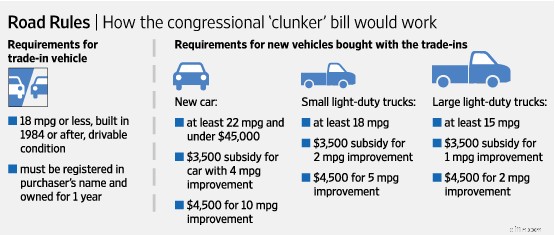
New vehicle eligibility. To qualify for the Cash for Clunkers voucher, you will need to either purchase or lease a new vehicle with a combined mpg rating of at least 22mpg for passenger cars, or at least a 1 or 2 mpg increase for large and small trucks respectively. New passenger vehicles must also have less than $45,000 MSRP. Used vehicles are not eligible for the Cash for Clunkers Program.
No physical voucher needed. You don’t need a physical Cash For Clunkers voucher to take advantage of this program. Dealers will apply a credit to your purchase. The dealer qualifies your vehicle based on government provided standards, then they apply for government reimbursement. Cash for Clunkers benefit is not taxable. The Cash for Clunkers Program does not result in a taxable benefit for participants, so you don’t need to worry about getting hit by the taxman next April. However, there may be some tax consequences of Cash for Clunkers Program for those with a business or under certain other circumstances. Here is additional Cash For Clunkers information.
When does the Cash for Clunkers Bill start and how long does it last?
Once the Cash for Clunkers program is signed into law, it will go into effect for new cars purchased between July 1, 2009, and November 1, 2009. It does not apply retroactively to cars purchased earlier in the year.
The government has set aside $1 billion for the Cash for Clunkers program and expects the program to last until the funds run out. Lawmakers expect the Cash for Clunkers bill to subsidize the purchase of 600,000 to one million vehicles, and depending on the success of the program and funds availability, the government may appropriate more funds at a later date.
Update: The Cash for Clunkers Program was suspended temporarily due to a lack of funds. Congress is expected to extend an additional $2 billion to the program to keep it alive.
Update 2: The Cash for Clunkers Program has ended.
How do you apply for a Cash for Clunkers voucher?
Assuming you have a vehicle eligible for the Cash for Clunkers Program, you can bring your vehicle directly to the dealership to process the voucher. The details haven’t been worked out completely at this time, but you will apply for the Cash for Clunkers voucher through a participating dealership, which will handle the details.
There will not actually be a physical “voucher” that the consumer needs to receive then turn over to the dealership. They will handle the details and apply the value of the voucher toward the purchase price of your new vehicle.
How will the government protect against fraud?
The National Highway Traffic Safety Administration is in charge of the program and will make an announcement regarding full qualifications within 30 days of the bill being passed. The NHTSA needs the time to work out the details to prevent fraud and ensure appropriate measures are taken to properly dispose of old vehicles.
Right now, the government is looking at methods to verify cars have been continuously registered and insured by the owner for the previous year and determining ways to ensure the cars that are traded in are sent to the junkyard and destroyed instead of being used or resold. Consumers should also be aware of Cash For Clunkers scams.
Other Cash for Clunkers Fast Facts:
- The Cash for Clunkers voucher can be used for a leased vehicle (under certain conditions).
- The Cash for Clunkers voucher can be combined with other government credits (such as the Hybrid vehicle tax credit).
- The Cash for Clunkers voucher can be combined with dealer incentives, rebates, and other cash back programs; in short negotiate like you normally would then apply the voucher like a coupon.
- The Cash for Clunkers voucher cannot be used for a motorcycle purchase.
- The Cash for Clunkers voucher cannot be used for a used vehicle.
- The suggested price of the new vehicle cannot exceed $45,000.
- Only one Cash for Clunkers voucher per purchase.
Official CARS information:
Here is the official CARS website and the official Frequently Asked Questions. The information in this article is derived from these pages, with a few thoughts of my own.
Beware of Cash For Clunkers Scams
Thieves and con artists are already taking advantage of the confusion surrounding the Cash for Clunkers Bill. It is important to understand how the Cash for Clunkers Bill works to avoid the scams that are already taking place. For official Cash for Clunkers information, visit the official site at http://www.cars.gov/, or the Frequently Asked Questions.
To avoid Cash for Clunkers scams you should also follow these tips:
- Do not give your personal information on websites. The Cash For Clunkers vouchers can only be processed by authorized dealerships. Do not submit information for a voucher online.
- Do not pay to process a voucher. Dealerships will process the vouchers for free.
- Look at previous economic stimulus scams for examples of what to avoid. There were how to avoid Stimulus Check and Government Grant Fraud.
- Use online safety tips. Here are some tips to avoid identity theft, and some more tips on preventing identity theft.
If it sounds too good to be true – it probably is. Common scams include:
- Websites alleging to “pre-authorize” applications.
- Websites offering to give you cash for your voucher (vouchers are non-transferable).
- Websites that state they are the “official” Cash for Clunkers or Car Allowance Rebate System (CARS) website. The official site is http://www.cars.gov/.
The best bet is to visit the official site before giving away any information.
My Thoughts:
The original intent of the Cash for Clunkers bill was to lessen our dependency on foreign oil by scrapping inefficient vehicles and replacing them with newer, more efficient vehicles. I think the intent of this bill is good, but I don’t know how much of an environmental impact it will have.
For one, it will only apply to a small group of people, many of whom are not in the market for a new vehicle. In addition, the new mileage requirements will not have much of an effect on our oil dependency.
How much of a difference will an improved efficiency of 1-2 mpg really make? Like a lot of well-intentioned legislation, I think the lawmakers changed the original intent of the legislation to pander to the special interest groups that put money in their pockets.
This bill won’t make much of a difference in our oil usage, but it may help the economy. And right now, that is a good thing.
What do you think?
Update: This article was originally published in 2009. It has been updated for historical purposes.
Related Post:
How We Manage Our Money on a Daily Basis

-

Calculating Total Cost of Ownership: Budgeting for Your Dream Car
Coming up with a car budget is an important part of the process of buying a car. When you want to purchase your dream car, you might save up for years. While this is a good idea, you will want t
-
Sell Your Car Privately: Maximize Your Car's Value | [Year]
When you buy a new car, do you trade your old car into the dealer – or do you try to sell it yourself? If you trade it to the dealer, you may be cheating yourself. Even though it’s much easier t
budget
- Understanding GI Bill Cashout Options & Benefits for Veterans
- Choosing Auto Insurance: A Guide for New Car Owners
- Cash Budget for Small Business: A Practical Guide
- How to Get the Most for Your Trade-In When You Sell Your Car
- Holiday Budgeting: A Step-by-Step Guide to Stress-Free Spending
- Navigating Post-Grad Finances: 4 Unexpected Budget Challenges
- Navigating Student Loan Repayment After Graduation: What You Need to Know
- Protect Your Investment: 10 Ways to Preserve Your Car's Value
- Smart Investments for Severance Money: Protecting Your Financial Future