
Inflation & Hyperinflation: Understanding the Worst-Case Scenarios
About a year ago I wrote a tongue in cheek article about how inflation is inconvenient. At the time, I was a little disappointed that the price of an ice cold beverage at my workplace increased 25%. Actually, it wasn’t the price increase that bothered me so much as having to carry around quarters. I know, it’s not that big a deal. It’s not like I had to run through the streets with a wheelbarrow full of money just to buy a loaf of bread! (yes, that has happened, keep reading!).
Inflation and hyperinflation
The inflation rates in the US and most first world countries have been relatively minor in the last few decades. It has been just high enough to keep the economy moving along. But what about really bad inflation? By really bad, I mean the worst possible situation you can imagine – run away inflation, or hyperinflation.
As much as we may hate inflation, it could be much worse. Here are three examples of hyperinflation that should make all of us feel a little more grateful about our current economy!
Hyperinflation in Zimbabwe
This weekend, the Zimbabwe Central Bank introduced two new bank notes in $20 billion and $50 billion denominations. The new $50 billion note is only enough money to buy two loaves of bread. As of Friday, Jan 9, 2009, the US dollar was trading at around $25 billion ZW dollars.
How bad is the inflation? In June The inflation rate is officially estimated at 231 million percent, or 231,000,000%. Only three weeks ago, a $10 billion note could purchase 20 loaves of bread, whereas it can now only purchase ½ loaf of bread. In other words, the money is worthless. (from CNN)
Hyperinflation in 1920’s Germany
The hyperinflation that Zimbabwe is experiencing is not the worst recorded case of hyperinflation. During post WWI, pre-WWII Germany, hyperinflation caused the inflation rate to swell from 300-800 billion percent, or 300,000,000,000% – 800,000,000,000% over a 6-month period. The value of German mortgages in 1913 was roughly $10 billion US dollars. At the height of hyperinflation in late 1923, these mortgages were only worthy one US penny (source).
Hyperinflation was so bad that workers demanded to be paid daily, or even multiple times per day, so that their wages would not be worthless at the end of the day. When they received their pay, workers ran from their jobs to the store in the hopes that their paychecks would still be enough to purchase a meal or some goods. Prices often changed hourly. There are stories of people using wheelbarrows to haul enough money to buy a loaf of bread. Money was sold or traded by weight and creative minds found other uses for the money, including making clothing with it, using it for wallpaper, and stuffing it in clothing and walls for insulation. This period of hyperinflation wiped out most of the middle and upper classes in Germany.
Hyperinflation in Hungary – worst case scenario
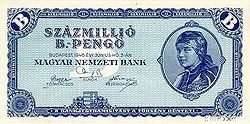 Amazingly, the hyperinflation experienced in Germany in the 1920’s was not the worst case of inflation on record; it is just one of the most widely known cases. The worst case of hyperinflation on record occurred in Hungary shortly after WWII when the Hungarian currency, the pengo, reached record levels of inflation. The largest denomination banknote of any currency ever printed was the 100 million b.-pengo note (pictured here), which was worth 10 ˆ 20 or 100 quintillion pengo.
The end result was a new currency to replace the worthless Pengo, the Forint was introduced in 1946 at the rate of 400 octillion pengo (400,000,000,000,000,000,000,000,000,000 or 400 x 10 ˆ 29) to 1 Forint.
Those numbers are so large I can’t even comprehend them!
Can Hyperinflation happen in the US?
I know what some people are thinking… can we experience hyperinflation in the US? Yes, it’s possible… But! Hyperinflation is usually caused by the collapse of a country’s government or as a result of war. And if that happens, well then I think we will have other problems to worry about!
If you enjoyed today’s little history lesson, here is some other fun reading:
- Hyperinflation.
- Hungarian pengo.
- Names of large numbers.
- German Economy in the 1920s.
- Zimbabwe: Great place, bad government.
Photo credit: wikipedia.
Related Post: How We Manage Our Money on a Daily Basis

-

Connecticut Family of Six: Budgeting on $144,000/Year | YNAB
Welcome to YNAB Money Snapshots—where you see a real picture of someone else’s budget and finances. They’re all anonymous, because sharing money is still a squirrelly topic for many, but we think air
-

Minnesota Couple Pays Off $200K Debt & Saves for Home | YNAB Money Snapshot
See how a couple in Minnesota making roughly $100K/year is handling a recent drop in income as they set their sights on buying their own house. Welcome to YNAB Money Snapshots—where you see a real pi
budget
- Top & Bottom States for Retirement: 2016 Analysis
- Consumer Reports Car Reliability: Best & Worst Vehicles of 2024
- How to Profit from Selling Your Condo: A Real-Life Story
- Understanding Inflation: Causes, Effects & How to Prepare
- Capital Preservation Strategies: TIPS & I-Bonds for Retirement Security
- Avoid Lifestyle Inflation: A Guide to Maintaining Financial Stability
- Real-Life Budget: Retired Couple Living in England on £45K/Year
- DC Budget Snapshot: How a $159K Income Funds Life in the Capital
- North Carolina Budget: How a Family Earns $219K Annually
-
 Deflation vs. Inflation: Understanding Price Declines and Economic Impact
The past year has brought many concerns with regard to the economy. When shopping for groceries or filling the gas tank increases, its not uncommon to wish prices were going down instead of up. ...
-
Understanding Inflation: Causes, Impacts & 10 Strategies to Protect Your Finances
In August 2020, Federal Reserve Chairman Jerome Powell announced plans to allow inflation to run slightly higher than the typical 2% goal that was long held, stating: inflation that is persi...