
Safe Fish Buying Guide: Avoiding Contamination & Ensuring Quality
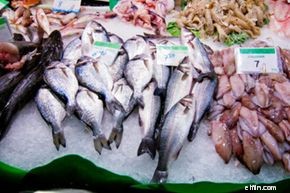 Being in the store over ice doesn't make it automatically safe to eat.
It's easy to get mixed signals about adding fish to your menu. Fish is one of the most nutritionally rich foods in the human diet, but there's more to this finny food than heart-healthy oil and an abundance of vitamins and minerals. Fish live in water, and all that water washing into rivers and eventually out to sea carries with it a scary load of pollutants. The tale ends at your dinner table with a salmon steak or tuna casserole that has the requisite nutritional bounty, as well as some substances you definitely don't want anywhere near your family, like mercury, polychlorinated biphenyls (PCBs) and Dichlorodiphenyltrichloroethane (DDT).
One big problem is that many fish varieties are susceptible to persistent organic pollutants (POPs) that accumulate in their fatty tissues. The longer the fish live, and the more other infected organisms they eat, the more pollutants they accumulate. Pollutants aren't limited to wild fish, either. Farmed raised salmon, for instance, can have higher concentrations of chemicals like PCBs than their free swimming counterparts. (This is probably a nasty surprise, but read on.) Pollution isn't the only potential problem, either. Fish and shellfish spoil quickly and can also harbor dangerous microorganisms that make people sick.
Watch Lists for Safe Fish
Don't let the bad news turn you against fish completely, though. In the 21st century, environmental issues are causing us to rethink the way we do a lot of things -- including the way we evaluate our food supply. Before you head over to the seafood department of your market, do some recon to discover which fish are the safest to eat in a particular season or from a specific region. There are a couple of really helpful Web sites for this. One is the Seafood Watch page hosted by the Monterey Bay Aquarium. If you have a favorite fish, it'll be listed. You'll discover the best geographical source for that fish, and if it isn't recommended at all, the best alternative. (This can be particularly helpful if you're looking for a recipe substitution.)
Another resource for up-to-the-minute seafood related news is the National Listing of Fish Advisories posted by the U.S. Environmental Protection Agency (EPA). It has all the information you'll ever need about fish harvested in U.S. waters. If you're buying locally caught catfish, or your favorite fisherman just walked through the door with dinner in hand, you can peruse the EPA's site for timely safety warnings.
For some general guidelines, these tips will help you determine some safe choices, acceptable alternatives and definite no-nos. The recommendations listed here take into account health considerations as well as environmentally friendly harvesting practices:
- Catfish - Choose farm-raised over freshwater catfish.
- Clams - Both domestic and wild clams are safe to eat.
- Crab - Stick with stone or Dungeness crab, and avoid imported king crab.
- Halibut - Choose U.S. Pacific halibut over Atlantic halibut.
- Lobster - Spiny, American and Maine lobster are safe.
- Mahi Mahi - Choose U.S. over imported varieties.
- Oysters - Avoid Gulf Coast oysters.
- Salmon - When scoping out the best salmon steak or fillet, opt for wild Alaskan salmon over farmed varieties, many of which have tested high for POPs.
- Scallops - Bay, sea and farmed scallops are safe to consume.
- Shrimp - Prefer domestic or Canadian shrimp over imported varieties.
- Swordfish - Choose U.S. over imported swordfish, and limit consumption because of their potential mercury content. (If you are pregnant, use caution in the quantity and variety of fish you consume.)
- Tilapia - Look for U.S. farmed tilapia, and choose it over Asian or South American farmed varieties.
- Tuna - With the exception of bluefin, tuna is considered safe in small quantities, but look for U.S. troll/pole-caught fish. Some good varieties are yellowfin, albacore, skipjack, tongol and bigeye.
We also have some eyes-on suggestions for choosing the best bass or other specimen your fishmonger has to offer:
- If you're considering a whole fish, check the eyes. Fresh, healthy fish have clear, bright eyes.
- Fish should never smell fishy. A good candidate should either have no aroma, or smell faintly of the seashore (or the lake).
- Look for fish with bright, red gills. As a fish ages in the retailer's case, its vivid red color starts to darken.
- Fish should not look dry around the edges.
- Avoid fish with dull, discolored patches or splitting flesh.
- Fish flesh should be resilient to the touch.
- Fish steaks or fillets may seep liquid, but it should be clear, not milky or gooey.
Use your best judgment. You don't have to be a fish expert to have suspicions about a "great" fish deal that may be questionable, or a specimen that looks less than perfect. When in doubt, pass.
-

Overcoming Shopping Addiction: Breaking Free from Compulsive Spending
Yesterday, I mentioned that because I grew up poor, I inherited a faulty money blueprint from my parents. They didnt know how to handle money effectively, so they couldnt teach me how to handle
-
Wedding Gift Etiquette: How Many Gifts Are Expected?
Earlier this week, I wrote about the problem with trying to buy the perfect gift. Sticking with that gift theme, theres a question thats been on my mind: If youre invited to an engagement party,
budget
- Cashing Checks at Banks You're Not a Member Of: What You Need to Know
- Buying a Home at 18: A Comprehensive Guide for Young Buyers
- Virtual Waiters: The Future of Dining Experiences?
- Reliable Used Car Parts: 9 Safe & Cost-Effective Options
- Top 5 Cryptocurrencies to Watch in June 2021 - Potential Growth
- Budget-Friendly Holiday Party Ideas: Celebrate Without Breaking the Bank
- Budget Cocktail Party: Tips & Tricks for an Affordable Celebration
- Dented Cans: Is Your Food Safe to Eat? - Food Safety Guide
- 10 Money-Saving Gadgets to Boost Your Budget
-
Maximize Savings: A Comprehensive Guide to Using Coupons
Before you make a purchase, think of how you can save money with coupons. There are so many ways to obtain coupons, online, newspapers, magazines and sometimes they are mailed directly to your h...
-
 Budgeting Schedule: Build a Routine for Financial Success
New budgeters tend to get caught up in the creation of their budget rather than the actual budgeting itself. Before I started using Mint’s monthly budgeting calculator, I’ve certain...