
B2B Ecommerce Punchouts: Streamline Sales & Reduce Errors
Expert salespeople once handled all of B2B sales.
They had personal relationships with the procurement professionals who worked for buyer organizations, and B2B sales depended entirely on in-person collaboration between buyers and sellers.
That sounds enticing, but we shouldn’t get too nostalgic.
The procurement process was inefficient, time-consuming, and prone to error.
With multiple revisions of documents flying around it was common for:
- Figures to be transferred incorrectly.
- Communications failures to result in misspending or delayed delivery.
- Buyer and seller expectations to become misaligned.
In the worst cases of procurement error, businesses have failed or become mired in expensive litigation.
Over the last decade, ecommerce has become the powerhouse of consumer retail.
Despite this, B2B sales organizations were slower to adopt, relying on established in-person relationships instead. But in recent years, B2B ecommerce has been on the rise, primarily driven by buyer demand.
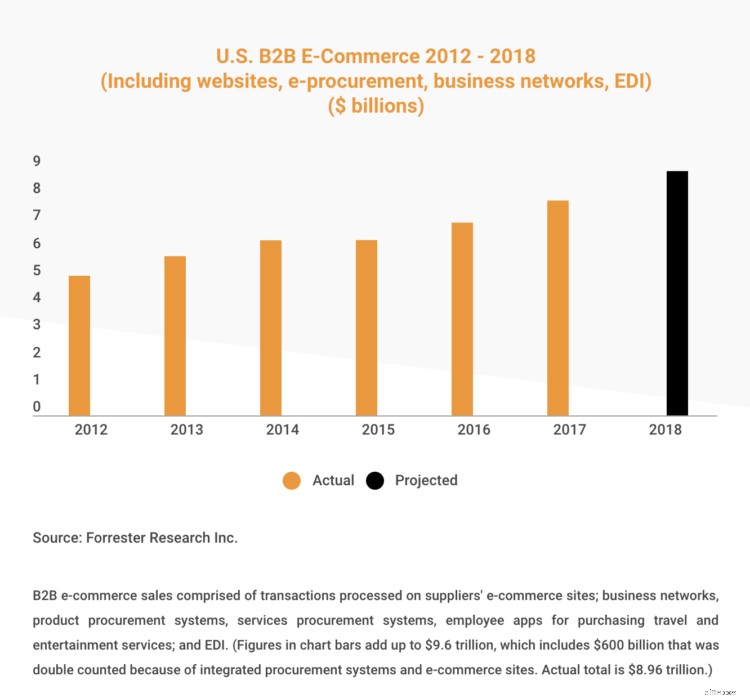
The U.S. business-to-business online commerce market is worth $9 trillion, with almost $5 trillion generated by EDI networks that connect buyer ERP platforms to supplier order management.
Other spending occurs via purchase order and invoice networks and employee travel and expense applications.
But the fastest growing B2B sales channel is SaaS eProcurement, which leverages ecommerce stores integrated with buyer eProcurement platforms via punchout catalogs.
The proportion of B2B sales conducted via SaaS eProcurement platforms is rising by 37% per year because it offers unique benefits to both buyers and sellers.
SaaS eProcurement platforms automate many of the procurement processes that would once have involved manual processing.
Automation encompasses the entire procurement process, from the selection of goods through order approval, the creation of purchase orders, and invoicing.
Software-as-a-Service eProcurement platforms provide managed eProcurement solution hosted by a third-party, allowing businesses to adopt eProcurement without a substantial capital investment in IT infrastructure and staff.
Businesses adopt eProcurement platforms like SAP Ariba and Jaggaer because they offer accountability, control, and insight into procurement processes.
With eProcurement, businesses can rationalize and streamline procurement, discovering cost efficiencies that reduce procurement spend.
Punchout catalogs integrate supplier ecommerce stores with buyer eProcurement platforms.
They allow buyers to shop on supplier ecommerce stores from within their eProcurement platforms, with purchase order and invoice data automatically exchanged between buyer and seller.
In this article, we will explore what punchout catalogs are, why B2B buyers love them, and how B2B sellers can make punchout catalogs work for their business.
Launch Your B2B Ecommerce Site
Experience customizable, future-proof technology built to work with your existing tools. Ready to launch your B2B ecommerce site? Get a preview of your site, complexities included.
Request A Demo Today
Marrying B2B Ecommerce and Procurement
Procurement is a strategic function for modern businesses — disruptions to the supply chain impact revenue and profit, and even the viability of the business.
The procurement process itself is often expensive and inefficient.
Businesses adopt eProcurement to take control of spending but face challenges when integrating suppliers with their chosen platform.
Punchout catalogs alleviate these challenges, empowering B2B sellers to integrate their products with their buyer’s back-end platforms.
Punchout catalogs allow buyers to access supplier catalogs from within their eProcurement platform, automatically synchronizing requisition and purchase order data between eProcurement and B2B ecommerce applications.
They also allow sellers to provide custom catalogs for each buyer, with special pricing and product selections.
-

BigCommerce Recognized as a Leader in B2B & B2C Ecommerce by Forrester
At BigCommerce, we strive to provide the best tools and resources to help merchants across the world make the most out of their ecommerce business. Whether you’re just starting out or are a Fort
-

B2B SEO Strategy: Outrank Competitors & Drive Revenue
Your Quick Takeaway With some smart research, some common sense and a little patience, there are huge gains to be made in Google rankings and monthly revenue. Joel Gross, CEO of Coalition Techno
Business
- Online Bank Safety: Risks, Rewards & How to Protect Your Money
- Ecommerce Holiday Calendar 2021-2022: Boost Sales & Traffic
- Avoid Ecommerce Pitfalls: 11 Mistakes New Brands Must Prevent
- Amazon & Ecommerce Growth: A 20-Year Success Story [Infographic]
- Unlock Growth: The Advantages of B2B Ecommerce in the Digital Age
- Navigating B2B Ecommerce Channel Conflict: Strategies for Success
- B2B Ecommerce Success: Key Lessons from 30 Years of Experience
- Choosing the Best B2B Ecommerce Platform: Expert Insights
- Key B2B Ecommerce Metrics to Track for Growth
-
Understanding the Oil & Gas Industry: A Comprehensive Overview
The oil and gas industry is one of the largest sectors in the world in terms of dollar value, generating an estimated $3.3 trillion in revenue annually. Oil is crucial to the global economic framewo...
-
 Launch Your Online Store: A Comprehensive Guide for Beginners
There are currently 7.1 million online retailers in the world with 1.8 million in the United States alone. And more are opening all the time. In the midst of all this opportunity, how do you kno...