
Understanding Business Partnerships: Types, Liability & Formation
A partnership is a type of business where two or more people establish and run a business together. There are three main types of partnerships: general partnerships (GP)General PartnershipA General Partnership (GP) is an agreement between partners to establish and run a business together. It is one of the most common legal entities to form a business. All partners in a general partnership are responsible for the business and are subject to unlimited liability for business debts., limited partnerships (LP), and limited liability partnerships (LLP).
One of the biggest benefits of this business arrangement is that it is a flow-through entity. Therefore, any incomeTaxable IncomeTaxable income refers to any individual's or business’ compensation that is used to determine tax liability. The total income amount or gross income is used as the basis to calculate how much the individual or organization owes the government for the specific tax period. generated in a partnership is treated as the personal income of the partners. This means it is only taxed once. In contrast, owners of a corporation face double-taxation. This is because the corporation’s income is taxed once, and then the owner’s personal income is taxed again.
Partnerships are one of many business types. Other business types include sole proprietorshipsSole ProprietorshipA sole proprietorship (also known as individual entrepreneurship, sole trader, or proprietorship) is a type of an unincorporated entity that is owned only, limited liability companies (LLC)Limited Liability Company (LLC)A limited liability company (LLC) is a business structure for private companies in the United States, one that combines aspects of partnerships and corp, and corporations.
Learn more about running a business with CFI’s Corporate & Business Strategy Course!

Types of Partners
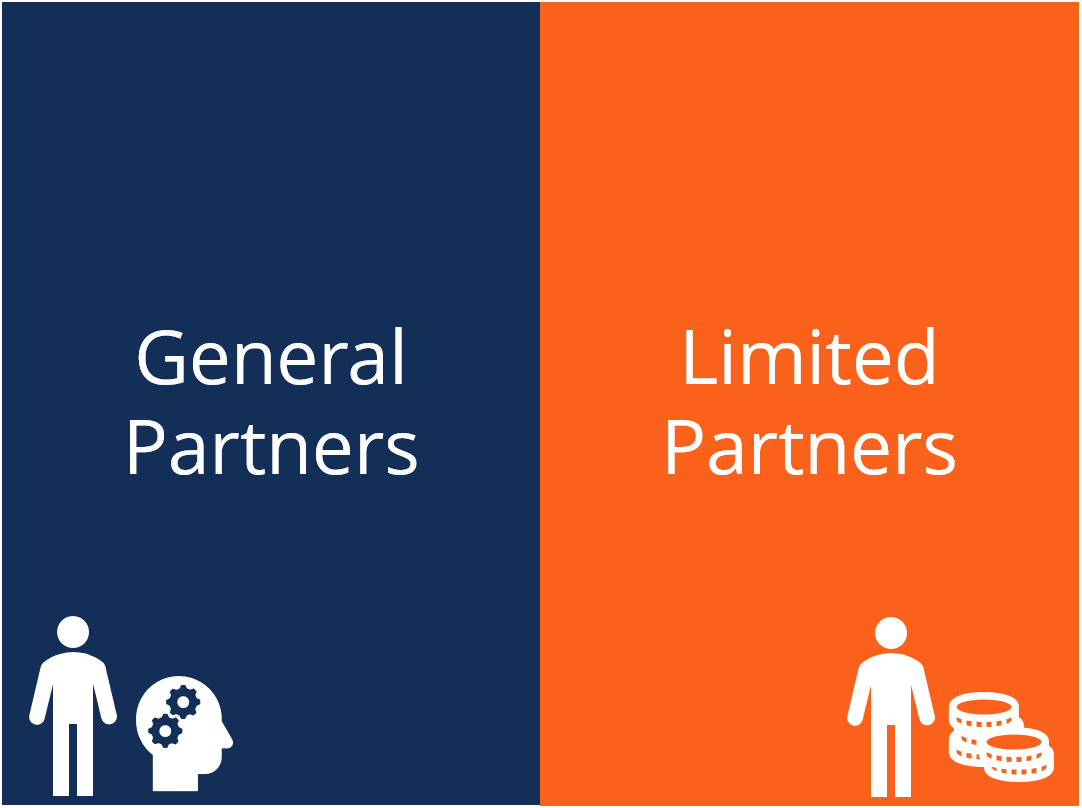
There are two different types of partners that exist in these business arrangements: general partners and limited partners.
General Partner: a partner that holds management responsibility. They are responsible for the operations of the business. Furthermore, general partners face unlimited liabilityLiabilityA liability is a financial obligation of a company that results in the company’s future sacrifices of economic benefits to other entities or businesses. A liability can be an alternative to equity as a source of a company’s financing. – they are fully liable for the debts of the business. This means that their personal assets can be seized to settle debt obligations or lawsuits.
Limited Partner: a partner with a financial stake in the business but no management responsibilities. Therefore, limited partners cannot be held personally liable for the debts of the business, as they do not actively manage it. The most a limited partner can lose is their investment in the business. Essentially, limited partners are most like shareholdersShareholderA shareholder can be a person, company, or organization that holds stock(s) in a given company. A shareholder must own a minimum of one share in a company’s stock or mutual fund to make them a partial owner. of a corporation.
Types of Partnerships
As mentioned, there are three main types of partnerships. Each type has its own advantages and disadvantages.
General Partnership (GP)
General partnerships (GP) are the most simple form of partnership. They are the easiest to form and the cheapest to maintain. They are simpler than corporations and even other types of partnerships. A general partnership is formed immediately when partners begin business activities. There is no official paperwork required. Only general partners exist in a GP.
The low upkeep cost is mainly due to the fact that there is no official state filing needed to create such a partnership. This means there are no filing-related costs. Similarly, there are few ongoing requirements. For example, it is not necessary to hold an annual general meeting.
Additionally, GPs are easy to dissolve. They can be broken up at any time.
While this arrangement is simple, there are some major disadvantages. All partners in a GP are general partners. This means that they face potentially unlimited liability in this arrangement, as GPs are not separate legal entities.
Additionally, all partners are fully liable for the actions of any of the other partners. Finally, the business is dissolved if any of the partners declare bankruptcyBankruptcyBankruptcy is the legal status of a human or a non-human entity (a firm or a government agency) that is unable to repay its outstanding debts or pass away.
Fortunately, there are ways to prevent dissolution in the case of bankruptcy or death. A partnership agreement usually accompanies this type of business arrangement. Partners can include clauses that state that the business will continue after the death of a partner and that provide a process whereby the interests of the deceased will be distributed to the remaining partners.
Thinking of starting a company? Corporate Finance Institute’s corporate & business strategy course teaches tactics and strategies in running a successful business!
Limited Partnership
Limited partnerships (LP) are a form of partnership that provides more protection for partners. In an LP, there is at least one general partner that manages operations and takes on unlimited liability. The remaining partners are limited partners, who hold financial stakes in the business but are not personally liable for the business.
Limited partners share the profits of the company but can only lose as much as they have invested in the business.
Finally, unlike GPs where there is very little paperwork involved, an LP requires state filings.
Limited Liability Partnership
Limited liability partnerships (LLP) are an extension of a GP. An LLP is essentially a GP where all partners are protected from the actions of other partners. Essentially, all partners have limited liability. This is different from an LP where there must be at least one partner with unlimited liability.
LLPs maintain their flow-through taxation status, which makes them very similar to limited liability companies (LLC).
While LLPs may seem enticing compared to GPs and LPs, some states restrict them to certain professions. These professions include lawyers, doctors, and accountantsAccountantAn accountant plays a very crucial role in an organization, regardless of whether it is a multinational company or a small, domestic one.. Therefore, a business owner may not always be able to create an LLP.

Partnership Agreement
The partnership agreement is a fundamental part of this business type. This agreement outlines how the business will operate in terms of such things as conflict resolution or allocation of profits. It is one of the most important documents for the business and can mitigate many of the potential negatives that have been discussed.
For example, as previously mentioned, the agreement should detail how a partner’s interest in the company is transferred upon death. This would allow a GP to continue existing even after one of the partners is gone. Additionally, the agreement should document the financial contribution of partners and outline the percentage of ownership between them.
Additional Resources
Proper financial management is the backbone of any business. Corporate Finance Institute has resources that will help you expand your knowledge, advance your career, and manage the financials of your company! Check out the informative CFI resources below:
- Financial Modeling & Valuation Analyst (FMVA)® Certification ProgramBecome a Certified Financial Modeling & Valuation Analyst (FMVA)®CFI's Financial Modeling and Valuation Analyst (FMVA)® certification will help you gain the confidence you need in your finance career. Enroll today!
- Corporate & Business Strategy
- Three Financial Statements SummaryThree Financial StatementsThe three financial statements are the income statement, the balance sheet, and the statement of cash flows. These three core statements are
- Budgeting and Forecasting
-

Understanding Interest-Bearing Debt: Definition & Examples
What Is Interest-Bearing Debt? A business has both income and debts, usually reflected on its balance sheet. Debts, also known as liabilities, can either be interest-bearing, which means they
-

Ecommerce Platforms: A Comprehensive Guide for Business Growth
Ecommerce has emerged as the single biggest growth driver in the worldwide marketplace. eMarketer, a leading independent market researcher, predicts global B2C ecommerce sales will reach $1.5 trillion
Business strategy
- Understanding Limited Partnership Interests: Roles & Liabilities
- Business Banking: Services, Accounts & Loans Explained
- Understanding Insolvency: Definition, Causes & Consequences
- Bootstrapping: How to Build a Business with Minimal Funding
- Business Plan: Definition, Importance & Funding Options
- Understanding Business Structures: A Comprehensive Guide
- Understanding Business Entities: Types & Legal Structures
- Family Limited Partnerships (FLPs): A Comprehensive Guide
- Crowdfunding: A Comprehensive Guide to Funding Your Ideas
-
 Understanding Succession Events: Definition & Implications
A succession event, in economic terms, is the occurrence of an event wherein one of the two parties involved take on the legal powers, assetsTypes of AssetsCommon types of assets include current, non-...
-
 Unlimited Liability: Understanding Risks & Protection
Unlimited liability is the legal obligation of company founders and business owners to repay, in full, the debt and other financial obligations of their companies. The legal obligation generally exist...