
Choosing a Crypto Exchange: Trust & Reliability Matter Most
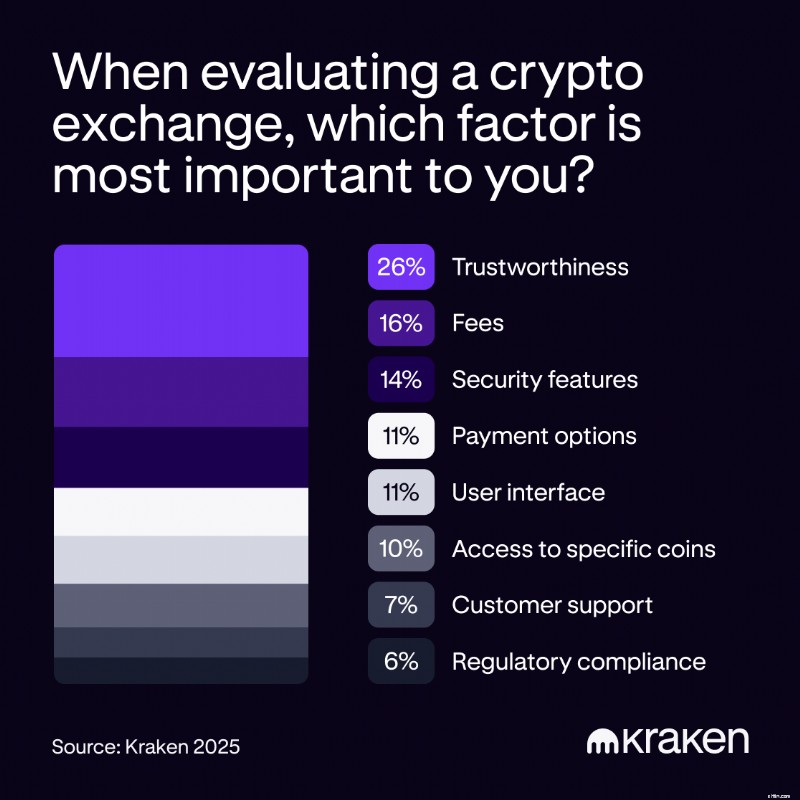
This sentiment also translates into actual selection criteria. When choosing an exchange, trustworthiness emerges as the top priority for 26% of users, outpacing fees at 16%.
While Kraken and Kraken Pro have long offered competitive fees across different trading volumes, this has never resulted in compromises elsewhere. From the assurance our crypto native support specialists deliver to the transparency our proof of reserve audits pioneered, Kraken earns the trust of our clients with action.
Distinct from general trustworthiness, security features captured another 14% of responses, further suggesting that investors value exchanges that invest in their clients’ privacy and security. Although it is always wise to self-custody your crypto, the reality is that many investors decide to keep their funds on the platform.
Because of that, investors are looking for a platform that prioritizes security above everything and doesn’t compete on fees alone.
This aligns with data from our 2025 Crypto Safety Survey, which found that security concerns significantly influence U.S. crypto users' choices when selecting an exchange.
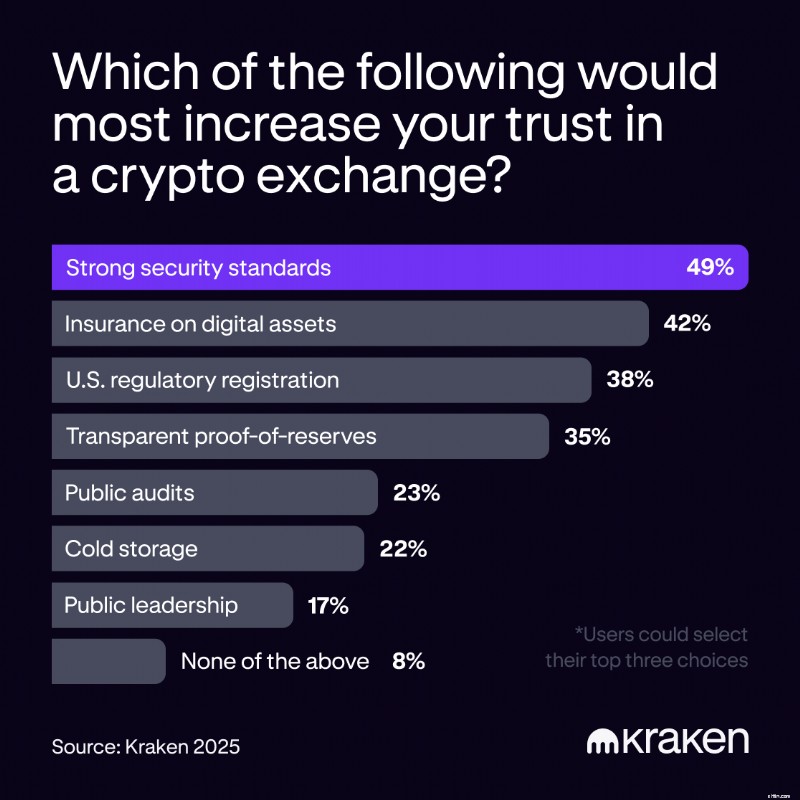
When asked what would most increase their trust in a crypto exchange, users prioritized tangible security measures. Nearly half (49%) selected strong security standards and communication history, while 42% chose insurance on digital assets. U.S. regulatory registration or oversight appealed to 38% of respondents and transparent proof of reserves attracted 35%.
This could suggest that, rather than taking an exchange's word for it, people want actual evidence (i.e., regulatory compliance, history of breaches or asset insurance) that shows an exchange can protect their funds.
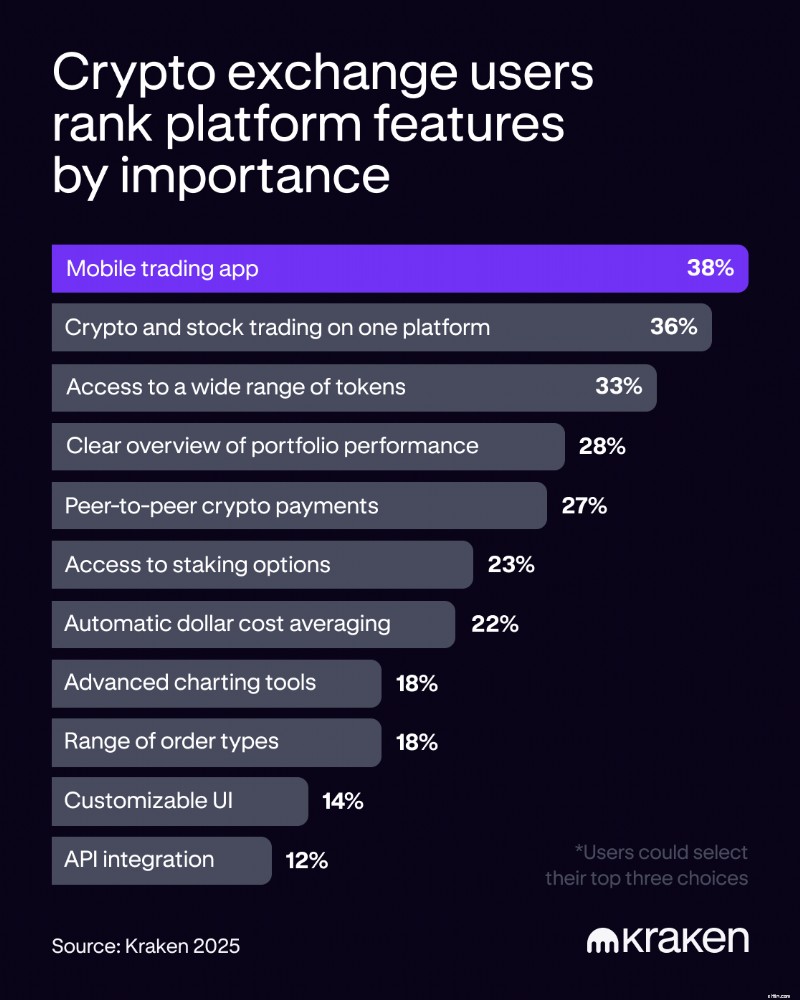
This preference pattern becomes more meaningful when viewed alongside user behavior. A significant 68% of crypto holders report they've avoided using products or features because they felt too complex or confusing.
This finding suggests a notable disconnect between the advanced tools many exchanges offer and the tools users actually engage with.
Payment method preferences show the importance of meeting users where they are. Our data reveals diverse funding preferences across different payment types:
- Debit cards are the most popular payment method, used by 25% of users.
- PayPal or other digital wallets are the second most common choice, with 22% of users.
- Bank transfer (ACH/wire) is used by 20% of users.
- Crypto deposit is preferred by 13% of users.
- Credit cards are used by 10% of users.
- Apple Pay or Google Pay is the least used method, with 9% of users.
Some users gravitate toward the immediacy of card payments, while others may prioritize bank transfers or the convenience of digital wallets they already use in other contexts. The variety in preferences indicates that payment flexibility might be as valued by users as other exchange features.
-

TD Ameritrade Invests in Cryptocurrency Exchange ErisX to Expand Digital Asset Trading
As digital assets move from the niche to the mainstream, investors continue to seek ways to access the cryptocurrency market. ErisX, a derivatives exchange and clearing organization, has announced tha
-

Asset-Based Loans: A Comprehensive Guide for Businesses
Asset-based loans involve something physical (an asset) that is used as collateral for a loan. For most companies, it is inventory or accounts receivableAccounts ReceivableAccounts Receivable (AR) rep
Digital currency exchange
- Secure Your Bitcoin: 4 Essential Security Tips for Crypto Investors
- Nexo Exchange Review: Is It a Secure Platform for Crypto?
- Day Trading Cryptocurrency: Risks, Rewards & Strategies (2024 Update)
- Kraken vs. Coinbase: A Comprehensive Comparison for 2024
- Ethereum's Explosive Growth: Understanding the 4 Key Drivers
- Bitcoin Scarcity: What Happens When Supply Limits Are Reached?
- Crypto Trading for Beginners in India: Strategies with Limited Capital (2024)
- AI Agents & Crypto Transactions: The Future of Trading in 2026
- Polymarket & Prediction Markets: Infrastructure Challenges for Growth
-
 Understanding Stock Options: A Beginner's Guide to Puts & Calls
What Is a Stock Option? A stock option gives an investor the right, but not the obligation, to buy or sell a stock at an agreed-upon price and date. There are two types of options: puts, w...
-
 10 Powerful Questions Answered: Expert Insights & Practical Solutions
The other day I received an email from a reader with 10 powerful questions she wanted me to answer. No introduction. No small talk.Just a list of questions and “Thanks for your time” at the bottom.Nat...