
Arbitrage Explained: A Beginner's Guide to Profitable Trading
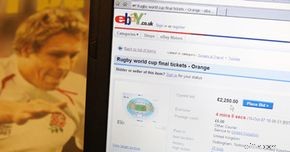 Buying and then immediately reselling sports tickets on eBay and other auction sites can mean a quick profit for agile arbitrageurs.
Did you ever buy something and then turn around and sell it right away to a predetermined buyer for a higher price? If so, you were engaging in a simple form of arbitrage -- a no-risk financial transaction that creates a profit. You were an arbitrageur -- a person who engages in arbitrage -- or a trader, for short.
People who buy and sell things on eBay or other Internet auction sites sometimes utilize an arbitrage strategy. In this case, a person buys a case of handheld video games from a local seller at a price she knows is much lower than the going price of handheld video games on the auction site. Then she turns around and resells the handheld video games on the auction site and makes a profit.
Like a chameleon, this type of commerce takes on different appearances, from the street vendor to the corporate mogul. In a 1980s movie based on arbitrage, the main character's name may remind you of a lizard-like creature. Find out which flick this is and learn about the different types of arbitrage on the next page.
Different Types of Arbitrage
 Traders react to a sell-off on the Tokyo Stock Exchange. Shares plunged partly because of arbitrage selling.
In the world financial community, arbitrage refers to two basic types of activities. One requires little or no risk on the part of the investor, and the other can be highly speculative.
In its purest form, arbitrage contains no element of risk. True arbitrage is a trading strategy that requires no investment of capital, can't lose money, and the odds favor it making money. Any transaction or portfolio that's risk-free and makes a profit is also considered arbitrage [source: Riskglossary].
But pure arbitrage actually quite rare. Why? Financial markets are set up in a way that discourages arbitrage from happening in the first place. Markets are designed so that securities are priced equally within all trading markets. They're said to be arbitrage-free.
Occasionally, minor price differences occur on financial markets. These price differences, called mispricings, mean that there's a temporary discrepancy between a stock's intrinsic value and its market value. A quick-moving trader can take advantage of such opportunities and make a profit. For example, a share of Microsoft may sell for $28.00 in the U.S. market and sell for $27.98 on one of the European exchanges. Such a difference may exist for a short time because exchange rates haven't been applied yet. If a trader makes a trade before the price is adjusted, he or she can make a profit of two cents per share. If enough shares are involved, this profit can be considerable.
If you watch the financial television channels such as CNBC and Fox Business News, or read financial blogs, newspapers or magazines, you'll hear a lot about arbitrage. Most of the time, however, the discussion won't revolve around true arbitrage. It'll revolve around speculative arbitrage -- which involves speculative trading strategies -- and transactions by hedge funds, the often mysterious and much-maligned investment partnerships between well-to-do investors.
To learn more about arbitrage, trading and related topics, follow the links on the next page.
Sources:
- "Arbitrage" Merriam-Webster. http://www.merriam-webster.com/dictionary/arbitrage
- "Arbitrage" Riskglossary.com http://www.riskglossary.com/link/arbitrage.htm
- "Arbitrage." Investopedia. http://www.investopedia.com/terms/a/arbitrage.asp
- Cramer, James J. "Bad Boys, Bad Boys." New York Magazine. October 13, 2003. http://nymag.com/nymetro/news/bizfinance/columns/bottomline/n_9352/
- Emmons, William R., and Schmid, Frank A. "Asset Mispricing, Arbitrage, and Volatility." Federal Reserve Bank of St. Louis. November/December 2002. http://research.stlouisfed.org/publications/review/02/11/EmmonsSchmid.pdf
- Engineering Statistics Handbook. "Introduction to Time Series Analysis." http://www.itl.nist.gov/div898/handbook/pmc/section4/pmc4.htm
- "Fixed Income Arbitrage." Investopedia. http://www.investopedia.com/terms/f/fixedincomearbitrage.asp
- "Hedge Fund" Investopedia. http://www.investopedia.com/terms/h/hedgefund.asp
- "What is Arbitrage?" Investopedia. http://www.investopedia.com/ask/answers/04/041504.asp
-

Mobile Security: Protecting Your Smartphone from Threats
Youd protect your computer from hackers and other online predators, and it may be time to consider the security of your smart phone. Unfortunately, consumers arent the only ones making the shi
-

Mobile Banking: How It Works & Benefits - A Comprehensive Guide
Cesar Rangel/AFP/Getty Images If extreme climber Alain Robert had a mobile banking account, he could also access his finances while climbing.You’ve probably seen the commercial: A woman, ha
finance
- Online Banking: A Comprehensive Guide to Features & Security
- Unrealized Profit Calculation: A Simple Guide
- Market Arbitrage: Understanding Risk-Free Profit Opportunities
- Non-Owner Car Insurance: Protection When You Don't Own a Vehicle
- Understanding Bitcoin: What It Is and How It Functions
- Understanding Life Insurance: A Comprehensive Guide
- Understanding Social Security: A Comprehensive Guide
- Understanding Financial Planning Software: A Comprehensive Guide
- Understanding Google Finance: A Comprehensive Overview
-
 A Comprehensive Guide to the Hiring Process for Businesses
Corporate Life Image Gallery©iStockPhoto/Kristian SekulicHopefully, the hiring process is one of mutual benefit for employers and employees. See more pictures of corporate life.If you are a new bu...
-
 Square: How It Works & Why It's Revolutionizing Payments
The Square device can turn your smart phone into a credit card machine. See banking pictures. Cash is so 20th century. Consumers are addicted to the convenience of plastic. Have you ever used ...