
Kyber Network: Decentralized Crypto Exchange & Liquidity Protocol
 Loi Luu
CEO and CoFounder
 Yaron Velner
CTO and CoFounder
 Victor Tran
Lead Engineer and CoFounder
Created by Loi Luu, Yaron Velner, and Victor Tran, Kyber Network has an impressive advisory board, which includes none other than Ethereum’s Vitalik Buterin.
Luu previously created Oyente, the first open-source security analyzer for Ethereum’s contracts, and also cofounded SmartPool, a decentralized mining pool project. Tran also happens to be a lead developer at SmartPool.
In short, the network is used as a medium to transfer tokens from person-person, serving as a P2P system as well as a host for ICOs. Kyber doesn’t require a sender’s tokens to match the recipient’s desired tokens---Kyber Network takes care of this conversion during the transfer.
Let’s run through an example:
Bob owes Sally 0.01 ETH for a hotel room they shared on vacation. The problem is that Bob only has REP, despite Sally requesting ETH. How do they solve such a dilemma?
Through Kyber’s protocol, Bob’s REP can be converted directly to the ETH Sally is requesting.
When Bob learns about Kyber Network, he learns from the network interface that the conversion rate for
the REP--ETH transfer is 1 ETH = 16 REP.
Next, Bob puts in a request to Kyber to convert 0.01 ETH worth of his REP to send to Sally. The Kyber contract, which controls the token reserve warehouse, first checks that Bob included enough REP in the contract, to see the conversion through. Basically, there’s no option for overdraft or under-spending here.
Once the contract approves that Bob has enough REP on his end to begin the conversion, the contract then sends the 0.01 ETH to Sally’s address. With the Kyber Network standard contract wallet, Sally sees the transaction as if the funds came directly from Bob’s address (rather than Kyber’s). Brownie points to Bob!
At the end of the transaction, Bob pays a small additional fee which gets added to the reserve pool in which the ETH originated.
Network Governance
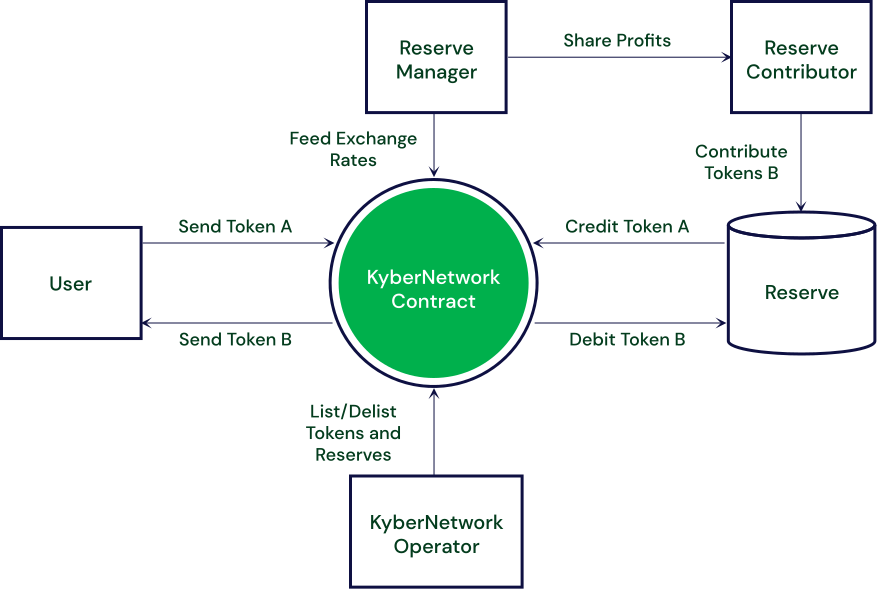
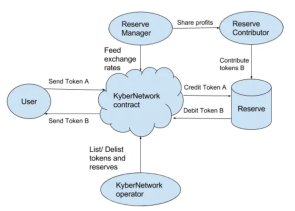
So, how does Kyber Network stay so flush? It maintains its liquidity through the “Dynamic Reserve Pool”, which contains all of the Reserve Entities in the system.
“Reserve Entities” bring liquidity to the platform, internally or hosted by a registered third party. Depending on whether the public contributes to their reserves, determines whether they are classified as “public” or “private”.
They answer to the Kyber Network Operator, which has the power to add and/or remove Reserve Entities, in addition to controlling which tokens are listed.
By having multiple entities in the pool, the network prevents monopolization and keeps exchange rates competitive. When a user requests an exchange, the smart contract makes the exchange through the Reserve Entity with the best exchange rate for the user.
The Reserve Manager maintains the entire reserve, calculates exchange rates, and enters the rate into the network. In exchange for their service, Reserve Managers earn profit through the spreads they set for their reserves.
Additionally, they also benefit from increased volume by having access to the overall Kyber Network and a Kyber-provided dashboard to help them manage their reserve.
Kyber Crystals--They Power More Than Lightsabers
If you are a Star Wars fan, you probably associated the name with the Kyber crystals used to power lightsabers in the George Lucas universe. And you’re not wrong. Kyber’s native token, Kyber Network Crystal (KNC) was in fact named after these very crystals.
Reserve Managers are required to purchase the ERC20 token to operate a reserve on the network. Each time an exchange occurs, the network charges a small KNC fee to the reserve, which goes towards operational costs and rewarding those who bring trade volume to the network. Once the KNC is used, the remaining KNC tokens are burned, or removed from circulation, which helps make KNC deflationary.
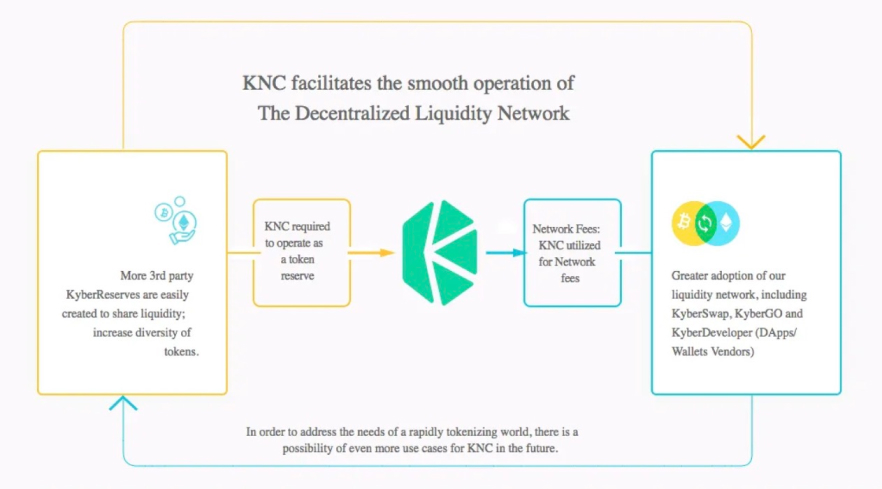
Source: Kyber Network
Of course, the system has internal mechanisms designed to prevent bad actors in the reserve pool. Kyber makes all exchanges through a transparent fund management model, which will flag any exchange rate for special approval.
-

Understanding ACH Transfers: A Comprehensive Guide
The Automated Clearing House network, also known as ACH, is a channel run by the National Automated Clearing House Association (NACHA)National Automated Clearing House Association (NACHA)The National
-

Jumbo CDs: Higher Rates & Deposits Explained
A jumbo CD is similar to a conventional CD although the former generally requires a higher deposit and accrues interest at a higher rate. A CD is a certificate of deposit that is offered by banks for
Fund information
- Decentralized Apps (DApps): A Comprehensive Guide
- Value Network Analysis: Understanding Business Value & Relationships
- Point of Service (POS) Health Insurance Plans: A Comprehensive Guide
- The Open Application Network (OAN): Empowering Users with Open Source Apps
- Blockchain Explained: The Technology Powering Cryptocurrency
- Decentralized Apps (DApps): A Comprehensive Guide
- Ethereum 2.0: A Comprehensive Overview of the Upgrade
- Kyber Network: Decentralized Token Swapping Explained | [Year]
- Mimblewimble Explained: A Deep Dive into Blockchain Privacy
-
 Understanding the DU: Your Mortgage Approval Explained
DU in relation to a mortgage stands for Desktop Underwriter, which is a mortgage program used to analyze a borrower's application to see if it meets criteria set up by the governing agency of that...
-
 Decentralized Finance (DeFi): A Comprehensive Overview
DeFi is short for Decentralized Finance. DeFi describes decentralized lending, borrowing, and interest-bearing systems like Maker and Compound, most of which are Ethereum-based. ...