
Monero (XMR): A Privacy-Focused Cryptocurrency Explained
History
Monero (XMR) was launched in 2014 to intentionally conceal transaction details like the identity of senders and recipients and the amount of every transaction, by disguising the addresses used by Monero participants.
Monero’s egalitarian approach of providing the community with equal opportunities, entices the community to continue supporting and developing the virtual currency.
Unlike Bitcoin, Monero does not have a fixed or capped supply, making it “ever-so-slightly-inflationary”. Initially, there were 18.5 million coins supplied, with an increase of approximately 0.87% in its first year.
Each year, that percentage lowers, estimating that it will take close to 117 years to reach 37 million coins, double the initial distribution. For it to double again, it will take 234 years.
It’s Origin Lies With Bitcoin
Monero’s origins are traced back to 2012, where Bytecoin came into existence--the first cryptocurrency which was written using CryptoNote technology. For the uninitiated, CryptoNote is the skeleton behind most of the privacy-based cryptocurrencies currently in existence.
CryptoNote coins all have one thing in common: it’s impossible to tell who sent funds in any single transaction. This is achieved by combining several keys in a public transaction through the use of “ring signatures” and “stealth signatures”. More on this later.
Of course, Bytecoin was a great first step in anonymizing cryptocurrency, but there were still some underlying issues surrounding its initial distribution. When it first launched, 80% of the Bytecoins that would ever be in existence (its cap), were already in existence. Basically, it’s viability was now on the clock.
To avoid the overall destruction of Bytecoin, seven developers decided to fork the Bytecoin blockchain, creating a new currency known as Bitmonero. This was eventually shortened to Monero, which in Esperanto, means “coin”.
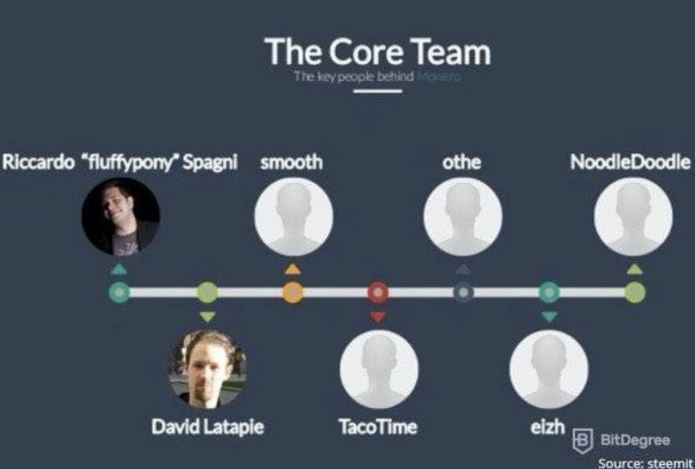
Keeping to the “anonymity” characteristic of Monero, five of the seven developers decided they wanted to keep their identities secret to the public. The two Monero developers that we know for certain are Riccardo Spagni and David Latapie. Spagni is the main developer today and goes by the nickname “Fluffypony”.
Privacy Centric
The main reason you would want to even consider Monero, is its privacy infrastructure, ensuring that you can never be linked to any single Monero transaction. You can see how this would be beneficial and often used in illegal transactions.
Monero alleviates privacy concerns using ring signatures and stealth addresses.
Ring Signatures
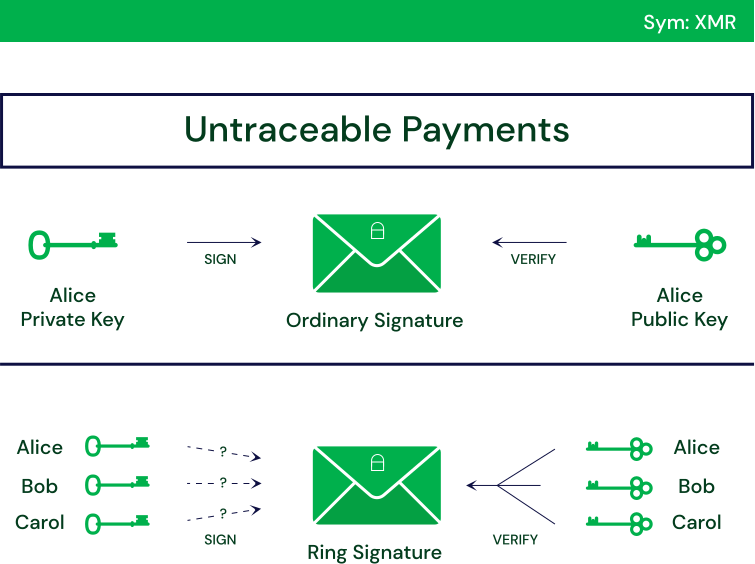
Ring signatures enable a participant who is sending money, to conceal his/her/their identity from other participants in a group. In its basic form, ring signatures are anonymous digital signatures from one member of the group, but they don’t reveal which one of those members signed the transaction.
Think of it as you having to endorse a check. You’re told the check is endorsed, but you have no idea who actually endorsed it because the multiple signatures to a transaction are all combined to produce a single, unique signature, making it impossible to know who actually signed the transaction.
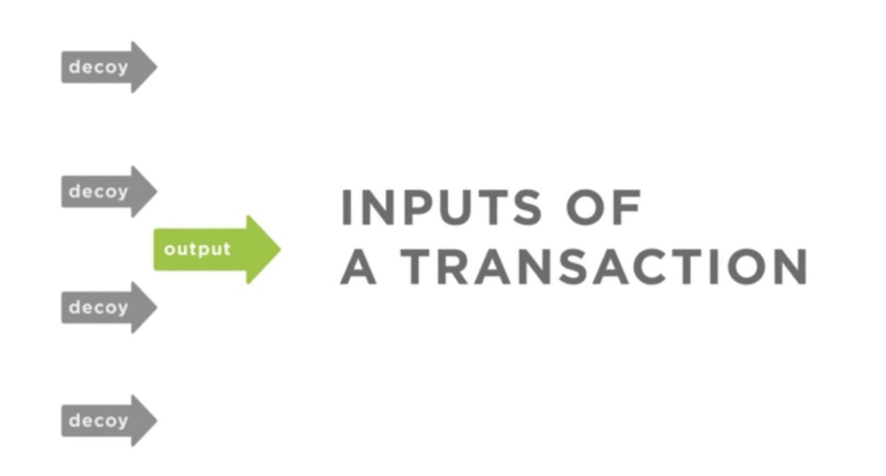
In generating a ring signature, the Monero platform uses a combination of a sender’s account keys and attaches it with public keys on the blockchain, allowing for the sender’s ability to be hidden.
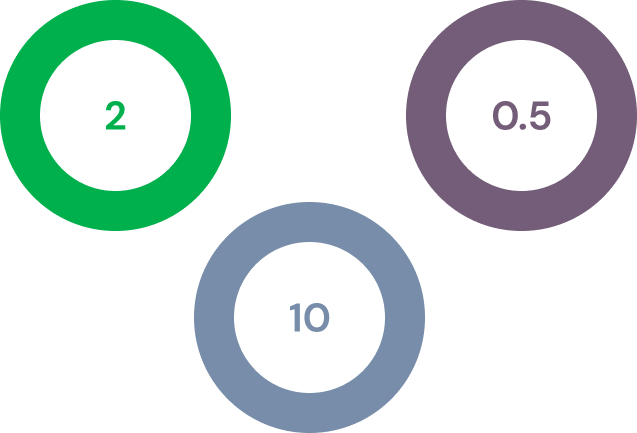
Before a signature is applied, the “ring size” must first be determined. Ring sizes are random outputs taken from the Monero network, which is of the same value as the XMR output. The bigger the ring size, the bigger the transaction, and thus the higher the transaction fees.
In a ring signature transaction, any of the decoys taken from the Monero network are just as likely of being output as the actual output, because any 3rd party (privy or not to the transaction) will have no idea who the actual sender is.
Those outputs are then individually signed with the user’s private spend key and it is sent to the blockchain.
Stealth Address
Stealth addresses are the second layer to the privacy shield, adding additional privacy with randomly generated addresses for single-time use, for every transaction on behalf of the recipient.
By utilizing stealth addresses, the actual destination address of a transaction would be concealed, hiding the receiving participant’s identity.
RingConfidential Transactions
Due to the successful implementations of ring addresses and stealth addresses, Ring Confidential Transactions (RingCT) was introduced in January 2017, hiding the senders and receivers identities. It was made mandatory for every transaction executed on the Monero network.
Prior to this implementation, every transaction was given its own ring signature and then added to the blockchain (see image above). What RingCT does is hide the transaction amounts in the blockchain, and allows for a wallet to pick up actual ring members from any RingCT output.
The Double Spending Problem
Now, what happens when the exact same coin is spent on more than one transaction at the same time? This is the double-spending dilemma, one of the major roles miners play in its attempts at preventing.
Because Monero’s ring signatures hide and cloak everything about a transaction, it prevents double-spending through advanced cryptography. As you know, every Monero transaction has its own unique key image. As such, miners can just look to the key image to determine whether a Monero coin has been double-spent or not.
-

Understanding Regulation Z: Your Rights as a Borrower
Regulation Z is a consumer-protection regulation that compels lenders to disclose the cost of credit in a clear way for consumers. Whether you’re applying for a mortgage or dealing
-

DeFi Explained: A Beginner's Guide to Decentralized Finance
The Beginner’s Guide to Decentralized FinanceIf you’re diving deep into the world of cryptocurrency, you have probably heard the term “DeFi” used to describe a variety of new protocols and assets. Fi
Fund information
- Understanding Routing Number Changes: What to Do When Your Bank's Routing Number Updates
- Walmart Benefits: Convenience, Low Prices & Services | Official Walmart
- UnitedHealth Group: Overview, Revenue & Healthcare Services
- Solvency Explained: Understanding Long-Term Debt and Financial Stability
- Accrual Accounting Explained: A Comprehensive Guide
- Market Cannibalization: Understanding and Avoiding Product Conflicts
- Tezos: A Comprehensive Overview of the Blockchain Platform
- Yearn.Finance: Understanding Yield Farming and DeFi
- Monero (XMR): Understanding Privacy-Focused Cryptocurrency
-
Understanding Cryptocurrency: A Beginner's Guide to Digital Currency
Cryptocurrency is a kind of digital currency that is intended to act as a medium of exchange. Cryptocurrency has become popular in the last decade, in particular, with Bitcoin becoming the most widel...
-
DB(k) Plans: A Hybrid Retirement Solution for Employers & Employees
The DB(k) plan is a type of retirement plan that is available for employers. This type of retirement plan combines features from the 401(k) plan with features from a defined benefit pension plan...