
Oil Price Crash: Historic Selloff Continues Amid Supply Glut

A historic selloff in the price of oil continued on Tuesday in the wake of a supply wave that has left the world awash with crude and running out of places to store it.
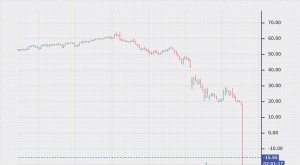
West Texas Intermediate crude oil futures for June delivery, the most active contract, dropped 43 percent to $11.58 per barrel. May futures, which crashed 305 percent to -$36.73 a barrel earlier this week, expired at $10.01 on Tuesday.
“This was an epic squeeze, but let’s not pretend this weakness is related strictly to the May contract,” wrote Stephen Schork, founder and editor of the daily subscription newsletter The Schork Report.
If the New York Mercantile Exchange, where oil futures contracts are traded, doesn’t hit storage capacity this month, “it certainly will hit capacity while the June contract is prompt,” he added. With storage at the max, the June contract can “crash into the single (if not negative) digits before it is all said and done.”
Monday's plunge in May-delivery prices was prompted partly by a selloff among traders speculating on oil prices who needed to dump their holdings before the contract's expiration required them to take delivery of the crude. Each futures contract gives the holder 1,000 barrels of oil for delivery at Cushing, Oklahoma, a key U.S. oil hub.
Essentially, oil bulls “got caught with their paws in the cookie jar,” Schork wrote.
U.S. crude oil inventories have swelled toward the maximum that can be stored as “stay-at-home” orders issued to slow the spread of COVID-19 have sharply reduced demand at the same time as a price war between Russia and Saudi Arabia dragged down prices.
Inventories at Cushing have surged by 48 percent since February to about 55 million barrels, closing in on the facility's 76 million-barrel limit.
A recent truce in the price war between Saudi Arabia and Russia may provide some relief.
The world’s largest oil producers, which include a slate of other nations, will cut production by 20 million barrels per day for the two months beginning May 1.
OPEC and its allies will reduce output by 9.7 million barrels while other major players such as the U.S. and Canada will cut their production mostly as a result of lower prices.
CLICK HERE TO READ MORE ON FOX BUSINESS
The agreement also says OPEC producers and their allies will trim output by 7.7 million barrels a day from July through next year.
-

Texas Oil Production: History, Current Output & Key Towns
The state of Texas experienced peak oil production in 1972. Afterward, production dwindled until the early 2000s. Production has more than doubled since Jan. 1999 when over 39 million barrels were p
-
The Getty Oil Takeover: A Financial Drama of the 1980s
Few episodes in the world of finance offer as much high drama as the Getty Oil takeover. It was the largest takeover in history, and it involved major players like American financier T. Boone Picken
Futures and Commodities
- Oil Prices Soar to Record Monthly Gain Amid Geopolitical Tensions
- Understanding Oil Benchmarks: Brent, WTI, and Dubai Crude
- Petroleum: Formation, Uses, and Properties - A Comprehensive Guide
- Understanding Oil Investments: A Comprehensive Guide
- Netback Explained: Understanding Oil Production Profitability
- Crude Oil: Definition, Uses & Environmental Impact
- Understanding Downstream Oil & Gas Operations: Refining & Production
- Understanding Benchmark Crude Oil: A Comprehensive Guide
- Unconventional Oil: Definition, Extraction Methods & Future Trends
-
 West Texas Intermediate (WTI) Crude Oil: Definition & Key Facts
What Is West Texas Intermediate (WTI)? West Texas Intermediate (WTI) crude oil is a specific grade of crude oil and one of the main three benchmarks in oil pricing, along with Brent and Dubai C...
-
Global Oil Exports: Top Exporters and Market Trends
The number one exported product in the world is oil. In 2019 (the latest year for which full data is currently available), this commodity accounted for more than 1.3% of the total global GDP. That y...