
Mutual Funds Explained: A Beginner's Guide to Investing
Mutual Funds are pools of money collected from many investors for the purpose of investing in stocksStockWhat is a stock? An individual who owns stock in a company is called a shareholder and is eligible to claim part of the company’s residual assets and earnings (should the company ever be dissolved). The terms "stock", "shares", and "equity" are used interchangeably., bondsBond TranchesBond tranches are usually portions of mortgage-backed-securities that are offered at the same time and that typically carry different risk levels, rewards, and maturities. For example, collateralized mortgage obligations (CMO) are structured with a number of tranches that mature on different dates, carry varying levels of risk, and pay different interest rates., or other securities. Mutual funds are owned by a group of investors and managed by professionals. In other words, a mutual fund is a collection of securitiesAsset ClassAn asset class is a group of similar investment vehicles. They are typically traded in the same financial markets and subject to the same rules and regulations. owned by a group of investors and managed by a fund managerPortfolio ManagerPortfolio managers manage investment portfolios using a six-step portfolio management process. Learn exactly what does a portfolio manager do in this guide. Portfolio managers are professionals who manage investment portfolios, with the goal of achieving their clients’ investment objectives..
Understanding How Mutual Funds Work
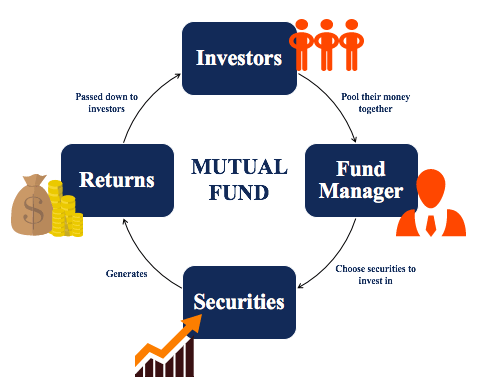
When you purchase a mutual fund, you are pooling money with other investors. The money pooled together by you and other investors are managed by a fund manager who invests in financial assets such as stocks, bonds, etc. The mutual fund is managed on a daily basis. Below is a diagram of how mutual funds work:
Common Types of Mutual Funds
There are six common types of mutual funds:
1. Money Market Funds
Money market funds invest in short-term fixed-income securities. Examples of short-term fixed-income securities would be government bonds, Treasury bills, commercial paper, and certificates of deposit. These types of funds are generally a safer investment but with a lower potential return than other mutual funds.
2. Fixed Income Funds
Fixed income funds buy investments that pay a fixed rate of return. This type of mutual fund focuses on getting returns coming into the fund primarily through interest.
3. Equity Funds
Equity funds invest in stocks. Furthermore, there are different types of equity funds such as funds that specialize in growth stocks, value stocks, large-cap stocks, mid-cap stocks, small-cap stocks, or a combination of these stocks.
4. Balanced Funds
Balanced funds invest in a mix of equities and fixed-income securities – typically in a 40% equity 60% fixed income ratio. The aim of these funds is to generate higher returns but also mitigate risk through fixed-income securities.
5. Index Funds
Index funds aim to track the performance of a specific index. For example, the S&P, or TSX. Index funds follow the index and go up when the index goes up and goes down when the index goes down. Index funds are popular as they typically require a lower management fee compared to other funds (due to the manager not needing to do as much research).
6. Specialty Funds
Specialty funds focus on a very small part of a market such as energy, telecommunications, healthcare, industrials, etc.
Benefits of Investing in a Mutual Fund
There are several key benefits to investing in a mutual fund:
1. Professional Management
Mutual funds are actively managed by a professional who constantly monitors the fund’s portfolio. In addition, the manager can devote more time selecting investments than a retail investor would.
2. Investment Diversification
Mutual funds allow for investment diversification. A mutual fund invests in several asset classes and not just a single stock or bond.
3. Liquidity
Mutual funds possess high liquidity. In general, you are able to sell your mutual funds within a short period of time if needed.
Disadvantages of a Mutual Fund
There are important disadvantages to consider when investing in a mutual fund:
1. Management Fees and Operating Expenses
Mutual funds typically charge a high MER (management fee and operating expenses). This would lower the overall return. For example, if the mutual fund posted a 1-year return of 10%, the MER would lower this return.
2. Loss of Control
Since mutual funds are managed by a manager, there is a loss of control when investing in a mutual fund. Remember that you are giving someone else your money to manage to when investing in a mutual fund.
3. Poor Performance
Mutual fund returns are not guaranteed. In fact, according to research, a large majority of mutual funds fail to beat major market indexes like the S&P 500. In addition, mutual funds are not insured against losses.
Related Resources
Develop your carer as a professional financial analystBecome a Certified Financial Modeling & Valuation Analyst (FMVA)®CFI's Financial Modeling and Valuation Analyst (FMVA)® certification will help you gain the confidence you need in your finance career. Enroll today! with CFI’s online financial modeling and valuation courses. To advance your career, these additional resources from CFI will be helpful.
- Fund of FundsFund of Funds (FOF)A Fund of Funds (FOF) is an investment vehicle where a fund invests in a portfolio composed of shares of other funds rather.
- Fixed Income SecuritiesTrading & InvestingCFI's trading & investing guides are designed as self-study resources to learn to trade at your own pace. Browse hundreds of articles on trading, investing and important topics for financial analysts to know. Learn about assets classes, bond pricing, risk and return, stocks and stock markets, ETFs, momentum, technical
- Investing: A Beginner’s GuideInvesting: A Beginner's GuideCFI's Investing for Beginners guide will teach you the basics of investing and how to get started. Learn about different strategies and techniques for trading
- Compare Finance CertificationsTop Finance CertificationsList of the top finance certifications. Get an overview of the best financial certifications for professionals around the world working in the finance industry
-

Quantitative Funds (Quant Funds): An In-Depth Explanation
In the wealth and asset management company, investments are managed by fund managers. They are aided by teams of research analysts in analyzing diverse and voluminous information. Investment strategie
-
Mid-Cap Equity Funds: Understanding Risk, Returns & Investment
The right equilibrium between risk and returns is best achieved with the help of mid-cap equity funds. Check out this post to know what they are, how they work, and whether or not you should invest in
invest
- Mutual Funds: A Beginner's Guide to Diversified Investing
- Closed-End Mutual Funds: A Comprehensive Guide
- Understanding Open-End Mutual Funds: A Comprehensive Guide
- Open-End vs. Closed-End Mutual Funds: A Comprehensive Comparison
- Vulture Funds Explained: Investing in Distressed Debt
- Slush Funds: Definition, Purpose, and Illicit Uses
- Segregated Funds: Understanding Insurance-Backed Investments
- Understanding Market Cap Mutual Funds: A Comprehensive Guide
- Mutual Funds Explained: A Simple Guide to Investing
-
 Understanding Mutual Funds: A Comprehensive Guide
[This is the first installment in a series examining index funds. Well discuss the managed mutual fund market first to form a basis of comparison with index funds. In Part II, we will look at how...
-
 Crypto Hedge Funds: Navigating the Emerging Market
Traditional hedge funds have been active in the financial markets for several years, allowing investors to practically invest in every asset class such as fixed income, equity, currency, and commodi...