
Understanding Overvalued Assets: A Comprehensive Guide
An overvalued asset is an investment that trades for more than its intrinsic value. For example, if a company with an intrinsic value of $7 per share trades at a market value $13 per share, it is considered overvalued.
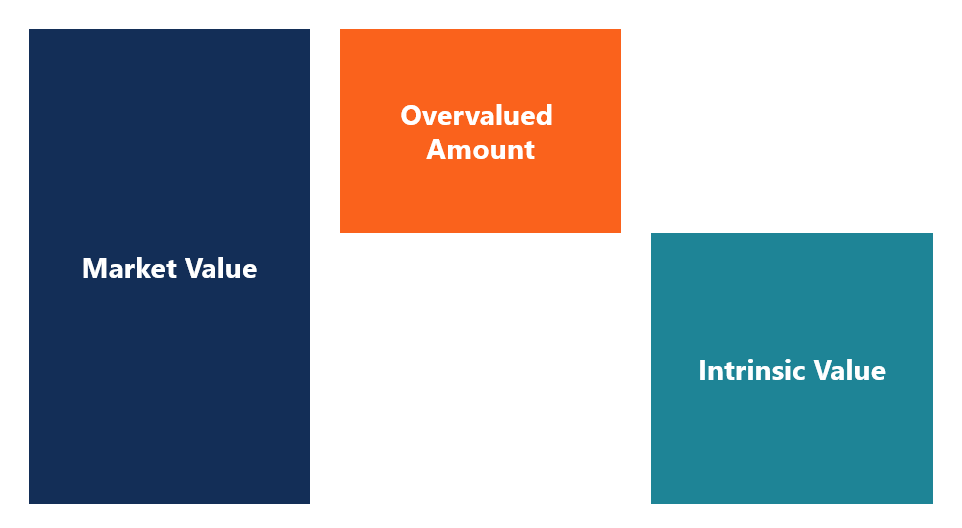
Intrinsic Value
An investment is other undervalued or overvalued compared to its intrinsic value. Because an investment’s intrinsic value is subjective, so is its “over/under” valued label.
As a refresher, the intrinsic value of an investment is the price a rational investor would pay for the investment. The concept is most commonly represented by the Net Present Value (NPV)Net Present Value (NPV)Net Present Value (NPV) is the value of all future cash flows (positive and negative) over the entire life of an investment discounted to the present. of all future cash flows the investment will produce. For a recap on the subject, please see CFI’s valuation methods guideValuation MethodsWhen valuing a company as a going concern there are three main valuation methods used: DCF analysis, comparable companies, and precedent transactions, as well as the financial modeling guideFree Financial Modeling GuideThis financial modeling guide covers Excel tips and best practices on assumptions, drivers, forecasting, linking the three statements, DCF analysis, more, and types of financial modelsTypes of Financial ModelsThe most common types of financial models include: 3 statement model, DCF model, M&A model, LBO model, budget model. Discover the top 10 types.
Undervalued vs. Overvalued
If the value of an investment (i.e., a stock) trades exactly at its intrinsic value, then it’s considered fairly valued (within a reasonable margin). However, when an asset trades away from that value, it is then considered undervalued or overvalued.
Value vs. Growth Investing
Investors who subscribe to the concept of value investing will not purchase stocks that are above their intrinsic value. Instead, they only look for opportunities to find “cheap” stocks. The opposite of a value investor is a growth investor, which is someone who believes that the stock is, in fact, not too expensive and will deliver more growth then the market (i.e., other investors) expect.
Short vs. Long Strategies
When a stock is overvalued, it presents an opportunity to go “short” by selling its shares. When a stock is undervalued, it presents an opportunity to go “long” by buying its shares. Hedge funds and accredited investors sometimes use a combination of short and long positions to play under/overvalued stocks. To learn more about trading, check out CFI’s technical analysis guideTechnical Analysis - A Beginner's GuideTechnical analysis is a form of investment valuation that analyses past prices to predict future price action. Technical analysts believe that the collective actions of all the participants in the market accurately reflect all relevant information, and therefore, continually assign a fair market value to securities..
Ratios for Overvalued Investments
There are many tools investors can use to discover assets (usually stocks) that are worth less than the price they have to pay for them. Here are some examples of commonly used ratios for assessing whether a stock is undervalued or not:
Price vs. Net Present Value (P/NPV)
Price-to-NPV is the most complete method for valuing an investment. To perform P/NPV analysis, a financial analyst will create a financial model in Excel to forecast the business’ revenues, expenses, capital investments, and resulting cash flow into the future to determine the Net Present Value (NPV)Net Present Value (NPV)Net Present Value (NPV) is the value of all future cash flows (positive and negative) over the entire life of an investment discounted to the present..
Next, the financial analyst will compare the resulting value from the Discounted Cash Flow (DCF) analysis to the market value of the asset. Check out CFI’s free financial modeling guideFree Financial Modeling GuideThis financial modeling guide covers Excel tips and best practices on assumptions, drivers, forecasting, linking the three statements, DCF analysis, more to learn more.
More Valuation Ratios
If a financial analyst doesn’t have enough time or information to create a financial model from scratch, they may use other ratios to value the company, such as:
- Enterprise Value to Revenue
- Enterprise Value to EBITDA
- Price to Earnings
- Price to Book Value
- Price to Cash Flow
- Dividend Yield and/or Dividend Payout Ratio
When using the financial ratios above, it’s important to avoid falling into the “overvalued trap.” Since companies can regularly have fluctuations in their financial statements, the ratios may appear more unfavorable then they should be over the long term.
A company can often incur one-off expenses on their Profit and Loss (P&L) StatementProfit and Loss Statement (P&L)A profit and loss statement (P&L), or income statement or statement of operations, is a financial report that provides a summary of a or include an asset write-down on their Balance Sheet when such accounting practices don’t automatically represent the long-term expected performance of the company.
Additional Resources
CFI offers the Financial Modeling & Valuation Analyst (FMVA)™ certification program for those looking to take their careers to the next level. To keep learning and advancing your career, the following resources will be helpful:
- DCF Model GuideDCF Model Training Free GuideA DCF model is a specific type of financial model used to value a business. The model is simply a forecast of a company’s unlevered free cash flow
- Long and Short PositionsLong and Short PositionsIn investing, long and short positions represent directional bets by investors that a security will either go up (when long) or down (when short). In the trading of assets, an investor can take two types of positions: long and short. An investor can either buy an asset (going long), or sell it (going short).
- Stock Investing: A Guide to Growth InvestingStock Investing: A Guide to Growth InvestingInvestors can take advantage of new growth investing strategies in order to more precisely hone in on stocks or other investments offering above-average growth potential.
- Stock Investing: A Guide to Value InvestingStock Investing: A Guide to Value InvestingSince the publication of "The Intelligent Investor" by Ben Graham, what is commonly known as "value investing" has become one of the most widely respected and widely followed methods of stock picking.
-

Understanding Residential Leases: A Comprehensive Guide
When you lease a home, you sign a rental agreement to live there. An executed lease is a legal document that includes your information, the property owner's information, rental terms and signature
-

Understanding Subleases: A Comprehensive Guide
A sublease, like a lease, is an agreement to allow a person or company to occupy real estate in return for regular rent payments. In a sublease, the tenant leasing from the original landlord in turn l
invest
- Understanding Prorated Payments: Definition & Calculation
- Understanding a $9,000 Salary: Annual Income Explained
- HODL Explained: The Origin and Meaning of a Bitcoin Term
- Understanding 'At Par': Definition & Implications in Finance
- Understanding Multi-Asset Class Investing: Diversification Explained
- Understanding Undervalued Assets: A Comprehensive Guide
- Understanding Opportunity Cost: A Guide for Investors
- Understanding Premium & Discount to Net Asset Value (NAV) in Mutual Funds
- Kasasa: The Meaning Behind Our Name & Mission
-
 Quarterly Billing: Advantages, Disadvantages & What You Need to Know
Paying quarterly can be an advantage if your income fluctuates. Sending out monthly bills can be an expensive proposition for businesses and governments, requiring an investment of time, labo...
-
 Understanding APY: Annual Percentage Yield Explained
When it comes to investing and banking, you want to make sure you are getting the best interest rate. You will often see the term "annual percentage yield" (APY) when opening an interest-bea...