
Financial Benefits of Quitting Smoking: Calculate Your Savings

As many as 42 million adults in the U.S. smoke cigarettes today, according to recent data from the Centers for Disease Control and Prevention (CDC). This isn't a health blog, though, so I'm not going rail on about 480,000 cigarette-related deaths that occur per year or the 16 million Americans who live with a smoking-related disease. I already know you probably want to quit. According to the CDC, more than two thirds of smokers do.
Instead, if you're one of the almost 18% of Americans who have yet to quit, I'm here to incent you by drilling down and showing you exactly how much money you could be socking away — if you weren't spending it on cigarettes. (See also: Here's How Rich You'd Be if You Stopped Drinking Expensive Coffee)
Not All Cigarette Prices Are Created Equal
Interestingly, the price of a pack of cigarettes is dramatically different, depending on where in the country you live. Each year, The Awl tracks the cost of a pack in each of the 50 states. The least expensive places to smoke are Virginia and Missouri, where a pack costs an average of $5.25. In New York, meanwhile, the price is a staggering $12.85. Everywhere else is somewhere in between.
I searched for the average number of cigarettes a smoker smokes per day, but the best I could uncover is a recent poll by Gallup, which indicates that 68% percent smoke less than a pack a day while 31% smoke a pack per day (1% smoke more than a pack every day). Without clear data to use as a guide, I decided to guesstimate for this project that the average smoker goes through a half pack (10 cigarettes) per day.
For Those of You in the Cheap States
If you live in Virginia or Missouri, where it's relatively cheap to smoke, a half pack a day habit will run you $18 a week, $78 per month, and $958 per year. That's according to QuitNet, a free online resource for tobacco users looking to break the habit.
Now, say instead of buying the equivalent of half a pack of cigarettes a day, you instead invest that amount in a mutual fund that averages 8% per year.
- After 10 years, you'd have banked $14,988.
- After 20 years, you'd have banked $52,169.
- After 30 years, you'd have banked $117,207.
- After 40 years, you'd have banked $268,030.
That's quite a nest egg. (See also: This One Thing Will Get You to $1 Million (Tax-Free!)
I know I said I wasn't going to talk about the health consequences but, well, I just can't help it. (I'm an ex-smoker myself. Everything you've heard about how annoying we are is true.)
According to QuitNet, after one week, you've added 12 hours and 50 minutes to your lifespan. After one month, two days and seven hours. After one year, it totals three weeks. Now, that's data worth compounding.
For Those Who Pay a Premium to Smoke
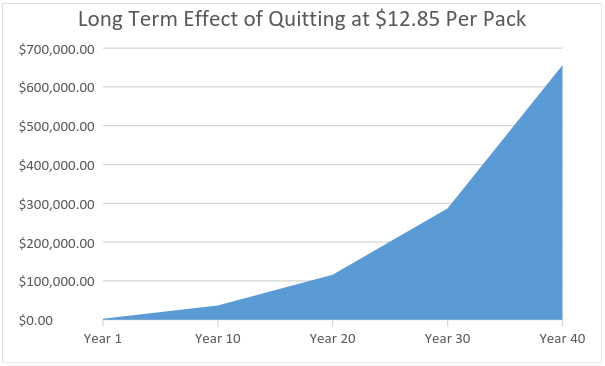
For those in New York who pay $12.85 per pack, the savings are even more dramatic. By quitting the habit, you'll save $44 per week, $192 per year, and $2,345 per year. Invest that amount in a mutual fund that averages 8% percent per year and…
- After 10 years, you'd have banked $36,688.
- After 20 years, you'd have banked $115,896.
- After 30 years, you'd have banked $286,901.
- After 40 years, you'd have banked $656,086.
For many of us, that 40-year number is more than enough to retire on!
And Then There Are the Unquantifiable Costs
Many non-salaried employees aren't paid for sick time, and those with a chronic smoking-related health ailment like respiratory disease or lung cancer are at risk to miss a greater number of work days than those who don't smoke.
Even among salaried employees who smoke, there are financial concerns to consider. It's currently illegal to discriminate against smokers in the workplace, but that doesn't keep employers from working around the established system. According to a recent post on Forbes, some employers will refuse to hire a candidate with nicotine in their urine during routine drug testing. For current employees, some may enforce smoke-free campus regulations — even when an employee is in his own car.
Quitting isn't easy. Trust me, I know. Even so, the long-term financial benefits may just be worth it.
What is your smoking habit costing you?


invest
- Cash Assistance Timeline: How Long to Expect Funds After Approval
- Retirement & Savings Goals at 40: What You Should Have
- Defining Wealth: What Does 'Rich' Really Mean?
- Loan Refinancing: Save Money & Improve Your Finances | [Your Brand]
- FAANG Investment Returns: What $500 Could Be Worth Today
- Understanding Rate of Return: A Guide to Smarter Investing
- Tax Implications of Having a Child: What Parents Need to Know
- Achieving Financial Freedom: Realistic Strategies & Expectations
- Unlock Savings: How Your Library Card Can Save You Hundreds Annually
-
 Reduce Impulse Spending: How Descriptive Language Can Help
Image Credit: @alexandrahraskova/Twenty20 You've probably heard of decision fatigue. It's part of what makes it easier to get things done earlier in the day rather than later. You only ha...
-
 Proven Strategies for Building Wealth: A 9-Step Guide
Building wealth is essential to pursuing financial independence. Wealth creates opportunity, yet it evades a lot of people. This is because many people simply look for ways to get rich quickly.The rea...