
Top 3 Index Funds with the Lowest Expense Ratios (2024)
An index mutual fund is a type of fund that invests all, or nearly all, of its total assets in securities comprising its underlying index. Index funds use passive investment strategies and thus tend to have low turnover and low expense ratios.
Funds that implement indexing strategies require less portfolio management and active trading, which minimizes their operating fees. Index funds with low expense ratios are beneficial to long-term investors who seek to track indexes and gain exposure to select segments of the market over time.
Expense Ratios and Management Fees
Expense ratios and management fees are part of an ongoing debate waging passive funds against active funds in the marketplace. A growing number of index funds continue to be developed in the market including the evolution of smart beta index funds that seek to replicate customized indexes.
To date, the debate on the added value of active management versus the advantages of passively managed funds continues. Expense ratios are often one of the key factors that may sway investors to choose passive fund investments over active managers when seeking targeted investment options.
As of the first quarter of 2021, the following three funds were among the lowest expense ratio mutual funds as reported by Morningstar. These funds were chosen based on expense ratio, retail investment availability, and broad market exposure.
1. The Fidelity 500 Index Fund (FXAIX)
The Fidelity 500 Index Fund (FXAIX) is an investor class fund marketed by Fidelity with a net expense ratio of just 0.015%. The fund tracks the holdings and return of the S&P 500 Index. The fund invests at least 80% of its total assets in the S&P 500 Index. The fund requires no minimum investment. It had a 2020 annual return of 18.4% versus 21% for its benchmark index.
2. The Vanguard Value Index Fund Investor Shares (VVIAX)
The Vanguard Value Index Fund Admiral Shares fund is marketed by Vanguard. It tracks the holdings and performance of the CRSP U.S. Large Cap Value Index. The fund has a net expense ratio of 0.05%. It does require a minimum investment of $3,000. For the year 2020, the fund had a one-year return that was 0.5%, behind the Index.
3. The Fidelity U.S. Bond Index Fund (FXNAX)
The Fidelity U.S. Bond Index Fund falls in Morningstar's "Intermediate-Term Bond" category. The fund is focused on U.S. bond investments. It has an expense ratio of 0.025% and requires no minimum investment.
The fund invests at least 80% of its assets in bonds in the Bloomberg Barclays U.S. Aggregate Bond Index. Its 2020 return was 7.8% versus 7.5% for the benchmark.
The Bottom Line
These funds must be traded with their affiliated platform, which is a factor that helps to keep the expense ratios down. The limited but easy access through the Fidelity and Vanguard trading platforms helps to limit many of the distribution and 12b-1 fees, keeping the expenses lower for investors.
-

Fund of Funds Investing: Diversify & Minimize Risk
The fund of funds investment strategy is a popular strategy that is designed to minimize risks and increase potential gains. The idea behind a basic mutual fund is that a fund manager is going t
-
Index Funds: 3 Key Benefits for Investors
If you want to be sure of making a profit on your investment, and have already decided on a mutual fund, index funds might be the next addition to your portfolio. These types of funds invest in
Investment fund
- Index Funds: A Beginner's Guide to Low-Cost Investing
- Diversify Your Portfolio: A Guide to Index Funds
- Top 11 Index Funds to Invest In for Long-Term Growth
- Index Funds vs. Mutual Funds: A Comprehensive Comparison
- Enhanced Index Funds: A Comprehensive Guide for Investors
- Understanding Mutual Fund Expense Ratios: A Comprehensive Guide
- ETFs vs. Mutual Funds: Understanding Expense Ratios & Costs
- Index Funds: A Comprehensive Guide to Passive Investing
- Top 5 Low-Cost Index Funds for Diversified Investing
-
Index Funds: A Comprehensive Guide to Investing in Market Performance
Getty ImagesIndex funds, which are designed to mimic the ups and downs of a specific index, from the S&P 500 Index to the Barclays Capital California Municipal Bond Index, have become a runaway su...
-
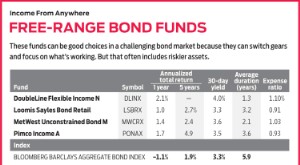 Unconstrained & Multisector Bond Funds: Navigating Market Volatility
With the broad bond market down 2% so far this year, it’s easy to see the appeal of a fund that can invest in the corners of the market that are working. That’s where so-called unconstrained bond fund...