
Mutual Funds: A Beginner's Guide to Diversified Investing
Many people think they don’t have enough money to invest. But it’s possible to create a diversified portfolio without breaking the budget. One of the most popular ways is with mutual funds. According to Statista.com, 44.8% of U.S. households owned mutual funds as of 2018.
And if you’re participating in your employer’s retirement plan, you’re probably already investing in mutual funds. Most plans offer a variety of mutual funds as part of their investment lineups.
Let’s take a closer look at how to invest in mutual funds and start to figure out which ones may be right for you.
Mutual Fund Basics: Why Invest in Them?
Two key reasons people invest in mutual funds are affordability and purchasing power. The minimum investment amount can potentially be as low as $50 depending on the policies of the fund provider. For example, you may have to set up automatic monthly purchases to get the lower minimum. In exchange for this investment, you can gain exposure to numerous stocks and other securities. It can be difficult to get this same type of exposure buying individual stocks with only $50 to invest.
On top of that, mutual fund investments generally offer:
- Professional management. Investment professionals research and select the securities for each fund, monitor market and economic conditions, and update the holdings as necessary.
- Diversification. Mutual funds typically include individual securities from different companies or industries, which helps manage risk. On any given day, holdings in a fund that are down might be offset by others that are up.
- Liquidity. You can usually request a withdrawal at any time, although you may want to check with the mutual fund provider or your financial consultant first to see if any redemption fees or restrictions apply.
Types of Mutual Funds
If you can think it, there’s probably a mutual fund for it. According to mutualfunds.com, there were more than 8,000 mutual funds as of 2019. Most fall into one of these broad categories:
- Money market. Generally considered to be low-risk mutual funds, money market funds invest in cash and cash equivalents such as Treasury bills and certificates of deposit. But there’s typically not as much opportunity for growth or inflation protection. For these reasons, money market funds are often used only for short-term savings or as part of a broader investment strategy.
- Fixed income. These funds are designed for investors seeking income over growth. They generally consist of government-backed Treasury notes and bonds, as well as corporate bonds that aim to produce interest and dividend income.
- Stocks (equities). These funds invest in corporations and are generally used by investors seeking growth who can handle a higher level of risk and market fluctuations. Stock funds can take many forms. Some might focus on smaller companies, while others focus on larger ones or those perceived to be undervalued.
- Index. This is a type of stock fund that seeks to mimic the performance of a particular market index like the S&P 500 or Russell 2000.
- Specialty. Specialties are also a type of stock fund, and they tend to be the most aggressive because of their narrow focus. Funds in this category may invest in a specific geographic region or theme, such as technology or the environment.
- Multi-asset (balanced). As the name implies, these funds offer a mix of stocks and fixed-income securities. One example that’s often used in retirement plans is target-date funds, where the split between stocks and bonds gets more conservative as the designated date approaches. Of course, the principal value of the investment in a target-date fund is not guaranteed at any time, including at the target date.
How to Choose Mutual Funds
With so many different types of mutual funds to choose from, it may be difficult to identify which ones are right for you. To help narrow your choices, look for ones that reflect your:
- Goals. What are you investing for? A new home? Children’s education? Retirement?
- Investment objectives. Given your goals, are you looking to maximize growth? Income? A combination of both?
- Risk tolerance. Are you aggressive? Conservative? Moderate? The goal is to find investments that match the level of risk you’re comfortable with.
- Time horizon. How soon will you need the money? For short-term goals, it may make sense to invest in money market or fixed-income funds. Stocks and multi-asset funds are often used to pursue long-term goals because your money has more time to potentially grow.
Which mutual fund is right for you?
TD Ameritrade tools and services can help you decide.
Based on your answers to these questions, you can determine which type(s) of mutual fund may be best suited to your goals, objectives, and risk tolerance. For example, if you’re seeking growth and can handle a moderate level of risk as you invest for your child’s college education, you might choose a stock fund that invests in large, established companies. If you’re hoping to put a down payment on a home within the next five years, you might want a balanced fund that aims to provide some downside protection.
From there, you’ll want to research and compare specific funds within that category. Some factors to consider include:
- Investment performance. Although there’s no guarantee of future results, a fund’s long-term track record offers clues as to how it may perform under different market conditions. Ideally, you want a fund with consistent performance that aligns with its investment objective.
- Portfolio holdings. Two mutual funds in the same category can have very different asset allocations. For example, one stock fund might be more heavily weighted in a particular sector or geographic region than another, making it more aggressive or conservative. Look for funds with allocations that reflect your risk tolerance.
- Management style. Likewise, each money manager has their own philosophy for how they evaluate and select the securities for their mutual fund. If you’re not comfortable with a manager’s style, it’s probably not the fund for you.
- Fees. Every mutual fund charges an investment management fee, also known as the expense ratio, that can range from a fraction of a percent to 2% or more. Plus, there may be sales charges and transaction or redemption fees. TD Ameritrade offers a wide assortment of funds that don’t have transaction costs.
All of this information and more is available on the investment company’s website and in the mutual fund’s prospectus, which you should read carefully when you’re trying to figure out how to invest in mutual funds. And as you conduct your research, make sure you’re comparing similar funds, such as bond fund to bond fund.
What Resources Are Available?
You may also want seek information from other sources. TD Ameritrade offers tools and resources to help facilitate your mutual fund research. One is the TD Ameritrade Premier List, which provides top picks* by independent investment professionals at Morningstar. Consider using the list to help evaluate a single fund or to help you build a diversified portfolio with multiple funds.
Another resource is the TD Ameritrade mutual fund screener, which can help you find mutual funds that match your goals and investment preferences. With this tool, you can create and save your own screens or use predefined ones.
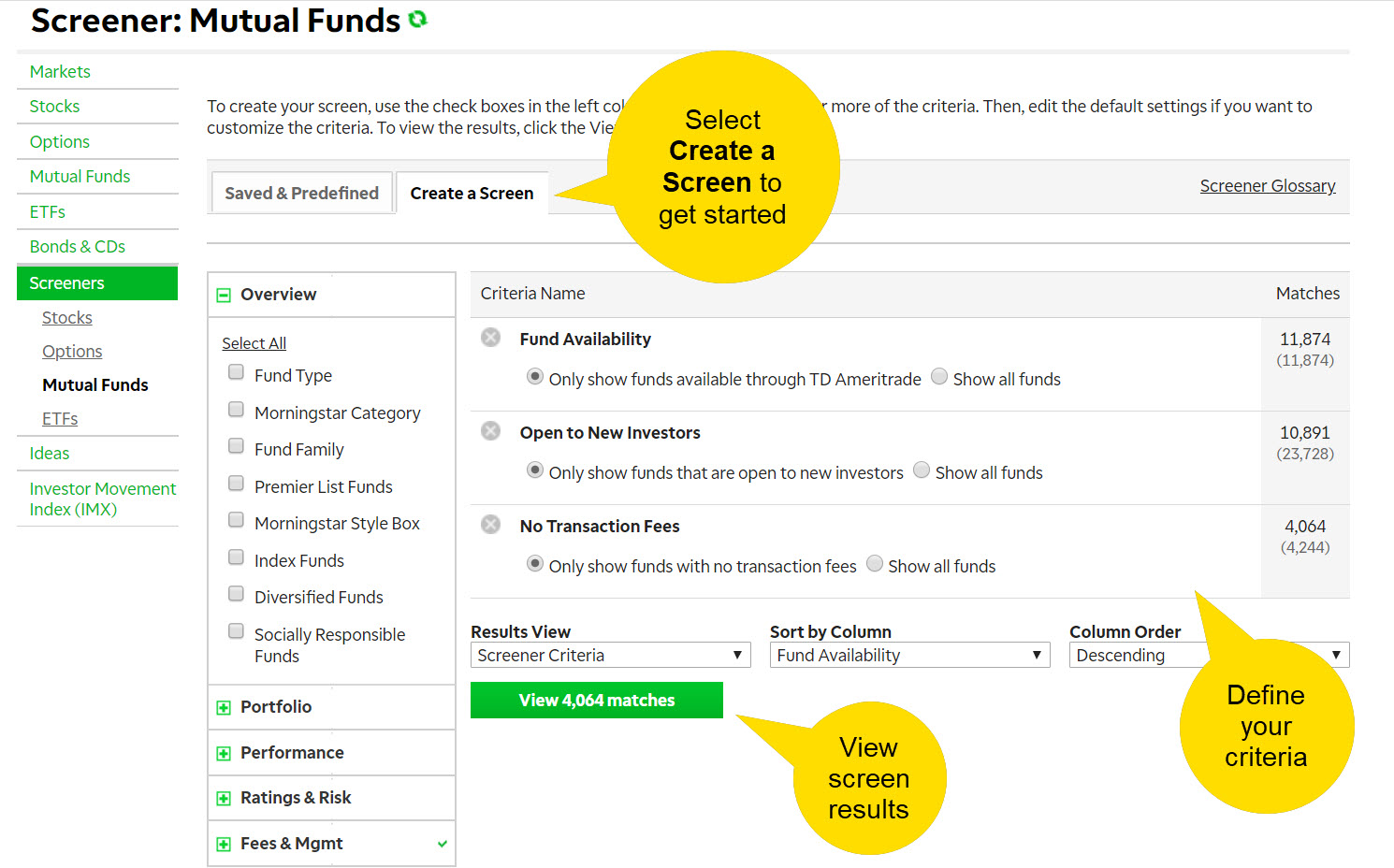
FIGURE 1: SCREENING MUTUAL FUNDS. Use the TD Ameritrade mutual fund screener to help you find mutual funds that match your goals and investment preferences. Go to Research & Ideas > Screeners > Mutual Funds. For illustrative purposes only. Past performance does not guarantee future results.
Mutual funds offer an affordable way for new and experienced investors to get exposure to the market, build a diversified portfolio, and manage risk. The key is to do your homework, which includes reading the prospectuses to find funds that fit your goals, investment objective, risk tolerance, and time horizon. To learn more about the basics of mutual funds, watch the video below.
 Investing Basics: Mutual Funds
4:44
Investing Basics: Mutual Funds
4:44
Carefully consider the investment objectives, risks, charges, and expenses before investing. A prospectus, obtained by calling 800-669-3900, contains this and other important information about an investment company. Read carefully before investing.
Asset allocation and diversification do not eliminate the risk of experiencing investment losses.
-

Investing in Index Funds: A Comprehensive Guide
This is the third installment of a three-part series examining index funds. In Part I, we looked at the managed mutual fund market. In Part II, we looked at how an index is calculated and what a
-

Investing in Index Funds: A Beginner's Guide to Passive Investing
Index funds function like a slice of a particular index market by mirroring its composition and performance. This can be great for passive investors, but also comes with some caveats.How to Invest in
Investment fund
- Mutual Funds: A Beginner's Guide to Investing for Long-Term Growth
- Mutual Funds: A Beginner's Guide to Investing with Lower Risk
- Mutual Funds Investing: A Beginner's Guide to Getting Started
- Mutual Funds for Beginners: A 2024 Investing Guide
- Investing in Mutual Funds: A Comprehensive Guide for Beginners
- Investing in US Stocks: A Guide for Indian Investors via Mutual Funds
- Direct Mutual Funds in India: A Comprehensive Guide for 2024
- Choosing the Right Mutual Funds: A Comprehensive Guide
- Mutual Funds: A Beginner's Guide to Investing
-
Investing in China: A Guide for Foreign Investors
Investing in China is becoming more and more popular because China continues to grow at a fast pace. You do not have to live in China to invest in the future of the country. There are various in...
-
Understanding Mutual Funds: A Comprehensive Guide
How do mutual funds work? To answer this, we must first understand what mutual funds are. To put it as simply as possible, mutual funds are funds pooled from a group of investors so that they ma...