
Skill Stacking: Boost Your Career with Versatility
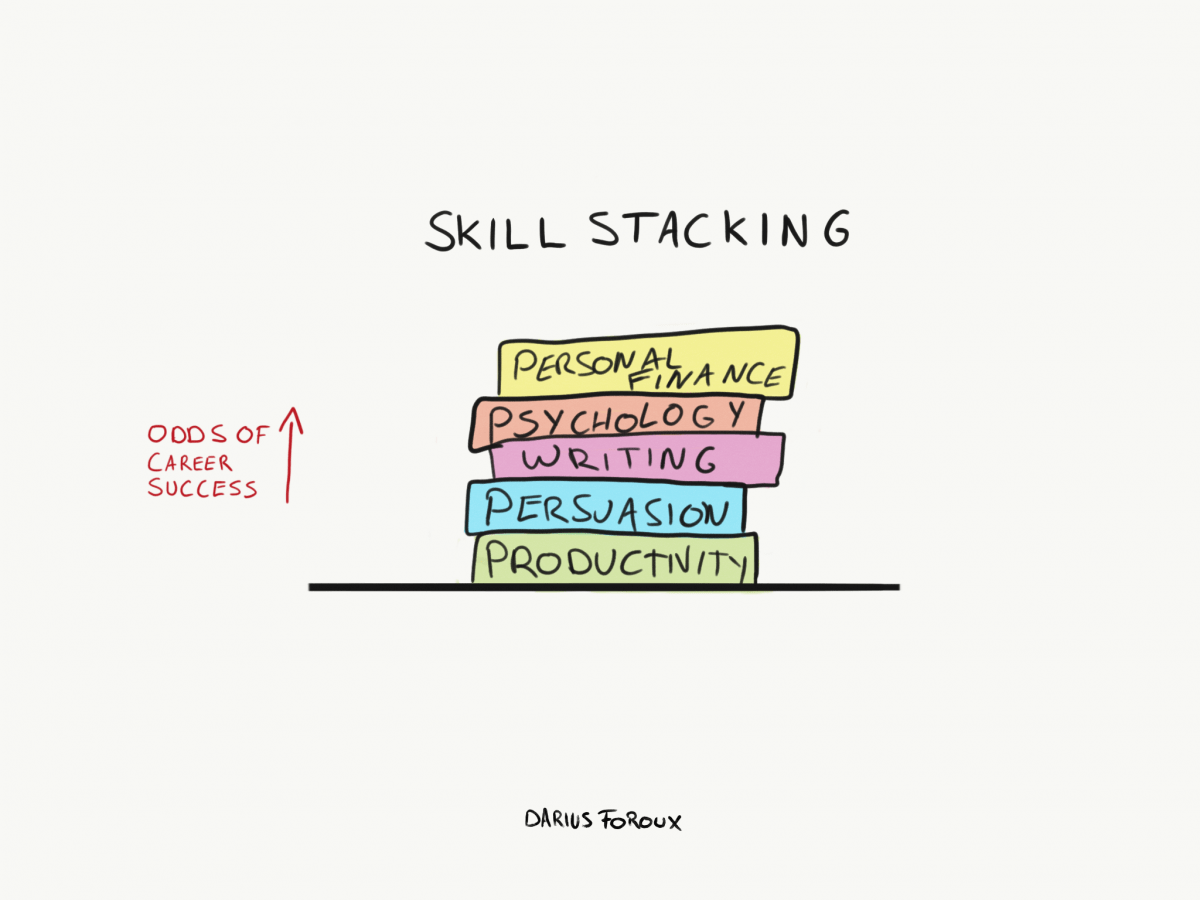
One of the most popular ideas in personal development is that all successful people have achieved mastery. Many of us believe in this false notion that you have to master a skill to achieve career success.
That’s because we, as a society, admire and glorify winners. We look at billionaires, champions, gold medalists, and other outliers. I must admit, there are many lessons we can learn from people who are masters at one particular skill.
But at the same time, it’s very daunting. Let’s be real, not everyone wants to spend 10 or 20 thousand hours to master a skill. We all have other things we value in life: Our family, friends, hobbies, health, you name it.
So when people write books and articles about outliers, we might get inspired, but from a practical point of view, the advice is useless. Not because we can’t apply the advice—most of the time, we don’t WANT to.
A More Realistic Approach To Career Success
I always knew I wanted to live life on my own terms. My definition of success is the same as Bob Dylan’s:
I realized that if you want to be successful according to that definition, you need two things: A stable career and enough income.
To be clear, you don’t need to become the best in the world to be successful. Nor do you need to be a millionaire. All you need is a valuable skillset to achieve that level of career success.
Build Your Skill Stack
About three years ago, I made a discovery that changed the course of my career and life. I’ve been working many different jobs since I was 17. I also studied business and marketing, getting a bachelor’s and a master’s degree. In 2010, I started my first business.
Over the years, I’ve developed many skills. Here’s how my skill stack looks like:
- Productivity and time-management
- Persuasion
- Web design
- Writing
- Accounting
- Drawing
- Project management
- Marketing
- Public speaking
- Teaching
I’m not a master at any of these skills. For example, I have poor drawing skills, reasonable web design skills, average marketing skills, solid productivity skills, and good but not great writing skills.
But when I stacked all my skills on top of each other and started blogging, it proved to be a success.
When I read How To Fail At Almost Everything and Still Win Big by Scott Adams, I understood why that was. He calls this concept Talent Stacking (I don’t like the word talent because it implies nature, I prefer skill because it implies nurture), and writes:
Every Skill You Acquire Doubles Your Odds Of Success
Scott Adams writes:
There are many examples of this if you look around you. How many people do you know who are not the best in the world and yet are doing well? It’s all about increasing your odds of success.
You simply have more chances of career success if you have more skills. Think about it. If you’re a one-trick pony, your opportunities are limited. But if you have multiple skills, you’re simply more valuable. And that’s what career success is ultimately about.
It comes down to value. How much value can you give to people or organizations?
“What Skills Will Make Me More Valuable?”
That brings us to the million-dollar question. To be clear, I’m not just using popular language here. This is truly a million-dollar question.
The more skills you have, and the more value you can create, the more rewards you receive. And yes, over your career, that’s probably more than a million bucks. So what are those valuable skills? I personally think you can’t go wrong by developing these skills:
- Productivity—My whole blog’s focus is on productivity for one reason: When you’re a person who can get shit done, you will always find away. With solid productivity skills, you can learn anything. That’s why I think it’s the first thing we must learn because it makes developing all the other skills a lot easier. Put simply: Productivity is the mother of all skills.
- Writing—The ability to translate your thoughts into words makes it easier to do our job. When you write in a clear and simple way, you can express yourself like very few people can.
- Psychology—A basic understanding of why we do what we do can help us to understand ourselves and others. You don’t have to become a therapist. As long as you know the basics of psychology, you’re better at dealing with other people; and yourself.
- Persuasion—This is the art and science of communicating in a way that resonates with people. When we’re good at persuasion, we are better at leadership, sales, holding conversations, public speaking, at anything else that requires influencing others. Influence is more about effective communication than anything else.
- Personal Finance—We often don’t think about managing our money. But when we get closer to retirement, we think, “Why didn’t I start earlier.” The time to start managing your personal finance is NOW.
I have a strong belief that acquiring these skills will turn you into a reliable human being. Someone you want to be your spouse, brother, sister, parent, etc. (If you want to hear more thoughts on this, listen to my podcast episode about it)
Let’s do the following thought exercise. Let’s say you own a business and you want to hire a CEO. What kind of person would you hire?
Answer that question for yourself. Write down what skills and qualities that person should have. Then, become that person by acquiring those skills.
-

Unlock Your Potential: The Power of Ambition for Success
What human traits predict career and life success? I’ve been curious about that question since I was 16. But at that age I didn’t think ambition was important.That was also the time I became int
-

115 Core Values: Define Your Character & Live with Purpose
Just like a healthy root system is essential for a healthy tree, core values are essential for a healthy life. They define our character and the way we live. Without values, we lack clarity about
Personal finance
- Unlock Forex Success: 4 Proven Strategies for Traders
- Unlock Career Success: 5 Proven Strategies for Advancement
- Achieve Your Dreams & Financial Freedom: A Practical Guide
- Needs vs. Wants: Creating a Successful Budget
- Achieve Your Financial Goals: 7 Practical Tips for Success
- Board Strategy: Assessing & Enhancing Your Board's Strategic Capabilities
- Build a Fulfilling Career: Strategies for Professional Growth
- Unlock Your Potential: The Power of Mindset for Success
- Gen X Career Mistakes: How to Rebuild Your Skills & Opportunities
-
 10 Powerful Questions Answered: Expert Insights & Practical Solutions
The other day I received an email from a reader with 10 powerful questions she wanted me to answer. No introduction. No small talk.Just a list of questions and “Thanks for your time” at the bottom.Nat...
-
 Master Habit Formation: A Proven Strategy to Overcome Procrastination
How often have you started a new habit that you already quit after several days? If you’re like me in the past, the answer is something like, “all the time.” I had no strategy in place to beat procras...