
Marcus Aurelius' Stoic Wisdom: 3 Rules for a Meaningful Life
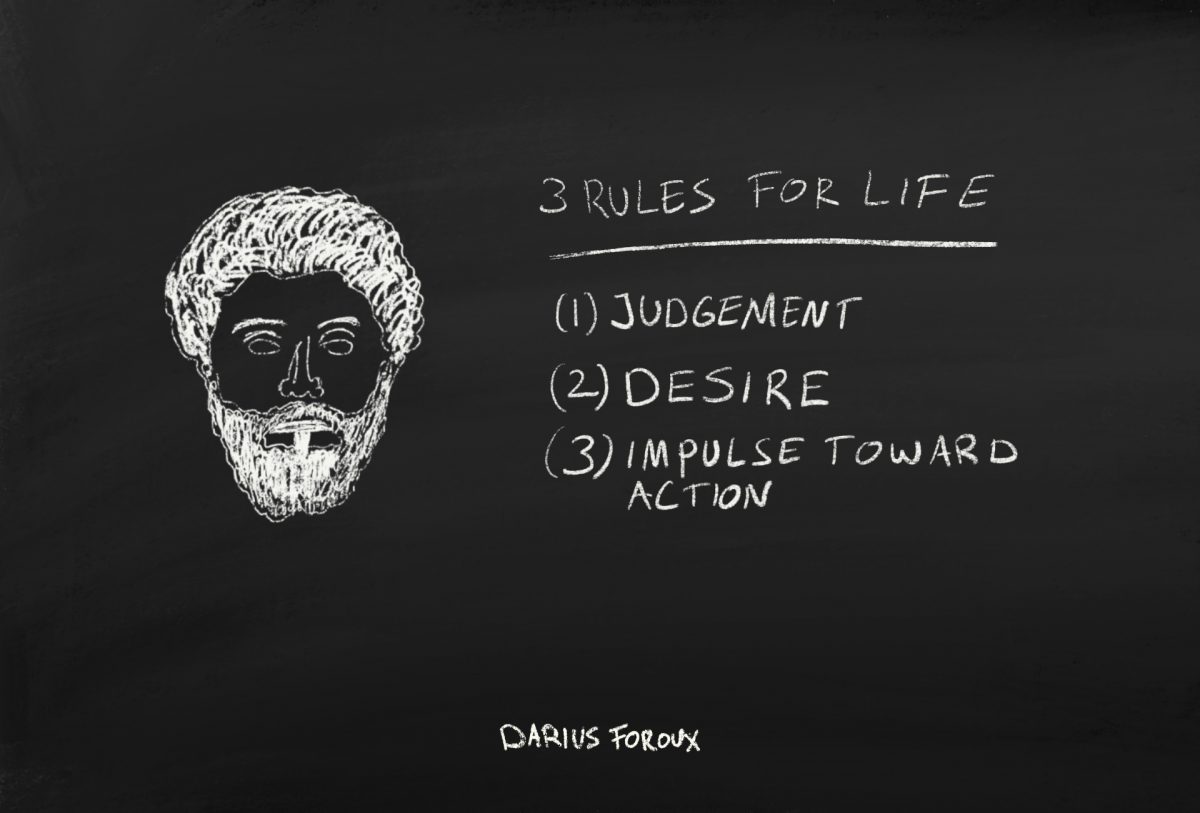
How does one live well? It’s a question that our fellow human beings have been pondering for centuries. Out of that simple question, many philosophies and religions have been born.
But no philosophy does a better job of explaining the ideas for living well in a practical way than Stoicism.
The Emperor-Philosopher Marcus Aurelius, once the most powerful man on earth, was also a practitioner of Stoicism. Marcus wrote a collection of thoughts, ideas, and rules for life in what was later published as Meditation.
He wrote the things in that book for his own use. He was practicing the philosophy of Stoicism. I read that in The Inner Citadel by Pierre Hadot, a book that analyzes Meditations. In that book, I also read that Marcus had 3 rules for life that are found throughout Meditations.
Hadot identifies the 3 rules for the life of Marcus Aurelius as the following concepts: (1) judgment (2) desire (3) impulse toward action.
As I was reading The Inner Citadel, I had difficulty grasping what Hadot meant by those three concepts. He does not tell us what to do with this information. He only says that Marcus Aurelius’s work was dominated by three rules that are based on judgment, desire, and an impulse toward action.
Because when I talk about “rules for life,” I think about directives. I think about “do this” and “don’t do that.” I use these types of rules in my life all the time. I look at rules like shortcuts that make life simple.
By this, I do not want to minimize the work of Hadot. In fact, I think his analysis of philosophy is the best that I have ever read. His conclusions about Stoicism and philosophy are spot on. And if you want to study Stoicism, I recommend Hadot’s work. But it’s not a light read—even for well-read people.
That’s why I sat down to translate the 3 rules for the life of Marcus Aurelius, as found by Pierre Hadot, in plain English. Here they are (for every rule, I mention a Marcus Aurelius quote that explains the idea):
Rule 1: Aim for pure judgment of events
We need to put that quote in context. Marcus realized that we make judgments about everything. But instead of making a pure judgment, we make value-judgments.
We add a personal twist to our judgment. In the above example, Marcus talks about when something bad happens to you. In that case, you can say, “So and so happened to me. And that hurt me.”
The last sentence is the value-judgment part. So when you drop that last part, you don’t let the bad thing to make an impact on you. The event merely happened. The end.
Let’s say you lose your job. What’s worse? The actual event of losing your job? Or you, worrying that you will never find a new job. Of course, it’s the last part—the worrying.
When you make a judgment like that and give meaning to events, you’re not making a pure judgment. So remember to look at everything that happens to you for what it is.
Did your partner cheat on you? Did you get ill? Did you lose money? Did people make fun of you? Stab you in the back?
The events themselves can’t hurt you if you don’t let them. Hence, aim for pure judgments of events.
Did something happen? Fine. Do something or move on.
Rule 2: Only desire what’s inside your control
In his Meditations, Marcus continuously repeats to himself that most things in life are outside of his control. He realized that life is unpredictable. In 2000 years, nothing has changed about that.
Shit happens to you all the time. Instead of resenting it or desiring a different life; work with what you have. We all know this piece of advice.
“If life gives you lemons, make lemonade,” so the overused platitude goes. Marcus takes it one step further. Instead of making the best of what happens to you, LOVE it.
He knew that most of the things we desire are outside of our control. Look at what you desire. More money? A social media following? A better job? A new car?
Or maybe that your partner will always love you? That you always keep your friends?
He desired none of the above. He only desired what’s inside his control or what happened to him. He had faith in something bigger than him. What happened to him happened for a reason.
Most things in life that happen are not up to you, my friend. And Marcus realized that like no one else. Only desire what’s inside your control.
Rule 3: Act according to the common good
Remove impulses from your life. Make your actions purposeful and never waste your energy on nonsense. Have a goal.
This is what Marcus is saying in the above quote. To many, it sounds like too much control. “OMG. This is OCD.”
That may be. If people want to waste their time on this earth let them. Marcus didn’t care for those folks. And neither should you.
We are here for a reason: To make things better.
And that’s why so many people are drawn to the writings of Marcus Aurelius and other Stoics. They wanted to make the world a better place.
I can’t think of a more noble goal than that. It is now up to us to keep this philosophy alive. And you can only do that by putting these 3 rules for life in practice.
-

Understanding Tax Implications of Selling Stocks
When you invest in the stock market, the Internal Revenue Service is not interested in your profits or losses until you cash in the stocks. Before then, you could see the value of your stocks skyrocke
-

Renting an Apartment as a Minor: Legal Rights & Challenges
Apartment landlords may not rent to a minor. Whether you're browsing the best apartment rental sites for ideas or checking with local complexes, you'll find that renting an apartment
Personal finance
- Simple Financial Rules of Thumb: 8 Guidelines for Better Money Management
- Roth IRA Conversions: A Comprehensive Guide
- Understanding Inherited IRAs: Rules & Beneficiary Options
- Navigating Life's Financial Transitions: Strategies for Key Events
- Unlock a Fulfilling Life: 10 Essential Lessons for Happiness & Well-being
- Craft Compelling Content: 3 Rules for Effective Articles
- Achieve Financial Freedom: 10 Steps to a Debt-Free Life
- Life Insurance: A Comprehensive Guide to Finding the Right Policy
- Life Insurance Claim Process: A Step-by-Step Guide
-
 Inherited IRA Rules: Understanding Transfer & Distribution Requirements
People are having a business discussion. When you inherit an individual retirement account, the funds aren't treated the same as an IRA you opened on your own. Transfer and distribution r...
-
 Understanding 401(A) to IRA Rollovers: Rules & Guidelines
Rules for Rollover 401A to IRA A 401A plan is similar to the more commonly used 403B plan provided to school district employees to help save toward retirement. Unlike a 403B plan, the 401A pl...