
The History of Bankruptcy: From Debtors' Prison to Modern Relief
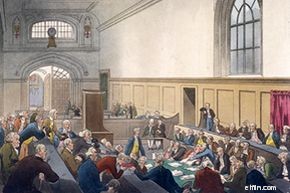 Examination of a bankrupt man before his creditors in the Court of King's Bench, Guildhall, London, 1808.
Imagine falling behind on your credit card payments and, eventually, becoming unable to pay them at all. Now imagine being thrown into prison because of it.
It may seem an unlikely scenario today, but there was a time in history when debtors were jailed for failure to pay -- a sentence that made little sense since being imprisoned left them unable to work. Even in the U.S., debtors were jailed until the early 1800s. Now our legal system deals with the inability to pay using a complex federal bankruptcy code designed to offer protections to debtors, and, in some measure, to creditors. But how did the bankruptcy code come about?
Bankruptcy laws are designed to liquidate the collective assets -- known as the estate -- of a debtor, and to dole out the proceeds to creditors. The creditors receive a portion of the proceeds according to claims they have filed with the bankruptcy court, which help satisfy what the debtor owes them. If the debtor owes more than the estate pays the creditor, as is often the case, then the balance of the debt is forgiven.
It's a concept that's been in play since the ancient Roman Empire, when creditors could have a debtor's estate sold to receive the proceeds. Bankruptcy proceedings were commonplace during the Middle Ages, and also included a selling of assets to relieve debts. The U.S. took its cues from England, modeling the largely unpopular Bankruptcy Act of 1800 -- adopted 11 years after the Constitution was ratified -- after the motherland's laws that provided protection to merchants, bankers and the like when bankruptcy charges were brought against them [source: Encyclopedia Britannica].
The Bankruptcy Act of 1800 was replaced by the 1841 Bankruptcy Act, which allowed -- for the first time -- a debtor to file bankruptcy voluntarily and receive a discharge. In addition, the protections were extended not only to merchants, but to all people. The Bankruptcy Act of 1867 allowed bankruptcy filers to choose whether to follow state or federal exemption guidelines. And the Chandler Act of 1938, which zeroed in on large corporate bankruptcy proceedings, was built upon the National Bankruptcy Act of 1898, when Congress passed the first permanent law governing bankruptcy.
President Carter signed the Bankruptcy Reform Act, the basis of modern bankruptcy, into law on Nov. 6, 1978. Known as the Bankruptcy Code, it created bankruptcy courts and, notably, no longer allowed student loans to be discharged [source: Federal Judicial Center]. The next major change came in 2005, with the Bankruptcy Abuse Prevention and Consumer Protection Act (BAPCPA). Essentially, the act made it harder to file for bankruptcy by increasing the complexity of the law, as well as the fees and amount of paperwork required when filing. It made it more difficult to have debts wiped clean and to file for bankruptcy more than once. It also requires bankruptcy filers to take a credit-counseling course -- which is far more palatable than a debtor's prison [source: Hahn].
-

Understanding Fiduciaries: Your Rights & Financial Protection
You’ve likely heard the term fiduciary used in investment circles. Although that is one context in which a fiduciary is important, it is not the only time whe
-
Smart Holiday Gifts: Investing in Your Loved Ones' Future
Holiday shopping can be ridiculously hard. Either the item they want is one everybody wants and it’s been out of stock for months or they’ve already bought it
Personal finance
- Roth 401(k) Loans: Rules, Limits & Tax Implications
- Bitcoin Creation: How New Bitcoins Are Minted & Distributed
- The Origin of Wall Street: A History of Dutch Defenses and Financial Power
- Top Investment Strategies for High Returns | [Year]
- Brexit Impact: Regulatory Changes for UK Private Equity & Venture Capital Firms
- Best Savings Accounts for Your Car Down Payment | Secure Your Funds
- Understanding the Drawbacks of Bankruptcy: What You Need to Know
- 401(k) Loans: Pros, Cons & What You Need to Know
- The Story Behind the Kasasa Name: A Banking Revolution
-
Top Fastest-Growing Industries for Investors in [Year]
Investing is all about looking towards the future. A great investor can spot trends before the general public. They can also predict the industries that are going to boom in the coming years. Howeve...
-
Understanding Bankruptcy: A Comprehensive Guide to Filing (Chapter 7)
“I declare … bankruptcy!” Somewhere along the way, that became the go-to phrase to describe the act of going the bankruptcy route. But as you might imagine, i...