
Understanding the Stock Market: A Beginner's Guide to Investing
It is important to invest money in the right avenues for wealth creation.
Stock market investment is one such lucrative option that rewards investors with high returns over the years. But to make this kind of return, it is important to understand how the equity market works.
Here is what you should know.
Participants of the Stock Market
The stock market is an avenue where investors trade in shares, bonds, and derivatives. This trading is facilitated by stock exchanges. It acts as a platform, a marketplace, that connect buyers and sellers. Four key participants are involved in the Indian stock market.
Securities Exchange Board of India (SEBI):
SEBI is the regulator of stock markets in India. It ensures that securities markets in India work efficiently, and transparently. It also protects the interests of all the participants and none gets any undue advantages.
SEBI lays down regulatory frameworks were exchanges, companies, brokerages, and other participants have to abide by to protect investors’ interests.
Stock exchange
The stock market is an avenue where investors trade in shares, bonds, and derivatives. This trading is facilitated by stock exchanges. In India, there are two primary stock exchanges.
- Bombay Stock Exchange (BSE) – Sensex is its index
- National Stock Exchange (NSE) – Nifty is its Index
Stockbrokers and brokerages
A broker is an intermediary ( person or a firm) that executes buy and sell orders for investors in return for a fee or a commission.
Investors and traders
Stocks are units of a company’s market value. Investors are individuals who purchase stocks to become part owners of the company. Trading involves buying or selling this equity.
Markets
To understand how to share market works, the next thing is to learn about primary and secondary markets
Primary Markets
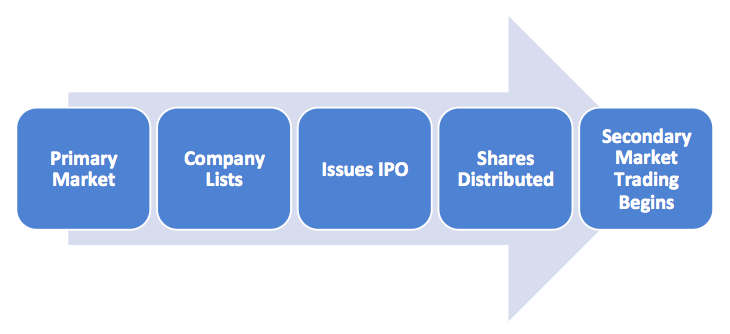
The primary stock market provides an opportunity for issuers of stocks (companies), to raise capital to meet their investment requirements. And to discharge liabilities.
A company lists its shares in the primary market through an Initial Public Offering or IPO. Through an IPO, a company sells its shares for the first time to the public. An IPO opens for a particular period. Within this window, investors can bid for the shares and buy them at the issue price announced by the company.
Once the subscription period is over, the shares are allotted to the bidders. The companies are then called public because they have given out their shares to the common public.
For this, companies need to pay a fee to the stock exchanges. They are also required to provide all important details of the company’s financial information such as quarterly/annual reports, balance sheets, income statements, along with information on new projects or future objectives to the stock markets.
Secondary Market
The last step involves listing the company on the stock market, which means that the stock issued during the IPO can now freely be bought and sold. The secondary stock market is where shares of a company are traded after being initially offered to the public in the primary market.
Trading in the Stock Market
Once listed on the stock exchanges, the stocks issued by companies can be traded in the secondary market. This buying and selling of stocks listed on the exchanges are done by stockbrokers /brokerage firms, that act as the middleman between investors and the stock exchange.
Your broker passes on your buy order for shares to the stock exchange. The stock exchange searches for a sell order for the same share.
Once a seller and a buyer are found, a price is agreed to finalize the transaction. Post that the stock exchange communicates to your broker that your order has been confirmed.
This message is then passed on to you by the broker. All this happens in real-time and in seconds.
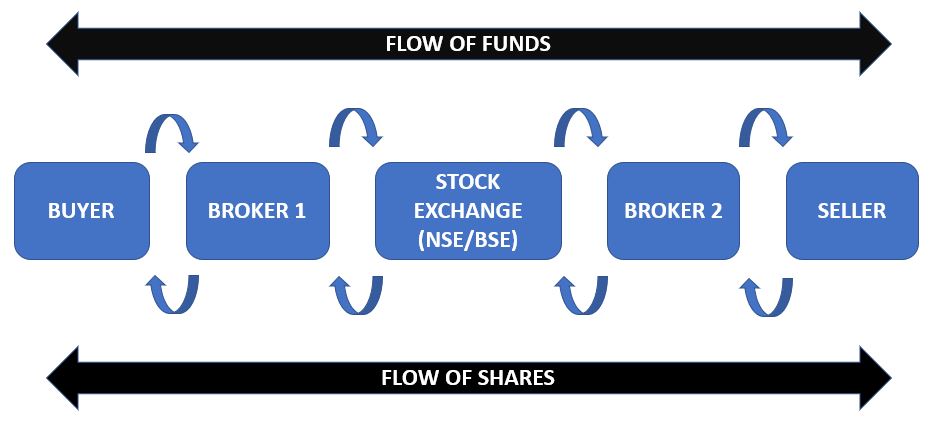
Meanwhile, the stock exchange also confirms the details of the buyers and the sellers of shares to ensure the parties don’t default.
It then facilitates the actual transfer of ownership of shares from sellers to buyers. This process is called the settlement cycle.
Earlier, it used to take weeks to settle stock trades. But now, this has been brought down to T+2 days.
For example
If you buy a stock today, the credit is given by end of the day.
The stock exchange also ensures that the trade of stocks is honored during the settlement.
If the settlement cycle doesn’t happen in T+2 days, the sanctity of the stock market is lost, because it means trades may not be upheld.
Stockbrokers identify their clients by a unique code assigned to an investor.
After the transaction is done by an investor, the stockbroker issues him/her a contract note which provides details of the transaction such as the time and date of the stock trade.
Apart from the purchase price of a stock, an investor is also supposed to pay brokerage fees, stamp duty, and securities transaction tax.
In the case of a sale transaction, these costs are reduced from the sale proceeds, and then the remaining amount is paid to the investor.
At the broker and stock exchange levels, there are multiple entities/parties involved in the communication chain like the brokerage order department, and exchange floor traders
Pricing of Shares in the Stock Market
Demand and supply for a stock play an important role in the changes in share prices as well as determining the price of a share.
Read here for more: Why do stock prices change
Just keep this small concept in your mind:
- When the demand for shares is more than supply, the price rises.
- When the demand for shares is less than supply, the price falls.
The Indian stock exchanges, BSE and NSE, have algorithms that determine the price of stocks on the basis of volume traded and these prices change pretty fast.
Happy Investing!
Disclaimer: The views expressed here are of the author and do not reflect those of Groww.
Mutual Fund Calculator
SIP Calculator PPF Calculator EMI Calculator Lumpsum Calculator PF Calculator Car Loan EMI Calculator Mutual Fund Return Calculator Gratuity Calculator Personal Loan EMI Calculator SWP Calculator HRA Calculator Home Loan EMI Calculator Sukanya Samriddhi Yojana Calculator CAGR Calculator SBI EMI Calculator FD Calculator GST Calculator SBI Personal Loan EMI Calculator RD Calculator HDFC EMI Calculator SBI Home Loan EMI Calculator NPS Calculator HDFC Personal Loan EMI Calculator SBI PPF Calculator Simple Interest Calculator HDFC Home Loan EMI Calculator SBI RD Calculator Compound Interest Calculator HDFC FD Calculator SBI SIP Calculator Interest Rate Calculator HDFC RD Calculator SBI FD Calculator
-

The 30-30-30-10 Budget: A Simple Guide to Financial Planning
Most financial experts agree that you should have a budget, but when you’re just getting started, that seems easier said than done. You might sit down to create your fir
-
Stock Market Performance & Business Impact: A Comprehensive Overview
The stock market affects individual businesses in an economy in many different ways. In the United States there are just under 4,000 publicly-traded stocks that can be divided broadly into
Stock investment skills
- Understanding the Stock Market: A Beginner's Guide to Tracking Market Activity
- Understanding the Stock Market: A Beginner's Guide to Stocks
- Stock Market Returns: Understanding Potential Growth & Risks
- Inflation's Impact on the Stock Market: A Comprehensive Analysis
- Understanding the Stock Market: A Beginner's Guide to Investing
- Understanding the Stock Market: A Beginner's Guide
- Understanding Stock Market Trends: A Beginner's Guide
- Understanding the Stock Market: A Beginner's Guide
- Understanding the Stock Market: A Beginner's Guide to Investing
-
 Understanding Cumulative Preferred Stock: A Comprehensive Guide
Owning cumulative preferred stock can provide you with a unique advantage as an investor. Here are the basics of cumulative preferred stock and how it can benefit you. Cumulative Preferred ...
-
 Understanding the Stock Market: A Beginner's Guide
Are you losing sleep wondering how the stock market works? Today's your lucky day. We'll impart all you need to know to become a market pro in no time flat.How do stocks work?What’s the one ...