
GOOG vs. GOOGL: Understanding Alphabet's Stock Tickers
There are two ticker symbols for Alphabet Inc. on the NASDAQ stock exchange: GOOG and GOOGL. There's little price difference between the two – as of June 11, 2021, it was $2,513.93 versus $2,430, respectively—still, what gives?
The short answer is a stock split, but a longer answer is an attempt by the co-founders of Google, Sergey Brin, and Larry Page, along with company chair Eric Schmidt, to retain as much control of the company as possible.
The two tickers represent two different share classes: A (GOOGL) and C (GOOG). The B shares are owned by insiders and don't trade on the public markets. It's those B shares that are still in the possession of Brin, Page, Schmidt and a few other directors.
In 2015, Google created a corporate structure under a new holding company and moniker called Alphabet.
Class Inequities
Google split its stock in April 2014, which created the A and C shares. Like any other one-for-one split, the number of shares doubled, and the price dropped in half. There is, however, one crucial difference. A shares receive one vote, C shares receive no votes, and B shares receive 10 votes. Anyone who held A shares at the time of the split received an equal number of C shares, but their voting power did not increase.
If you want a vote at the shareholders meeting, buy the A shares. They trade at a slight premium, which shows that the market does place some value on voting power. See the difference in the chart below:
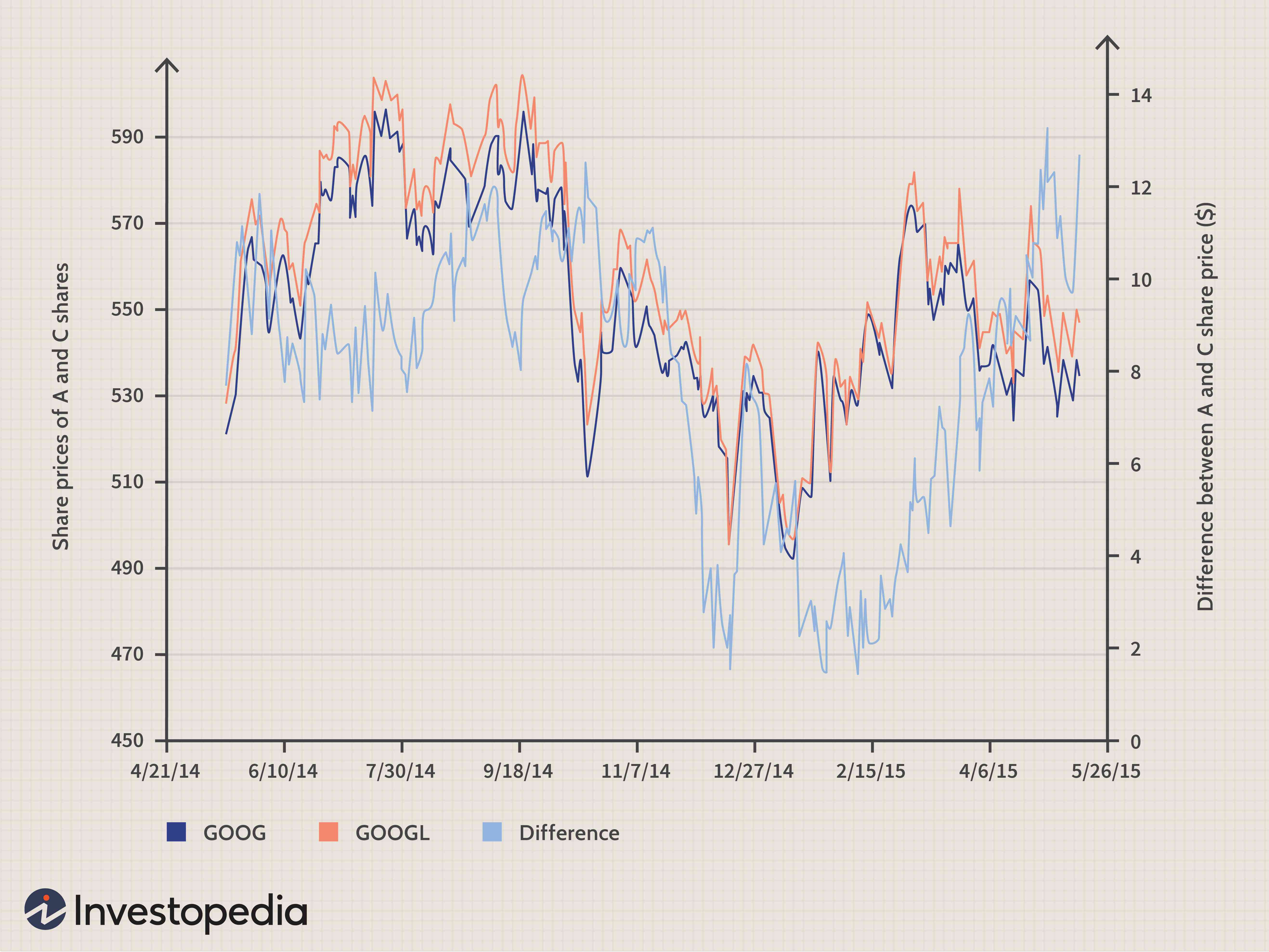
Note that the A shares consistently trade at a premium to the C shares. The difference is not large—perhaps 2% at most—but it is there. Google plans to continue issuing C shares to finance acquisitions and reward employees, so it's far from clear whether the market will price the C shares at larger discounts in coming years or simply bake in the current difference at a few percentage points.
Class C
There was one twist that came with owning the C shares. In part to quiet some stockholders' objections to the original split, Google promised to compensate C class shareholders if the price of their shares fell more than 1% below those of A shares a year after the split. While the difference isn't huge, it did exist.
What about the B shares? Brin and Page owned some 44.6 million B shares at the end of January 2015, but they announced a plan to sell some of those shares. In March 2015, there were some 52 million B shares outstanding, but Securities and Exchange Commission (SEC) filings showed that Brin converted a total of 48,998 B shares to A shares towards the end of April 2015, to be sold over a period of time. This somewhat reduced his voting control of the company.
The upshot is that Google allows investors to buy a very large share of its equity. Control of the company, though, not so much. Some investors are willing to accept that because Google, like Apple Inc. (AAPL) and Facebook Inc. (FB), is very much a bet on its founders and executives. Other companies may be like that as well, but, in Silicon Valley, it's particularly salient because so many firms are based on one person's big idea.
Not every investor will be so sanguine, however. There are surely many who see some of Google's more out-there ventures—the investment in SpaceX, driverless cars—as a distraction from its core search and advertising business that drives the company's revenues and reputation.
1:14What’s the Difference Between GOOG and GOOGL?
The Bottom Line
There's definitely a difference between the price of the two types of Google shares you can buy, though it is relatively small. If voting at the stockholders' meeting is important to you, aim for the A shares.
-

Top 4 Stocks to Watch During Earnings Season
Shah GilaniEarnings season usually kicks off officially with Alcoa Corp. (NYSE: AA) scheduled to report earnings after the market closes on July 15, but we all know things are already heating up.Ill
-
Options vs. Stocks: Understanding Risk & Reward
Options and stocks are two ways to put money to work in the market, but they offer sharply different profiles for risk and reward. Stocks offer high-risk, high-reward potential, while options take th
Stock trading
- Investing in Bank Stocks: A Comprehensive Guide for Beginners
- Understanding What Happens After You Buy Stock: A Beginner's Guide
- Investing in Nintendo: A Guide to Buying Shares
- Berkshire Hathaway Class B Stock: A Comprehensive Buying Guide
- Investing in Netflix: A Guide to Buying Shares
- Absa Share Investing: A Comprehensive Guide for Investors
- Stock Splits Explained: How They Work & Why Companies Do Them
- Understanding Broker Obligations: Do Brokers Have to Buy Your Shares?
- Investing in IPOs: A Comprehensive Guide for Beginners
-
 Stock Investing for Beginners: How Many Shares to Buy?
How Many Shares Should a Beginner Buy in Stocks? Each investor is unique, so there is no single answer as to how many shares of stock a beginner should buy. The amount of money you have to in...
-
 Understanding Consumer Psychology: Why We Buy Premium Chocolate
Image Credit: @jenni.heller/Twenty20 While it's true that many millennial shoppers want to spend ethically, it can get a little overwhelming pretty fast. No one really knows what we're ea...