
Accounting Explained: Understanding Financial Records & Reporting
Accounting is a term that describes the process of consolidating financial information to make it clear and understandable for all stakeholders and shareholdersShareholderA shareholder can be a person, company, or organization that holds stock(s) in a given company. A shareholder must own a minimum of one share in a company’s stock or mutual fund to make them a partial owner.. The main goal of accounting is to record and report a company’s financial transactions, financial performance, and cash flows.

Accounting standards improve the reliability of financial statements. The financial statements include the income statement, balance sheet, cash flow statement, and the statement of retained earningsStatement of Retained EarningsThe statement of retained earnings provides an overview of the changes in a company's retained earnings during a specific accounting cycle. It is structured as an equation, such that it opens with the retained earnings at the beginning of the reporting period, makes adjustments for items such as net income and dividends. The standardized reporting allows all stakeholders and shareholders to assess the performance of a business. Financial statements need to be transparent, reliable, and accurate.
Summary
- Accounting is a term that describes the process of consolidating financial information to make it clear and understandable for all stakeholders and shareholders.
- The main goal of accounting is to accurately record and report an organization’s financial performance.
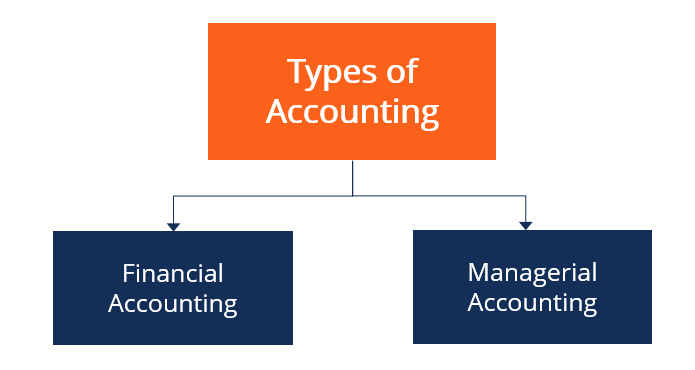
- Accounting can be classified into two categories – financial accounting and managerial accounting.
Importance of Accounting
1. Keeps a record of business transactions
Accounting is important, as it keeps a systematic record of the organization’s financial information. Up-to-date records help users compare current financial information to historical data. With full, consistent, and accurate records, it enables users to assess the performance of a company over a period of time.
2. Facilitates decision-making for management
Accounting is especially important for internal users of the organization. Internal users may include the people that plan, organize, and run companies. The management team needs accounting in making important decisions. Business decisions may range from deciding to pursue geographical expansion to, instead, improving operational efficiency.
3. Communicates results
Accounting helps to communicate company results to various users. Investors, lendersLenderA lender is defined as a business or financial institution that extends credit to companies and individuals, with the expectation that the full amount of, and other creditors are the primary external users of accounting information. Investors may be deciding to buy shares in the company, while lenders need to analyze their risk in deciding to lend. It is important for companies to establish credibility with these external users through relevant and reliable accounting information.
4. Meets legal requirements
Proper accounting helps organizations ensure accurate reporting of financial assets and liabilities. Tax authorities, such as the U.S. Internal Revenue Service (IRS) and the Canada Revenue Agency (CRA), use standardized accounting financial statements to assess a company’s declared gross revenue and net income. The system of accounting helps to ensure that a company’s financial statements are legally and accurately reported.
Types of Accounting
Accounting can be classified into two categories – financial accounting and managerial accounting.
1. Financial Accounting
Financial accounting involves the preparation of accurate financial statements. The focus of financial accounting is to measure the performance of a business as accurately as possible. While financial statements are for external use, they may also be for internal management use to help make decisions.
Accounting principles and standards, such as GAAP (Generally Accepted Accounting Principles)GAAPGAAP, Generally Accepted Accounting Principles, is a recognized set of rules and procedures that govern corporate accounting and financial, IFRS (International Financial Reporting Standards), or ASPE (Accounting Standards for Private Enterprises), are standards that are widely adopted in financial accounting. The accounting standards are important because they allow all stakeholders and shareholders to easily understand and interpret the reported financial statements from year to year.
2. Managerial Accounting
Managerial accounting analyzes the information gathered from financial accounting. It refers to the process of preparing reports about business operations. The reports serve to assist the management team to make tactical decisions.
Managerial accounting is a process that allows an enterprise to achieve maximum efficiency by reviewing financial accounting, deciding on the best following steps to take, and then broadcasting the required steps to all internal business managers.
An example of managerial accounting is cost accounting. Cost accounting focuses on a detailed break-up of costs for effective cost control. Managerial accounting is very important in the decision-making process.
Careers in Accounting
The role of an accountant is to responsibly report and interpret financial records. Small businesses may hire only one accountant. Large companies may employ an entire accounting department.
The broad range of the accounting profession can vary widely and may include roles from tax planning to audit accounting. Accountants may become certified with the CPA (Certified Public Accountant) designation. The four largest accounting firms include Deloitte, KPMG, PwC, and Ernst & Young.
Related Readings
CFI offers the Commercial Banking & Credit Analyst (CBCA)™Program Page - CBCAGet CFI's CBCA™ certification and become a Commercial Banking & Credit Analyst. Enroll and advance your career with our certification programs and courses. certification program for those looking to take their careers to the next level. To keep learning and developing your knowledge base, please explore the additional relevant resources below:
- Accounting Salary GuideAccounting Salary GuideIn this accounting salary guide, we give you the midpoint compensation figures for those employed both in public and private accounting. Accountants are responsible for examining financial statements to ensure accuracy and compliance with existing laws and regulations, handling tax-related tasks such as calculating the
- IFRS vs US GAAPIFRS vs. US GAAPThe IFRS vs US GAAP refers to two accounting standards and principles adhered to by countries in the world in relation to financial reporting
- Three Financial StatementsThree Financial StatementsThe three financial statements are the income statement, the balance sheet, and the statement of cash flows. These three core statements are
- Stakeholder vs. ShareholderStakeholder vs. ShareholderThe terms “stakeholder” and “shareholder” are often used interchangeably in the business environment. Looking closely at the meanings of stakeholder vs shareholder, there are key differences in usage. Generally, a shareholder is a stakeholder of the company while a stakeholder is not necessarily a shareholder.
-

Understanding Financial Crises: Causes, Impacts, and Examples
A financial crisis is defined as any situation where one or more significant financial assets – such as stocks, real estateReal EstateReal estate is real property that consists of land and impro
-

Financial Engineering: Principles, Applications & Career Paths
Financial engineering encompasses a broad, multidisciplinary field of study and practice that, essentially, applies an engineering approach and methodology to the world of finance. It integrates and u
Accounting
- Understanding Accounting: Its Role in Business Strategy
- Accounting Conservatism: Definition, Examples & Importance
- Understanding Accounting Income: A Key Financial Metric
- Understanding Accounting Methods: Cash vs. Accrual
- Understanding Financial Audits: A Comprehensive Guide
- Understanding Finance: A Comprehensive Overview
- Forensic Accounting: Investigating Fraud & Financial Crime | [Your Company Name]
- Understanding the Philosophy of Accounting: Principles & Concepts
- Bookkeeping: Definition, Importance & Benefits for Businesses
-
 Factset: Financial Data & Analytics Solutions for Investment Professionals
Factset Research Systems is a company that provides software and financial data solutions for investment professionals. The company offers a number of financial services, such as business advisory, da...
-
 Understanding Finance: A Comprehensive Overview of Key Concepts
Finance is defined as the management of money and includes activities such as investing, borrowing, lending, budgeting, saving, and forecasting. There are three main types of finance: (1) personalPers...