
Understanding Financial Crises: Causes, Impacts, and Examples
A financial crisis is defined as any situation where one or more significant financial assets – such as stocks, real estateReal EstateReal estate is real property that consists of land and improvements, which include buildings, fixtures, roads, structures, and utility systems. Property rights give a title of ownership to the land, improvements, and natural resources such as minerals, plants, animals, water, etc., or oil – suddenly (and usually unexpectedly) loses a substantial amount of their nominal value.
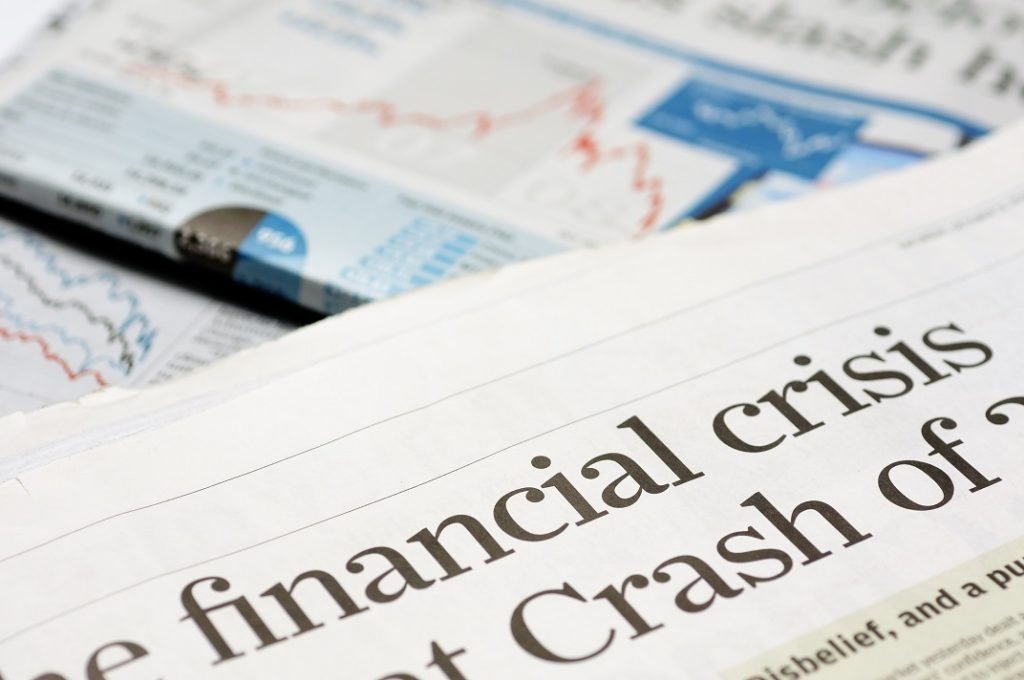
Common examples of a financial crisis include financial market crashesAsian Financial CrisisThe Asian Financial Crisis is a crisis caused by the collapse of the currency exchange rate and hot money bubble. It started in Thailand in July 1997 and – either widespread or within specific industries – housing market crashes and bank runs. A bank run happens when large numbers of bank depositors panic and seek to withdraw, all at once, all their funds on deposit with their bank.
In the United States, over the past couple of centuries, financial crises of one sort or another occur roughly every 25-30 years. Recent examples include the Global Financial Crisis of 2008 and the dot-com speculative bubble bursting around the turn of the century.
Summary
- A financial crisis is generally defined as any situation where significant financial assets – such as stocks or real estate – suddenly experience a sharp decline in value.
- They are often preceded by periods of economic boom and overextension of credit to borrowers.
- Economic recessions that follow a financial crisis are usually significantly more severe than recessions that are not preceded by a specific financial crisis.
Understanding Financial Crises
While various financial crises differ in both their nature and their severity, there are some common conditions that typically accompany such crises.
One is that a financial crisis is often preceded by, accompanied by, or followed by periods where there are widespread credit problems. The 2008 Global Financial Crisis was no exception. It was largely precipitated by a massive boom in subprime mortgage lending, which created a large stack of mortgage loans that were virtually doomed from the start to end up in default.
Subprime mortgage loans are loans granted to homebuyers with relatively lower credit scoresCredit ScoreA credit score is a number representative of an individual's financial and credit standing and ability to obtain financial assistance from lenders. Lenders use the credit score to assess a prospective borrower’s qualification for a loan and the specific terms of the loan. – in short, large loans given to people who are likely to encounter difficulty making the loan payments.
According to several studies of financial crises, the rapid expansion of available credit, followed by a shorter period of sharp credit tightening, frequently provides an early warning indication of a coming financial crisis. Financial crises are nearly invariably followed by a period of severe credit tightening, where lenders seek to curb their risk exposure by only extending credit to borrowers with stellar credit ratings.
Another fact about financial crises is that although they don’t happen very frequently, they do seem to occur with relative regularity. Over the past century and a half or so, the United States has experienced on average, some type of financial crisis about once every 25 to 30 years.
However, the most recent history shows financial crises arising a bit more often. The U.S., for example, suffered a major stock market meltdown in 1987, then the dot-com bubble in the early 2000s, and then the 2008 Global Financial Crisis.
Financial crises are often difficult to foresee, and one reason is the fact that the triggering cause may be a relatively small event or series of events. For example, the dot-com bubble that happened around 2000-2002, while it was cataclysmic for many investors in the rapidly growing tech industry, initially involved a relatively small proportion of the overall stock market. Despite the failure of numerous companies, several dot-com companies, such as Amazon and Google, enjoyed massive growth in the ensuing years.
Finally, a financial crisis commonly leads to a notably severe period of overall economic recession. An economy’s gross domestic product (GDP)Gross Domestic Product (GDP)Gross domestic product (GDP) is a standard measure of a country’s economic health and an indicator of its standard of living. Also, GDP can be used to compare the productivity levels between different countries. typically declines by up to 50% more during a recession that follows a financial crisis, compared to a “normal” recession that is not preceded or ushered in by a particular crisis.
The Next Financial Crisis?
The world may be on the verge of another major, global financial crisis in the wake of the Covid-19 pandemic (if we’re not already in one). However, it’s difficult to see, as of mid-2020, what the ultimate economic consequences of the virus and the widespread quarantine lockdowns may be. It is, in part, because many lenders are currently practicing credit forbearance – that is, not pressing debtors who are falling behind in making their loan payments.
Therefore, the true level of financial distress experienced by many companies and individuals may not have reached its full effect. Many market analysts warn that, thus far, we’ve only seen the tip of the iceberg in terms of both corporate and personal bankruptcies – that there are likely many more to come.
Secondly, governments are doing everything they can think of to prop up their economies. However, while most governments are pledging to do “whatever it takes,” their extraordinary efforts cannot be sustained forever. Although interest rates remain, for the moment, at record-low levels, there are already signs of lenders in the U.S. beginning to tighten up on credit. A severe credit crunch in the not-too-distant future is certainly not out of the question.
Related Readings
CFI is the official provider of the global Commercial Banking & Credit Analyst (CBCA)™Program Page - CBCAGet CFI's CBCA™ certification and become a Commercial Banking & Credit Analyst. Enroll and advance your career with our certification programs and courses. certification program, designed to help anyone become a world-class financial analyst. To keep advancing your career, the additional CFI resources below will be useful:
- Bank RunBank RunA bank run occurs when customers withdraw all their money simultaneously from their deposit accounts with a banking institution for fear that the bank
- Economic CollapseEconomic CollapseEconomic collapse refers to a period of national or regional economic breakdown where the economy is in distress for a long period, which can
- Dotcom BubbleDotcom BubbleThe dotcom bubble is a stock market bubble that was caused by speculation in dotcom or internet-based businesses from 1995 to 2000.
- The Economic Crash of 2020The Economic Crash of 2020The economic crash of 2020 was precipitated by the COVID-19 pandemic. The sudden appearance of the virus, its rapid spread, and uncertainty about how
-

Financial Analysis: A Comprehensive Guide for Professionals
Financial analysis involves using financial dataFinancial DataWhere to find data for financial analysts - Bloomberg, CapitalIQ, PitchBook, EDGAR, SEDAR and more sources of financial data for financial
-
YoY Analysis: Understanding Year-over-Year Growth & Financial Insights
YoY stands for Year over Year and is a type of financial analysisAnalysis of Financial StatementsHow to perform Analysis of Financial Statements. This guide will teach you to perform financial stateme
finance
- Understanding Financial Crises: Causes, Effects, and Prevention
- Understanding the 2008-2009 Global Financial Crisis: Causes & Impact
- Understanding the Asian Financial Crisis: Causes, Impact, and Lessons Learned
- Understanding Auditors: Roles, Responsibilities & Audit Processes
- EBITDARM Explained: A Comprehensive Guide to Financial Analysis
- Eurocurrency Explained: What It Is & How It Works
- Factset: Financial Data & Analytics Solutions for Investment Professionals
- Understanding Finance: A Comprehensive Overview of Key Concepts
- Financial Engineering: Principles, Applications & Career Paths
-
 Understanding Guarantees: Protecting Lenders and Borrowers
A guarantee is a legal promise made by a third party (guarantor) to cover a borrower’s debt or other types of liability in case of the borrower’s defaultDebt DefaultA debt default happens ...
-
 MiFID II Explained: A Comprehensive Guide for Investors
MiFID II is the revision of the Markets in Financial Instruments Directive (MiFID), originally published in 2004. It is the foundation of financial legislation for the European UnionEconomic UnionAn e...