
Accounting Profit vs. Economic Profit: Understanding the Difference
Accounting profit is a company’s net earnings on its income statement,Income StatementThe Income Statement is one of a company's core financial statements that shows their profit and loss over a period of time. The profit or whereas economic profit is the value of cash flow that’s generated above all other opportunity costsOpportunity CostOpportunity cost is one of the key concepts in the study of economics and is prevalent throughout various decision-making processes. The. This guide will help you thoroughly understand accounting profit vs economic profit, and while they may sound similar, they are actually quite different.
What is Accounting Profit?
Accounting profit is the net incomeNet IncomeNet Income is a key line item, not only in the income statement, but in all three core financial statements. While it is arrived at through that a company generates, found at the bottom of its income statement. The figure includes all revenue the company generates and deducts all expenses to arrive at the bottom line.
Common sources of revenue include the sale of goods and services, receipt of dividends or interest, and rental income, to name a few.
Common types of expenses include the cost of goods sold (COGS)Cost of Goods Sold (COGS)Cost of Goods Sold (COGS) measures the “direct cost” incurred in the production of any goods or services. It includes material cost, direct, marketing and advertising expenses, salaries and benefits, travel, entertainment, sales commissions, rent, depreciation and amortization, interest, and taxes.
Learn more in CFI’s Free Accounting Crash Course.
Accounting Profit Example
Below is an example showing Amazon’s 2017 consolidated statement of operations (also known as a statement of profit and loss or income statement).
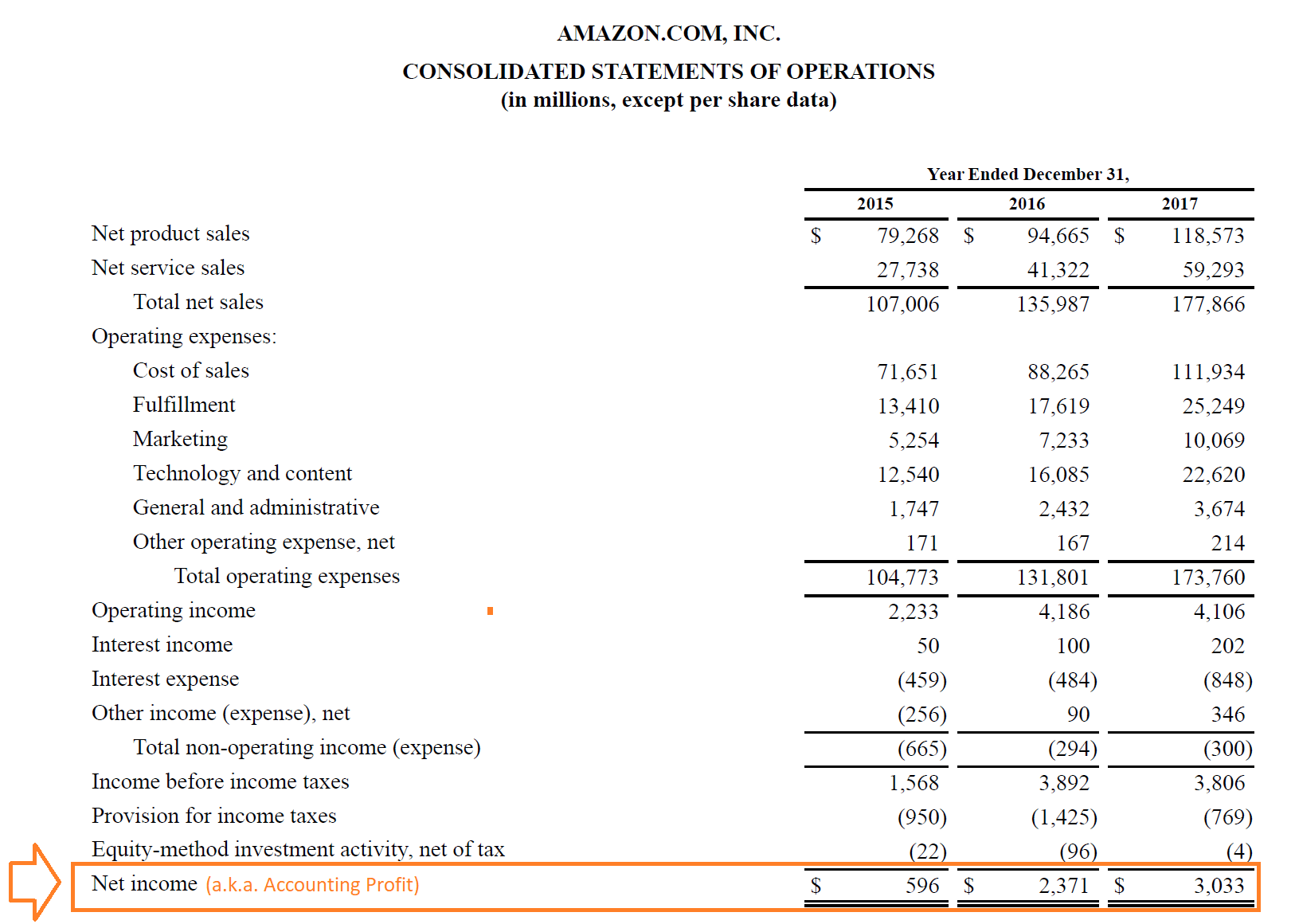
In the example, you can clearly see how the statement starts with revenue (sales) and then deducts all expenses to arrive at net income (a.k.a. accounting profit). In 2017, the figure was $3.0 billion for Amazon.
Learn more in CFI’s Financial Analysis Course.
Economic Profit
Economic profit differs quite significantly from accounting profit. Instead of looking at net income, economic profit considers a company’s free cash flow, which is the actual amount of cash generated by a business. Due to accrual accounting principles, the figure is often materially different from accounting profit.
Furthermore, once the company’s free cash flow is calculated, it must then take into account the opportunity cost that managers of the business can expect to earn on comparable alternatives.
Learn more in CFI’s Economic Value Added GuideEconomic Value Added (EVA)Economic Value Added (EVA) shows that real value creation occurs when projects earn rates of return above their cost of capital and this increases value for shareholders. The Residual Income technique that serves as an indicator of the profitability on the premise that real profitability occurs when wealth is.
Economic Profit Example
For example, imagine a company has two choices: Invest $1,000 into a new t-shirt product line (Project #1) or invest $1,000 into a new sock product line (Project #2). Project #1 will have revenues of $200 and costs of $125, while Project #2 will have revenues of $300 and costs of $280.
Below is an example (simplified) calculation of how to calculate the economic profit of each project.
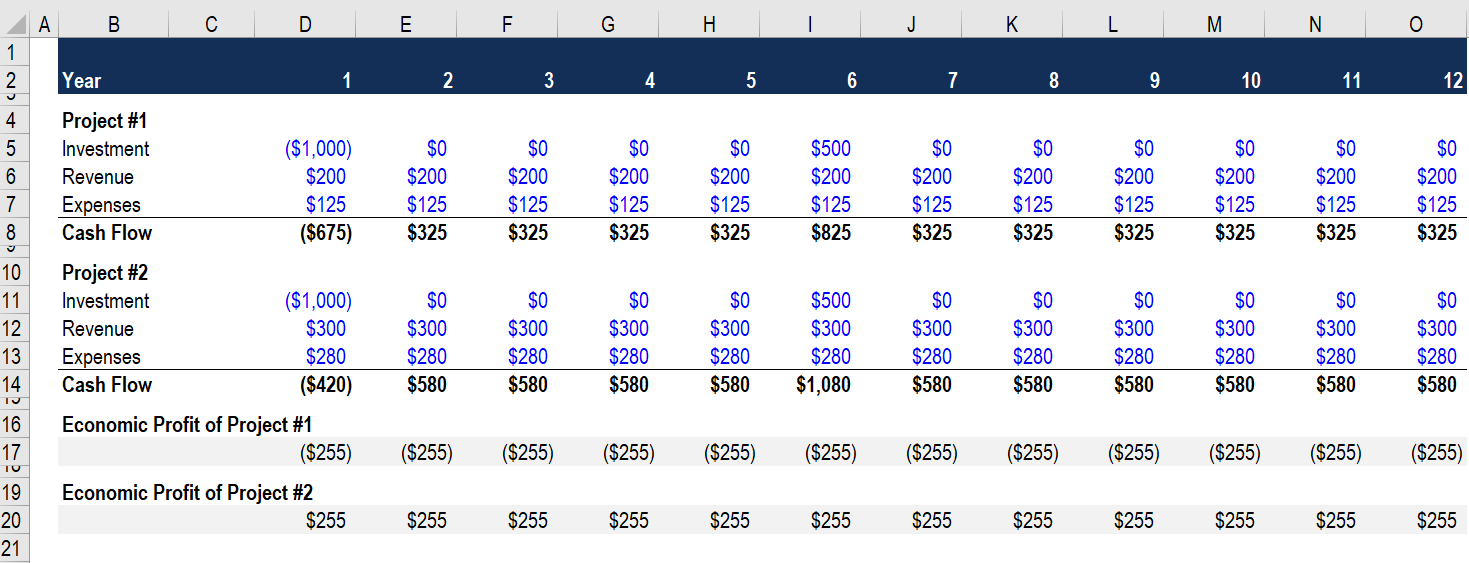
The first step is to calculate the cash flow of each project. For a detailed explanation of how to perform the calculation, see CFI’s Ultimate Cash Flow GuideThe Ultimate Cash Flow Guide (EBITDA, CF, FCF, FCFE, FCFF)This is the ultimate Cash Flow Guide to understand the differences between EBITDA, Cash Flow from Operations (CF), Free Cash Flow (FCF), Unlevered Free Cash Flow or Free Cash Flow to Firm (FCFF). Learn the formula to calculate each and derive them from an income statement, balance sheet or statement of cash flows.
The next step is to take the difference between the cash flows of each project and compare them to see which generates more economic profit.
As you can see, Project #2 generates a positive economic profit, relative to Project #1. Learn more in CFI’s Financial Modeling Courses.
Additional Resources
Thank you for reading this guide to understanding accounting profit vs economic profit. CFI’s mission is to help anyone become a world-class financial analyst.Become a Certified Financial Modeling & Valuation Analyst (FMVA)®CFI's Financial Modeling and Valuation Analyst (FMVA)® certification will help you gain the confidence you need in your finance career. Enroll today! These additional CFI resources will be helpful:
- Depreciation MethodsDepreciation MethodsThe most common types of depreciation methods include straight-line, double declining balance, units of production, and sum of years digits.
- DividendDividendA dividend is a share of profits and retained earnings that a company pays out to its shareholders. When a company generates a profit and accumulates retained earnings, those earnings can be either reinvested in the business or paid out to shareholders as a dividend.
- Financial Accounting TheoryFinancial Accounting TheoryFinancial Accounting Theory explains the why behind accounting - the reasons why transactions are reported in certain ways. This guide will
- Free Cash FlowFree Cash Flow (FCF)Free Cash Flow (FCF) measures a company’s ability to produce what investors care most about: cash that's available be distributed in a discretionary way.
-

Understanding Accounting Income: A Key Financial Metric
Accounting income is the profit a company retains after paying off all relevant expenses from sales revenue earned. It is synonymous with net incomeNet IncomeNet Income is a key line item, not only in
-

Understanding Accounting Methods: Cash vs. Accrual
An accounting method refers to a set of rules that a company adheres to when keeping its financial records and reporting financial transactions. The transactions are recorded in a manner that accurate
Accounting
- Top 15 Accounting Challenges & Solutions for 2021
- Profit vs. Cash Flow: Understanding the Key Difference
- Accounting Profit Explained: Calculation & Importance
- Understanding Accounting Transactions: A Comprehensive Guide
- Understanding Normal Profit: A Key Concept in Economics
- Cash Accounting Explained: A Simple Guide for Businesses
- Accounting Cost vs. Economic Cost: A Comprehensive Guide
- Accounting Ratios: A Beginner's Guide to Business Analysis
- Economic Profit vs. Accounting Profit: Understanding the Difference
-
 Accounting Explained: Understanding Financial Records & Reporting
Accounting is a term that describes the process of consolidating financial information to make it clear and understandable for all stakeholders and shareholdersShareholderA shareholder can be a person...
-
 Accounting Forums: Connect, Learn & Grow - A Comprehensive Overview
There are several accounting forums on the internet that offer both students and professionals from different locations the opportunity to connect and reach out to one another. Businesses are also tak...