
Fixed vs. Variable Costs: A Managerial Accounting Guide
Cost is something that can be classified in several ways, depending on its nature. One of the most popular methods is classification according to fixed costs and variable costs. Fixed costs do not change with increases/decreases in units of production volume, while variable costs fluctuate with the volume of units of production. Fixed and variable costs are key terms in managerial accounting, used in various forms of analysis of financial statementsAnalysis of Financial StatementsHow to perform Analysis of Financial Statements. This guide will teach you to perform financial statement analysis of the income statement,.
The first illustration below shows an example of variable costs, where costs increase directly with the number of units produced.
In the second illustration, costs are fixed and do not change with the number of units produced.
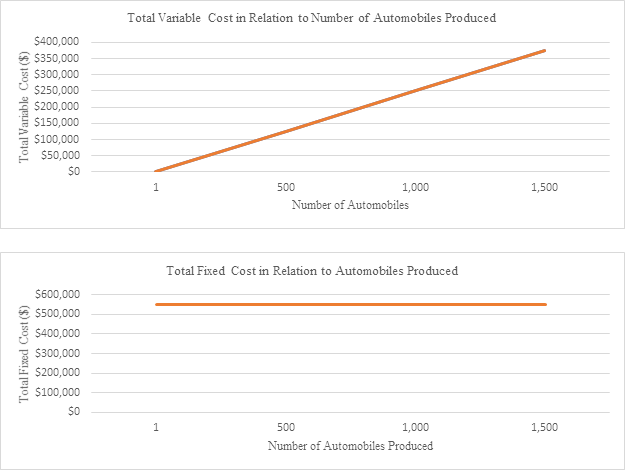
Graphically, we can see that fixed costs are not related to the volume of automobiles produced by the company. No matter how high or low sales are, fixed costs remain the same.
On the other hand, variable costs show a linear relationship between the volume produced and total variable costs.
Launch our financial analysis courses to learn more!
Financial Accounting vs. Managerial Accounting
While financial accounting is used to prepare financial statements that benefit external users, managerial accounting is used to provide useful information to people within an organization, mainly management, to help them make more informed business decisions.
A clear comparison can be seen in the following table:
Variable Costs vs. Fixed Costs
The table below summarizes the key difference between fixed and variable costs:
Example 1 – Fixed vs. Variable Costs
The following table shows various costs incurred by a manufacturing company:
Example 2
Let’s say that XYZ Company manufactures automobiles and it costs the company $250 to make one steering wheel. In order to run its business, the company incurs $550,000 in rental fees for its factory space.
Let’s take a closer look at the company’s costs depending on its level of production.
Launch our financial analysis courses to learn more!
Applications of Variable and Fixed Costs
Classifying costs as either variable or fixed is important for companies because by doing so, companies can assemble a financial statement called the Statement/Schedule of Cost of Goods Manufactured (COGM)Cost of Goods Manufactured (COGM)Cost of Goods Manufactured (COGM) is a term used in managerial accounting that refers to a schedule or statement that shows the total. This is a schedule that is used to calculate the cost of producing the company’s products for a set period of time.
The COGM is then transferred to the finished goods inventory account and used in calculating the Cost of Goods Sold (COGS)AccountingOur Accounting guides and resources are self-study guides to learn accounting and finance at your own pace. Browse hundreds of guides and resources. on the income statement.
By analyzing variable and fixed cost prices, companies can make better decisions on whether to invest in Property, Plant, and Equipment (PPE)PP&E (Property, Plant and Equipment)PP&E (Property, Plant, and Equipment) is one of the core non-current assets found on the balance sheet. PP&E is impacted by Capex,. For example, if a company incurs high direct labor costs in manufacturing their products, they may look to invest in machinery, which will reduce these high variable costs in exchange for more stable and known fixed costs.
This decision should be made with volume capacity and volatility in mind as trade-offs occur at different levels of production. High volumes with low volatility favor machine investment, while low volumes and high volatility favor the use of variable labor costs.
If sales were low, even though unit labor costs remain high, it would be wiser not to invest in machinery and incur high fixed costs because the high unit labor costs would still be lower than the machinery’s overall fixed cost.
The volume of sales at which the fixed costs or variable costs incurred would be equal to each other is called the indifference point. Finally, variable and fixed costs are also key ingredients to various costing methods employed by companies, including job order costing, process costing, and activity-based costing.
Launch our financial analysis courses to learn more!
More Accounting Resources
CFI offers the Financial Modeling & Valuation Analyst (FMVA)®Become a Certified Financial Modeling & Valuation Analyst (FMVA)®CFI's Financial Modeling and Valuation Analyst (FMVA)® certification will help you gain the confidence you need in your finance career. Enroll today! certification program for those looking to take their careers to the next level. To keep learning and advancing your career, the following resources will be helpful:
- Analysis of Financial StatementsAnalysis of Financial StatementsHow to perform Analysis of Financial Statements. This guide will teach you to perform financial statement analysis of the income statement,
- Guide to Financial ModelingFree Financial Modeling GuideThis financial modeling guide covers Excel tips and best practices on assumptions, drivers, forecasting, linking the three statements, DCF analysis, more
- The Analyst TrifectaThe Analyst Trifecta® GuideThe ultimate guide on how to be a world-class financial analyst. Do you want to be a world-class financial analyst? Are you looking to follow industry-leading best practices and stand out from the crowd? Our process, called The Analyst Trifecta® consists of analytics, presentation & soft skills
- Advanced Excel FormulasAdvanced Excel Formulas Must KnowThese advanced Excel formulas are critical to know and will take your financial analysis skills to the next level. Download our free Excel ebook!
-

Dividend Capture Strategy: Benefits, Costs & How It Works
Using the dividend capture strategy has become more and more popular in the stock market today. It is being utilized as a way to boost returns and minimize risk. While it does present you with s
-
Fixed vs. Variable Annuities: A Comprehensive Comparison
Both fixed and variable annuities can provide you with some benefits when planning for your retirement. These tools each have some unique features for you to consider. Interest Rate One of the b
Accounting
- Understanding Fixed Costs: Definition, Examples & Importance
- Understanding Variable Costs: Definition & Examples
- Understanding Variable Overhead Costs: A Comprehensive Guide
- Forex Spreads: Fixed vs. Variable - Understanding the Difference
- Day Trading Taxes & Costs: A Comprehensive Guide for Traders
- Indexed Annuities vs. Fixed & Variable: A Comprehensive Comparison
- Variable Costs Explained: Definition, Examples & Impact
- Fixed vs. Variable Costs: Understanding the Difference for Businesses
- Understanding Variable Costs: Definition, Examples & Reduction Strategies
-
Reduce Variable Annuity Costs: A Guide to Lower Fees
Variable annuities can be a good way to potentially earn a steady income during your retirement years. At the same time, they can also get very costly. Here are a few ways to lower costs for a v...
-
Variable Annuities: Benefits & Risks - A Comprehensive Guide
Variable annuities have become a popular product to use in retirement planning. This type of investment has several advantages and disadvantages that you will want to become aware of. Here are s...