
Understanding Form 1040-EZ: History & Replacement
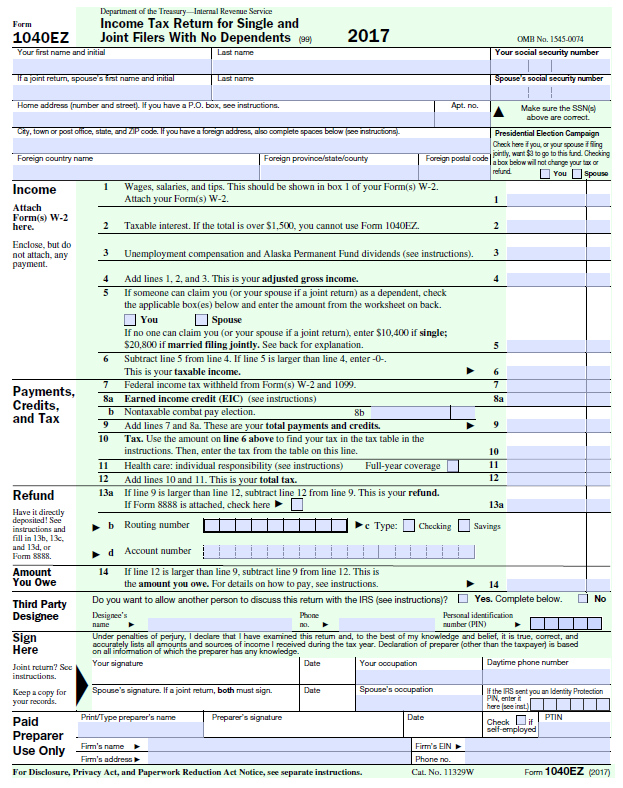
Form 1040-EZ is a federal income tax form that was offered by the Internal Revenue Service (IRS) up through tax year 2017. Many American taxpayers used the form to file and report their federal income taxes for the year. Form 1040-EZ was discontinued, along with Form 1040-A, in 2018. Beginning in 2019 (filing taxes for tax year 2018), all U.S. taxpayers are required to file some version of Form 1040.
Why Use Form 1040-EZ?
A large segment of the American population was qualified to use Form 1040-EZ before its discontinuation by the IRS. Using 1040-EZ took significantly less time, as compared to using Form 1040 or Form 1040-A, both of which are quite a bit longer and more detailed than the 1040-EZ. Form 1040-EZ was best suited for individuals with no dependents, minimal interest income, and whose taxable income was less than $100,000.
Who was Eligible to File Form 1040-EZ?
A person was eligible to file their taxes using Form 1040-EZ if they met all of the conditions listed below:
- A citizen of the United States or a resident alien.
- Filing status of single or married filing jointly.
- Taxable income less than $100,000, and interest income less than $400.
- Income only derived from the following sources: grants, scholarships, wages, unemployment compensation, interest, or permanent fund dividend.
- Taxpayer 65 years old or younger.
- Not itemizing deductions.
Tips for Preparing Tax Filing Forms, including 1040-EZ
1. Render name and Social Security number correctly
After providing all the information on their tax form, the last thing an individual should do is double-check the information and ensure he spelled their name and rendered their Social SecuritySocial SecuritySocial Security is a US federal government program that provides social insurance and benefits to people with inadequate or no income. The first Social number correctly. Why? The IRS takes longer to look through the form and process tax returns where the name and SSN don’t match those they have in their records.
Delayed processing often causes a delay in the issuance of tax refunds. Individuals who wish to change their SSN or name should visit the social security administration before filing their tax returns.
2. Gather all W-2 forms
There should be a Form W-2 from each employer that an individual worked for that showed wage incomeRemunerationRemuneration is any type of compensation or payment that an individual or employee receives as payment for their services or the work that they do for an organization or company. It includes whatever base salary an employee receives, along with other types of payment that accrue during the course of their work, which, as well as tax withholding. Form W-2 is usually available to be collected towards the end of every January.
Every W-2 is needed before tax returns can be filed. The form helps the IRS calculate and add up withholding and wages to be compared to the taxpayer’s reported totals.
3. Gather all 1099-INT forms
Form 1099-INTs are prepared and used by banks or credit unions. It reports the total amount of interest incomeInterest IncomeInterest income is the amount paid to an entity for lending its money or letting another entity use its funds. On a larger scale, interest income is the amount earned by an investor’s money that he places in an investment or project. an individual earned over the year. The form is also available for collection towards the end of January.
If a person does not receive a Form 1099-INT, it means they did not earn more than $10 in interest from the institution issuing the form.
4. Collect Form 1099-G
Individuals who received unemployment benefits during the year should provide Form 1099-G. State agencies use the form to report the total amount of unemployment benefits received by an individual.
5. Understand itemized deductions vs. standard deductions
All taxpayers are eligible for the standard deduction, a set amount that reduces their taxable income. As of 2019, the standard deduction for single filers is $12,200, and for married couples filing jointly, $24,400.
Instead of taking the standard deduction, taxpayers can choose to itemize their deductions – that is, list tax-deductible expenses. With the large increase in the standard deduction allowance (the standard deduction was nearly doubled as part of the Trump tax bill), nearly all taxpayers will fare better just taking the standard deduction, as opposed to itemizing. One possible exception might be individuals who own their own business or who are self-employed, and who have extensive eligible deductions to take.
Final Word
Part of the process of filing your taxes involves making sure that you complete all the necessary tax forms. In the U.S., additional forms besides the basic Form 1040 are called “schedules.” Schedules are used for reporting non-standard income (such as gambling income), claiming certain tax credits, or reporting income earned from a foreign source.
Related Readings
Thank you for reading CFI’s explanation of U.S. federal Income tax Form 1040-EZ. CFI is the official provider of the Financial Modeling & Valuation Analyst (FMVA)®Become a Certified Financial Modeling & Valuation Analyst (FMVA)®CFI's Financial Modeling and Valuation Analyst (FMVA)® certification will help you gain the confidence you need in your finance career. Enroll today! certification program, designed to transform anyone into a world-class financial analyst.
To keep learning and developing your knowledge of financial analysis, we highly recommend the additional CFI resources listed below:
- Accounting for Income TaxesAccounting For Income TaxesIncome taxes and their accounting is a key area of corporate finance. There are several objectives in accounting for income taxes and optimizing a company's valuation.
- How to Use the IRS.gov WebsiteHow to Use the IRS.gov WebsiteIRS.gov is the official website of the Internal Revenue Service (IRS), the United States’ tax collection agency. The website is used by businesses and
- Schedule ASchedule ASchedule A is an income tax form that is used in the United States to declare itemized deductions.It is attached to Form 1040 for taxpayers that pay annual income taxes. Taxpayers can choose to claim either a standard tax return deduction or itemize their qualifying deductions line by line.
- Tax ShelterTax ShelterA tax shelter is a financial vehicle that an individual can use to help them lower their tax obligation and, thus, keep more of their money. It is a legal way for individuals to “stash” their money and avoid getting it taxed.
-
Understanding Form 1040-EZ: History & Replacement
Form 1040-EZ is a federal income tax form that was offered by the Internal Revenue Service (IRS) up through tax year 2017. Many American taxpayers used the form to file and report their federal income
-

Basic Attention Token (BAT): A Decentralized Advertising Revolution
Advertising is one of the most critical revenue models for any online business, but current centralized models for the $330 billion a year industry are inefficient. The Basic Attention Token is crypto
Accounting
- Understanding Proxy Season: Shareholder Meetings & Key Dates
- Understanding the W-9 Form for Insurance: A Comprehensive Guide
- Understanding Auctions: A Comprehensive Guide
- Understanding Value Reporting Forms for Businesses
- Broker-Dealer Explained: Roles, Differences & How They Serve Clients
- Understanding 1099 Forms: What They Are & Why You Need Them
- Hyperledger: Understanding the Open Blockchain Framework
- Nexo: Crypto Lending & CeFi Explained | Secure Loans with Crypto
- Understanding Trustafarians: Origins, Lifestyle & Cultural Impact
-
Understanding IRS Form 8606: Reporting Non-Deductible IRA Contributions
Form 8606 is a US Internal Revenue Service tax form used to report non-deductible contributions to your individual retirement account (IRA). The IRA is a private account that allows you to save ...
-
Tax Forms Checklist: Essential Documents for Federal & State Filing
Don’t look now, but Tax Day is right around the corner. As you start getting ready to file your federal and perhaps also state income tax returns, here are a few of the tax forms you may need to have ...