
Understanding Schedule K-1: A Comprehensive Guide
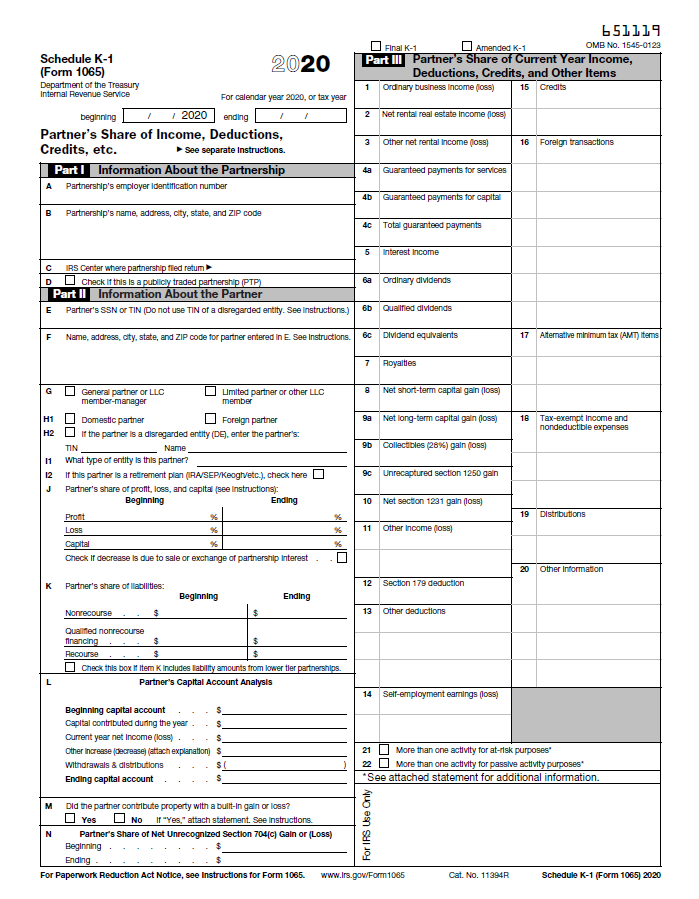
Schedule K-1 is an Internal Revenue Service (IRS) tax form used for business partnershipsPartnershipA partnership is a type of business where two or more people establish and run a business together. There are three main types of partnerships: GP, LP, LLP to report each partner’s income, deductions, and credit from the partnership for the tax year. The IRS is the United States federal agency responsible for taxes. The IRS’s Canadian equivalent is the Canadian Revenue Agency (CRA), and the Canadian equivalent of Schedule K-1 is the T5013.
Summary
- Schedule K-1 is an IRS tax form used by partnerships to report income, deductions, and credit of their partners. The Canadian equivalent of Schedule K-1 is the T5013.
- K-1 splits partnership earnings so that earnings can be taxed at an individual income tax rate instead of the corporate tax rate.
- The three variations of Schedule K-1 forms for different users are Form 1065, Form 1041, and Form 1120-S
How Does Schedule K-1 Work?
Partnerships are categorized as “pass-through entities,” meaning that partners can shift the business’ tax liability to the individual partners themselves. Instead of paying corporate taxCorporate vs Personal Income TaxIn this article, we will discuss corporate vs personal income tax. Corporate tax is an expense of a business (cash outflow) levied by the government on business earnings, such earnings pass through to the partners, who then pay personal income tax on their claim.
Schedule K-1 reports the division of earnings to each partner for taxation purposes and must be completed individually. Division of earnings is decided between the partners themselves and is commonly based on each partner’s contribution or pre-existing partnership agreements. If partners choose to reinvest their earnings back into the business, no earnings will be reported on the K-1.
If the partnership makes a loss over the tax year, partners can indicate the loss on the K-1 and carry the amount forward until a year of profit for a future tax deduction. Consecutive years of net losses can accumulate and be used to apply against future income.
For example, a partnership makes losses of $60,000 each year for the first two years of operations. In the third year, it makes a profit of $150,000. Therefore, the partnership makes no tax payments on the first two years of losses. For the positive year (third year), the partnership is taxed on [$150,000 – ($60,000 x 2)] = $30,000. As mentioned, the earnings amount is then split between the partners and taxed at their individual income tax brackets.
Who Files for Schedule K-1?
The three Schedule K-1 forms for different users are:
1. Form 1065 (Partnerships)
Form 1065 encompasses all types of partnerships, including general partnerships, limited partnerships (LP), and limited liability partnerships (LLP). Certain limited liability corporations (LLC)Limited Liability Company (LLC)A limited liability company (LLC) is a business structure for private companies in the United States, one that combines aspects of partnerships and corp with multiple members may be taxed as a partnership using the form.
2. Form 1041 (Beneficiaries of Trusts and Estates)
Beneficiaries who inherit income-producing trusts and estates must file through Form 1041.
3. Form 1120-S (S Corporations)
Form 1120-S is reserved for S Corporations – domestic corporations with less than 100 shareholders and only one class of stock. Shareholders of S corporationsS Corporation (S Subchapter)An S Corporation (S Corp) is a closely held corporation (Limited Liability Company (LLC), partnership, or C Corporation) that is treated as a are taxed as partners.
Related Readings
CFI is the official provider of the Commercial Banking & Credit Analyst (CBCA)™Program Page - CBCAGet CFI's CBCA™ certification and become a Commercial Banking & Credit Analyst. Enroll and advance your career with our certification programs and courses. certification program, designed to transform anyone into a world-class financial analyst.
In order to help you become a world-class financial analyst and advance your career to your fullest potential, the additional resources below will be beneficial:
- Accounting for Income TaxesAccounting For Income TaxesIncome taxes and their accounting is a key area of corporate finance. There are several objectives in accounting for income taxes and optimizing a company's valuation.
- Double TaxationDouble TaxationDouble taxation is a situation associated with how corporate and individual income is taxed and is therefore susceptible to being taxed twice.
- Limited Liability Partnerships (LLPs)Limited Liability Partnerships (LLPs)Limited Liability Partnerships (LLPs) are a corporate business structure that enables entrepreneurs, professionals, and enterprises to provide services via
- Types of BusinessesTypes of BusinessesThere are four main types of businesses to choose when forming a company: sole proprietorships, partnerships, limited liability companies, and corporations.
-

Understanding Tax Basis: A Comprehensive Guide for Businesses
All businesses have assets. For very small businesses, those assets may be office equipment. For large companie
-

Accelerated Dividends: Understanding Early Dividend Payments
An accelerated dividend is a dividend that is paid out ahead of a change in the way the dividends are treated, such as a change in the tax rateCapital Gains TaxCapital gains tax is a tax imposed on ca
Accounting
- Franchise Tax Explained: What It Is & Who Pays
- Understanding Income Tax: A Comprehensive Guide for Individuals & Businesses
- Understanding Taxation: A Comprehensive Guide to Government Revenue
- Progressive Tax Explained: How It Works & Examples
- Regressive Taxes: Definition, Examples & Impact on Income Inequality
- Schedule C: Understanding Profit & Loss for Sole Proprietors
- Tax Depreciation Explained: A Comprehensive Guide for Taxpayers
- IRA Explained: Your Guide to Individual Retirement Accounts & Tax Benefits
- Understanding Regressive Taxes: Definition & Examples
-
 Deemed Dividends: Understanding Tax Implications for Investors
What Is a Deemed Dividend? A deemed dividend is a tax instrument used by publicly traded corporations as a means of shifting tax liability from shareholders during the sale of company stock. ...
-
 Understanding 403(a) Annuities: A Guide to Tax-Deferred Retirement Savings
Retirement plans come in a variety of accounts recognized by the IRS. One such account is a 403a annuity that is a company-sponsored retirement plan. These plans are tax deferred, with the investment ...