
Schedule C: Understanding Profit & Loss for Sole Proprietors
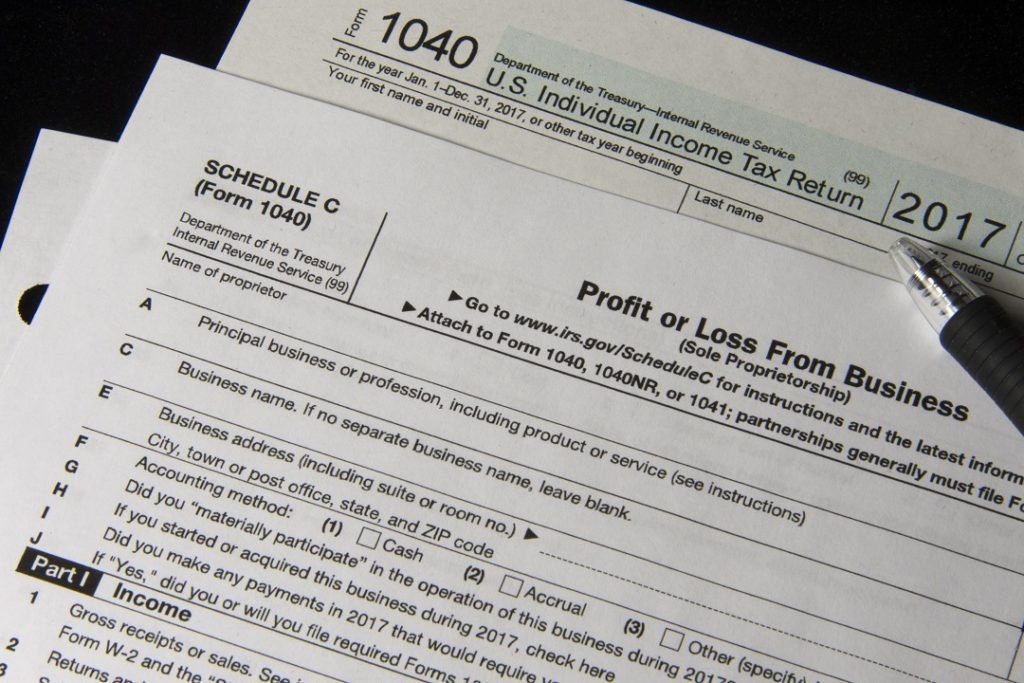
The Schedule C tax form is used to report profit or loss from a business. It is a form that sole proprietorsSole ProprietorshipA sole proprietorship (also known as individual entrepreneurship, sole trader, or proprietorship) is a type of an unincorporated entity that is owned only (single owners of businesses) must fill out in the United States when filing their annual tax returns. The Schedule C form is designed to let sole proprietors write off as much of their expenses as possible from their tax bill, in hopes of spurring entrepreneurship.
Eventually, some of the ventures will turn into highly profitable businesses that will bring in more tax revenue for the government. This is why the US Government wants to reduce the tax burden on small businesses during the time that they are most likely to fail, in expectation of seeing payback on that decision in the long term.
Beneficiaries of Schedule C
The Schedule C form benefits both small business owners and the US Internal Revenue Service (IRS). Within the parameters set out by the form, small business owners can deduct a lot of expenses from their tax bill. Expenses such as advertising, commissions, fees, supplies, automotive, utilities, home office, and so on are all tax-deductible. Anything that is deemed by the IRS to be an “ordinary and necessary” business expense can be used as a tax deduction.
Such an open-ended approach enables small businesses to retain as much revenue as possible in order to finance their operations. The approach is deemed to be fair since it is generally agreed upon that the majority of the tax burden should be borne by large multinational corporations and high net worth individuals.
It would take thousands, maybe even tens of thousands of schedule C filings to equal the tax revenue collected from a single, large multinational corporationMultinational Corporation (MNC)A multinational corporation is a company that operates in its home country, as well as in other countries around the world. It maintains a.
Sole Proprietorship Model
The Schedule C form aims to help businesses that are set up as sole proprietorships. Unlike a limited liability corporation (LLC)Limited Liability Company (LLC)A limited liability company (LLC) is a business structure for private companies in the United States, one that combines aspects of partnerships and corp, sole proprietorships do not enjoy limited liability and the owner can be personally responsible for settlements in the event of losing a lawsuit. This means that the person suing the sole proprietor can go after the person’s personal assets such as his/her car, house, valuables, etc.
Within such a context, we can see how the schedule C form is helpful to smaller businesses that typically have lower levels of profitability. Several years of tax savings increase the likelihood of the business staying afloat for several years to come. Ideally, as the business grows and expands, it is able to acquire more assets, attract more investors, and, ultimately, pay more in taxes.
Thus, the US government is, in a sense, able to successfully “recover” all the lost tax revenue that business owners were able to write off during the early stages of their business.
In the later stages of growth, sole proprietors are likely to switch their business structure to either that of a limited liability corporation (LLC) or a C-corporation.
More Resources
Thank you for reading CFI’s explanation of Schedule C. CFI is the official provider of the Financial Modeling and Valuation Analyst (FMVA)™Become a Certified Financial Modeling & Valuation Analyst (FMVA)®CFI's Financial Modeling and Valuation Analyst (FMVA)® certification will help you gain the confidence you need in your finance career. Enroll today! certification program, designed to transform anyone into a world-class financial analyst.
To keep learning and developing your knowledge of financial analysis, we highly recommend the additional CFI resources below:
- EFTPS®EFTPS®EFTPS® stands for the Electronic Federal Tax Payment System, which is an online tax payment system website operated by the IRS.
- How to Use the IRS.gov WebsiteHow to Use the IRS.gov WebsiteIRS.gov is the official website of the Internal Revenue Service (IRS), the United States’ tax collection agency. The website is used by businesses and
- Schedule ASchedule ASchedule A is an income tax form that is used in the United States to declare itemized deductions.It is attached to Form 1040 for taxpayers that pay annual income taxes. Taxpayers can choose to claim either a standard tax return deduction or itemize their qualifying deductions line by line.
- Tax DeductibleTax DeductibleA tax deductible expense is any expense that is considered "ordinary, necessary, and reasonable" and that helps a business to generate income. It is usually deducted from the company's income before taxation.
-
Accounting vs. Tax Depreciation: Key Differences Explained
Before we discuss accounting depreciation vs tax depreciation, let us first talk about depreciation itself. Essentially, depreciation is a method of allocating the cost of a tangible asset over severa
-

Amended Tax Return: Definition, Filing & 1040-X Form
An amended return is filed with the tax authority to make corrections to a previous year’s tax return. The tax return’s amended version can increase tax benefits or tax liability, dependin
Accounting
- Business Banking: Services, Accounts & Loans Explained
- Franchise Tax Explained: What It Is & Who Pays
- Understanding Income Tax: A Comprehensive Guide for Individuals & Businesses
- Understanding Tax Deductions: What Businesses Need to Know
- Progressive Tax Explained: How It Works & Examples
- Regressive Taxes: Definition, Examples & Impact on Income Inequality
- Understanding Schedule K-1: A Comprehensive Guide
- Tax Depreciation Explained: A Comprehensive Guide for Taxpayers
- Schedule C Taxes: Essential Tips for Freelancers & Independent Contractors
-
 Understanding Regressive Taxes: Definition & Examples
Regressive tax is one of two main types of tax systems utilized by a country. Under a regressive tax system, taxes are assessed uniformly on everyone regardless of their income. Most nations, includin...
-
Crowdfunding: A Comprehensive Guide to Funding Your Ideas
Have you ever had a great business idea but no means to finance it? In those situations, people often think, “If I could get a million people to donate $1 each, I’d have a...