
The Benihana Effect: How Lifestyle Inflation Impacts Long-Term Relationships
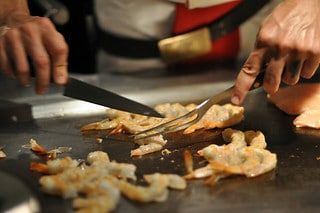
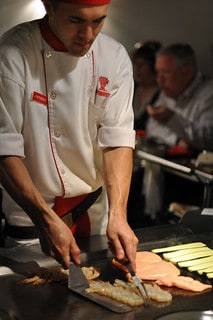
Kris turned 42 yesterday. And as we've done for 24 consecutive years now, we celebrated her birthday at the Japanese restaurant Benihana.
This year was different for a few reasons. Most obviously, we're no longer in a relationship. (Although we're no longer married, we continue to maintain a friendship.) But also, Benihana has changed their menu slightly. This might not sound like a big deal, but it was kind of odd to us.
You see, for 24 years we've been ordering the same thing. Every year, Kris orders the “Splash and Meadow” combination, which consists of shrimp and beef. And every year, I order “Rocky's Choice”, which is a combo of beef and chicken. (Plus I get fried rice.) We've been ordering these same birthday meals every June for more than half our lives. That's kind of amazing.
In the Beginning
When we first started this tradition, we had just finished our sophomore year of college. We were both waiting tables to bring in spending money, and we couldn't afford much. We did our shopping at the discount grocery store. If we went out to eat, it was to Dairy Queen. That first trip to Benihana was an extravagance!
I don't remember exactly how much we spent on Kris's birthday dinner back in 1989, but I'm sure it must have been about $50 or $60 after tip. I remember getting the check and feeling overwhelmed. That was like a week's worth of tips from my job in the coffee shop at the Holiday Inn. It almost felt obscene to spend so much on one meal.
(In the years that followed, of course, I'd charge most of these birthday meals to my credit cards. In those early days, when I wanted to splurge, I had to splurge with cash. It's all I had.)
As time passed, our incomes grew. Kris got a job teaching high school. I started selling boxes for the family box factory. Our annual trips to Benihana still seemed expensive, but not terribly so.
Then, one year, something changed.
Lifestyle Inflation in Action
When we returned to Portland, we began to dabble in some of the nicer restaurants in town. We learned that we liked them. But eating out was expensive. Again, it cost us $50 or $60 per meal.
The next year, we returned to Benihana for Kris's birthday. Again the check came to about $50 or $60, the same as always. But this time, something was different. Though the total bill was the same, it seemed much less. We'd grown accustomed to paying for nice meals, and now what used to seem like an extravagance somehow seemed acceptable.
And here we are in 2012. Now, after 24 years of birthday dinners at Benihana, the price for our dinners remains virtually unchanged. My Rocky's Choice costs $25.75 and Kris's Splash and Meadow has a similar price. After tip, our meal costs about $60 or $65. (Well, that's not exactly true. It cost closer to $100 this year because I ordered spicy tuna rolls and then we both had a cocktail.)
Whereas this $60 used to seem like a small fortune, today it seems perfectly reasonable. During the last couple years of our marriage, we had many restaurant meals in this price range — and we'd often spend more.
By the Numbers

Here's what I mean:
- In 1989, the meal at Benihana cost about $50 or $60, which was the equivalent of about two days of my work.
- In 2012, the meal at Benihana cost about $60 or $65, which is the equivalent of about one hour of my work.
So, this Benihana Effect represents lifestyle inflation, but seen from a different perspective, from the perspective of a fixed point.
Lifestyle inflation used to play a huge role in my life. Not so much anymore. For one thing, I maxed out my consumption some years back. Since then, I've been de-flating my lifestyle. I'm not ready to live in a tiny house (like some of my friends do), but everything I need — and then some — fits into this 735-square-foot apartment.
If there's still lifestyle inflation in my world, it takes the form of the products I choose to buy. It used to be that I'd pay middle-of-the-road prices for middle-of-the-road products. Not anymore. Today, it's all or nothing. I'll pay top dollar for top quality, or I want to buy the cheapest possible option. My quest for quality could be viewed as another form of lifestyle inflation, I guess. But you know what? I'm okay with that. It's also a form of conscious spending.
Footnote: I've begun dating. As a result, I'm meeting a variety of women with a variety of relationships to money. It's fascinating. It's curious to see where people choose to spend, and to see who does (or does not) have strong financial habits. But it's also interesting to see how much a date costs now compared to what it might have cost when I was in college. Talk about lifestyle inflation! If this keeps up, I'll be posting a list of “100 fun and frugal date ideas” — but I sure hope it doesn't come to that…-

A Brief History of Manufacturing: From Handcraft to Industry
Modern manufacturing includes the process necessary for the production of a product and its components. Prior to the Industrial Revolution, manufacturing simply meant creating products or goods by han
-
Understanding Status Spending: A Timeless Financial Lesson
Back in the dark ages that were 1980s, anyone who was anyone in my elementary school wore Jordache jeans. My sister and I, of course, wanted to fit in with the popular kids and begged our parents for
budget
- Inflation's Impact on Dollar Purchasing Power: A Comprehensive Explanation
- Understanding Lifestyle Inflation: How Raises Can Hinder Your Financial Goals
- Inflation's Impact on Home Buying: What You Need to Know
- RV Trip Cost Breakdown: A Detailed Look at U.S. Travel Expenses
- Conquer Lifestyle Inflation: A Guide to Maintaining Financial Stability
- Conquer Lifestyle Inflation: Protect Your Financial Growth
- Avoid Lifestyle Inflation: A Guide to Maintaining Financial Stability
- Why a Highly Motivated Team Drives Workplace Success
- Trump & the Market: Analyzing Market Reactions to Political Uncertainty
-
 Lifestyle Inflation: When It's Okay to Upgrade Without Increasing Costs
Despite that I dont own it, I like my apartment. Its got a mountainous view, its comfortable, and my neighbors are few but friendly. Sure, Id like to own a home someday. But, unless I move to an...
-
Upselling Strategies: Mastering the Art of Increasing Sales
Upselling is an unavoidable part of doing business and the art of the upsell has graduated far beyond the ubiquitous line, “would you like fries with that.” Just about anywhere you spend m...