
Check Writing Guide: How to Format a Check for $15,010.15
The 2016 Federal Reserve Payments Study revealed that Americans haven't given up writing checks in favor of electronic methods. In fact, 17.3 billion checks totaling $26.83 trillion were written over the course of the previous year. In addition to individuals writing checks, businesses also often opt to pay their manufacturers, suppliers and employees with paper checks. If you find yourself in a situation where a large hand-written check is needed, you'll need to know how to fill it out properly.

Times a Large Check is Needed
It's not every day you'll be asked to write a check for $15,000.10, but there are a few occasions when this situation might present itself. For example, you might need to make a down payment on a house or on a lot where you'd like to build a house. Or, you might want to purchase a car without taking out a loan to save money in the long run. Finally, you might need to write a large check to pay legal or medical fees.
Enter the Date First
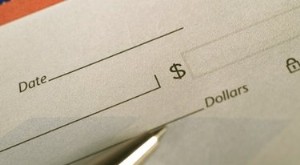
When writing a check for $15,000.10, you must begin by entering the current date in the upper right-hand corner where "Date" is written on the check. You can use the numerical format to insert the month, day and year, or you can spell out the month and then use numbers for the day and year.
Write Who the Check Is For
You'll see the words "Pay to the Order Of" or "Pay To" on the left-hand side of the top line. If you're writing the check to a business, list the name of the company on this line. If you're writing the check to an individual, include both the first and last name of the recipient.
List the Dollar Amount
Write $15,000.10 in numerical form in the box with the dollar sign in front of it. You'll notice it rests directly next to the "Pay to the Order Of" line. You can write $15,000.10 using decimals or $15,000 10/100 using a fraction.
Write the Payment Amount in Words
Just below the "Pay to the Order Of" section is a line for spelling out the payment amount. Here you'll write "Fifteen thousand" and then add either the words "and ten cents" or the fraction 10/100. Draw a straight line through any empty space between your payment amount and the word "Dollars." This helps to prevent fraud.
Utilize the Memo Section
In the bottom left-hand corner, you'll see the word "Memo" or "For" with a line next to it. Use this space to write yourself a reminder of what the money is being used for. For example, you might write "2012 Honda Element" or "555 Main St. down payment." You also can use this spot to add your account number if you're paying a supplier or a large bill.
Add Your Signature
The last thing you'll do when filling out the check is sign your name on the line in the bottom right-hand corner of the check. Always make sure your signature matches the one the bank has on file for you, or you risk the check being refused. This step also prevents fraud in the event that someone gets a hold of your check and tries to sign it with your name.
Update Your Checkbook Register
Once you've written your check for $15,000.10, you need to update your checkbook register to include the transaction. This is the best way to determine how much money you have remaining in your account after writing the check.
-

Maximize Savings: Proven Strategies for Lowe's & Home Depot
There are many ways to save big at both Lowe's and Home Depot every time you shop. With both stores competing for your business, it's getting even easier to save at least 10% on every shopping
-

Online Check Payment: A Step-by-Step Guide
Paying bills online has become a popular method of settling monthly expenses. Using the Internet to pay bills makes it possible to pay bills on the day they are due rather than having to estimate the
budgeting
- Check Writing Guide: A Simple Step-by-Step Tutorial
- Check Writing Guide: How to Write a Check Correctly
- Writing Checks: Handling Dollars & Cents - A Simple Guide
- Manifest Wealth: Your Guide to Creating an Abundance Check
- Deposit Checks: A Step-by-Step Guide for Savings & Checking Accounts
- Writing Checks for Exact Amounts: A Guide to Cents Only
- Writing a Check for a Child: A Step-by-Step Guide
- Check Writing Guide: A Step-by-Step Guide for Secure Payments
- Writing a Check: A Complete Guide - Steps, Tips & FAQs
-
 Printing on Blank Bank Checks: A Step-by-Step Guide
Learn how to complete temporary bank checks. When you first open a checking account at a bank, the bank hands over temporary checks for you to use until your pre-printed checks come in. The b...
-
Using Checks in 2024: Benefits, How-To, and When to Use Them
There are a lot of ways to pay your bills these days — electronic transfers, debit and credit cards, and digital methods of payment (known as digital wallets). In fact, while people still write millio...