
Leveraging Big Data in Ecommerce: Personalization & Retention Strategies
The surfacing of the Facebook debacle involving Cambridge Analytica and the massive amounts of data collected from 87 million users, which was used to influence the 2016 presidential election, revealed big data as the powerful beast it can be.
Even when used with good intentions, as Facebook CEO Mark Zuckerberg alleged his company did, data can lead people, and businesses, astray.
Wired dives straight to the heart of the matter:
The cherry picking that can be done with big data allows you to manipulate information to tell you whatever you want it to, which is great for headlines, but bad for business.
However, that’s not to say that big data can’t still be an essential tool in your arsenal as your grow your ecommerce channel.
The key to wielding big data in such a way as to make it work for you demands you focus on two things:
- Your circle of competence.
- The way the world works.
One of the most exciting yet challenging things about running an ecommerce site or channel is unpredictability — though the possibility of having to appear before the Senate, as Zuckerberg did, is perhaps not the kind of excitement that any business owner wants to be involved with.
Nonetheless, both technology and human behavior are constantly changing, and as a business owner or ecommerce manager, you have to be ready to adapt.
Due to the ease of creating and maintaining an ecommerce shop, as well as the rise of micro-brands, today’s market is riddled with cutthroat competition and decreased customer loyalty.
Online businesses are constantly looking for ways to retain customers and improve the customer experience, not knowing that the solution is right at their fingertips.
Despite the intense competition, ecommerce business owners have an advantage over traditional retailers that own brick and mortar shops.
Ecommerce is nimble and adaptable; these businesses aren’t confined to a particular location and often have inventory or retail leases to worry about when using 3PLs or running an ecommerce-only operation.
Ecommerce businesses do have the ability to reach a global market, with access to information that brick and mortar retailers don’t have.
Nonetheless, it is even more essential that ecommerce business owners and managers operate within their circle of competence.
Everyone has a circle of competence created through study and experience. The key is to function within this circle and leverage your expertise to amplify your output.
When you are properly leveraging your deeper understanding of a market, product, or clientele, you are able to reap larger rewards for the same amount of effort than someone operating outside their circle of competence.
As Warren Buffet wrote in a 1996 Chairman’s Letter,
Combining your understanding of how the real world works with your circle of competence will allow you to utilize big data to your advantage.
In other words, it can help you build a data-driven ecommerce business.
What is Big Data and Why Should You Use it?
Big data is a big buzzword when it comes to modern business management. It refers to extremely large data sets that may be analyzed to reveal patterns and trends in human behavior.
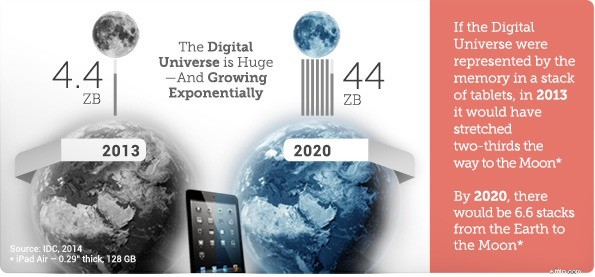
With people producing an estimated 1.7MB of new information per second, it is expected that our accumulated digital universe of data will grow from 4.4 zettabytes to 44 zettabytes (or 44 trillion gigabytes) by 2020.
Many brands think access to big data is confined to big retailers that can afford an in-house team or who can afford to buy data from data brokers.
You’ll be happy to discover that this logic is flawed, as even the smallest businesses have the means to access and analyze ecommerce big data.
Ecommerce platforms like BigCommerce track and give merchants access to consumer behavior data, which business owners can use to make informed decisions.
Yet, despite having so much ‘power’ in their hands, less than 0.5% of available data is being used for these purposes.
In this, we’ll look at how you can leverage ecommerce big data effectively to grow your business and better serve your customers.
-

Data Protection During COVID-19: Essential Tips for EU & UK Businesses
As businesses adapt to the COVID-19 pandemic, the challenges of managing a remote workforce and its desire for information about the virus’s impact have signific
-
Holiday Fulfillment Optimization: Expert Strategies for 2020
GET THE FULL HOLIDAY GUIDE For more expert advice, download our 2020 Holiday Guide. DOWNLOAD THE GUIDE The holidays are the busiest time of the year, as consumers continue to do more shopping on
Business
- Boost Ecommerce Conversions: 5 On-Site Search Optimization Strategies
- Ecommerce Holiday Calendar 2021-2022: Boost Sales & Traffic
- Big Data Analytics for Cryptocurrency Market Security
- Ecommerce Customer Service: Drive Acquisition & Loyalty
- Boost Ecommerce Sales: A Guide to Loyalty Programs for Retention & Community
- Ecommerce Personalization: A Comprehensive Guide to Scaling Customer Loyalty
- Boost Ecommerce Profits: Why Customer Retention is Your #1 Marketing Strategy
- Ecommerce Security & Data Privacy: Navigating Current & Future Regulations
- Headless Commerce: A Guide for Enterprise Ecommerce Success
-
 US Economy: Record Unemployment Claims Signal Economic Downturn
By: Spencer Israel If the U.S. economy was a movie, then Thursday gave us our first teaser trailer. And it was bad. By now, you know the number. A record 3.28 million Americans filed for unemployme...
-
 Ecommerce Analytics: Drive Sales Growth with Data-Driven Insights
How can you expect to achieve results if you don’t know how you are performing at present? How can you make sales if you’re simply having a stab in the dark whenever you try a new ecommerce mar...