
Facebook Ads for Beginners: Campaigns, Objectives & Strategies
In this chapter, we’ll introduce you to the different campaigns, objectives and ad types you should use to promote your products and where they each fall in the customer journey.
Again, think of this guide as maturity model. In this chapter, we’ll start you at the very beginning.
By the end of this guide, expect to be effectively running profitable campaigns.
Setting Up Your Facebook Business Account
If you haven’t done so already, your first step will be to go to business.facebook.com and create a free account.
As you progress through this guide, you will hear many references to:
- The Business Manager
- The Facebook Ads Manager
- The Power Editor.
The Business Manager houses the other two.
If you haven’t set up a Business Manager account, here’s how you do it.
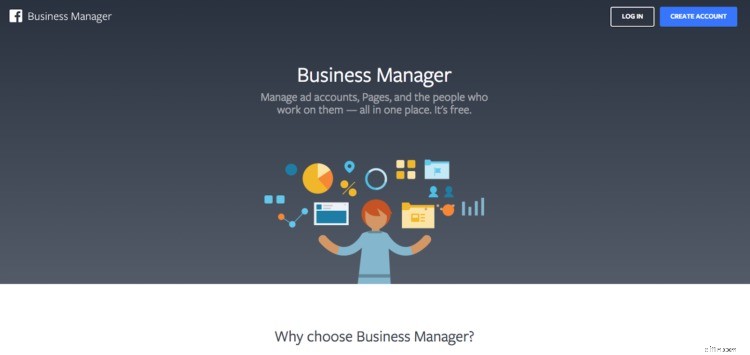
1. Go to business.facebook.com.
Click on the blue create account button in the upper right-hand corner.
- If you aren’t currently logged into Facebook, you will be asked to log in.
- If you don’t have a personal Facebook account, click on Create Account to get one.
You should see a screen like this:
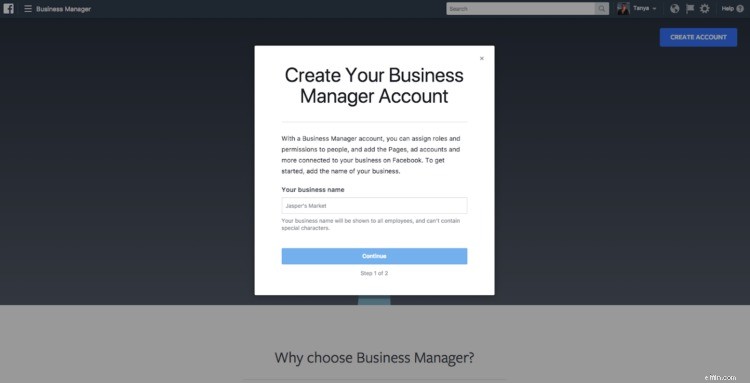
2. Insert your business name in the appropriate field.
3. Add your name and business email address. Select Finish.
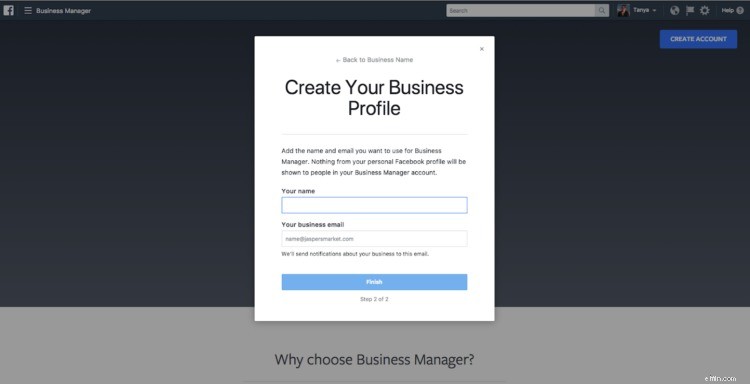
Once you have created this account you will be able to set up your first Facebook ad campaign.
Campaign Types
There are two basic campaign types you will want to run for your ecommerce store.
- Cold Traffic Campaigns
- Remarketing Campaigns
These tie into the campaign objectives below, and you’ll choose your objective based on the type of campaign you’re running.
1. Cold Traffic Campaigns.
These campaigns are used to target prospective customers or people who have never heard of you before.
The idea behind a prospecting campaign is:
- To build your audience
- Generate interest in your products
- Make more people aware of your brand and what you sell.
If you’re doing a lead generation campaign (or if you’re driving traffic to a landing page where you collect email addresses), you’ll build your email list so you can follow up with these prospective clients outside of Facebook.
Pro Tip
Don’t just rely on Facebook likes, Messenger subscribers and Facebook ads to build your audience.
Make sure you’re building your email list at the same time.
That way if Facebook makes any major changes, you still have a customer base to promote your products to.
2. Remarketing Campaigns.
Once you’ve built an audience on Facebook, gotten new customers, had people click on your ads and sent new visitors to your website, you can create a remarketing campaign using these audiences.
These are all people who are aware of your brand and your products because you’ve introduced yourself during your prospecting campaigns and through email follow up (if you’ve been collecting email addresses).
Your remarketing campaigns are where you’ll make your sales and build a loyal following of happy customers who will help sustain your business.
They’re also a good way to create what many marketers refer to as “evangelists” or people who love your products and tell all their friends about your company, by offering special deals for loyal customers.
-

Understanding Stock Funds: A Beginner's Guide
Stock funds are one of the most common types of mutual funds in the market today. This type of fund carries with it some unique features when compared to other mutual funds. Here are the basics
-
Understanding Currency Exchange Rates: A Comprehensive Guide
Currency exchange rates are rates that signify how much one currency is worth in relation to another currency. This allows you to exchange one set of currency for another without having to
Business
- Understanding Bitcoin Mining: A Beginner's Guide
- Understanding Senior Debt: A Comprehensive Guide
- Understanding Investment Volatility: A Comprehensive Guide
- Vulture Funds: Understanding High-Risk, High-Reward Investments
- Understanding Market Capitalization: A Beginner's Guide
- Market Orders Explained: A Beginner's Guide
- Understanding Business Overhead Expense (BOE) Insurance | [Company Name]
- Asset Allocation: A Comprehensive Guide for Investors
- Financial Priorities: Rebuilding Your Financial Foundation After 2020
-
Auction Rate Securities (ARS): A Comprehensive Overview
Auction rate securities are a type of investment in which the interest rate for investors is determined by a Dutch auction. These securities are purchased through an auction format and the varia...
-
Understanding Optimal Portfolio Theory: A Beginner's Guide
Optimal portfolio theory finds the optimal set of hypothetical portfolios that reside within the space of the x and y axes, the portfolio frontier space. It is a mathematical concept very simila...