
Find the Right Ecommerce Marketing Agency: A Step-by-Step Guide
When it comes to marketing in 2020, simply using traditional methods is no longer going to cut it.
We’re witnessing an uprising.
In a constantly changing digital and competitive landscape, businesses all around the world are turning to marketing agencies to help build and grow their brands.
Using an agency to develop your ecommerce marketing strategy can give you a leg up on your competition because you gain access to the newest techniques, tools, and resources.
More and more businesses are turning to outside help as they grow.
In the US alone, brands spent more than $162.9 billion on marketing services in 2018.
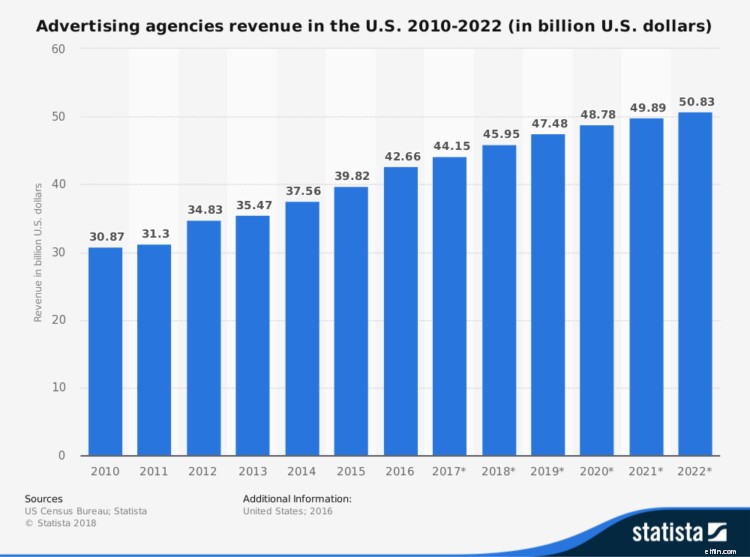
For agencies in particular, they’re seeing the pendulum swing. By 2022, agency revenue in the United States is predicted to rise to over $50 billion.
There’s a whole lot of money to be made as an agency.
- But why are agencies so profitable?
- What value does adding an agency bring to your business?
We surveyed over 30 of the best marketing agencies worldwide and got a lay of the land.
This is why you should work with an agency, and this is how you should pick one.
These are the agencies used by merchants all over the world to help build and grow their businesses.
After reading this article, you’ll have a comprehensive understanding of what benefits come with using a marketing agency versus in-house offerings.
You’ll also know what to ask when down-selecting an agency to work with, and what things you should consider prior to taking the plunge into an agency relationship.
Thinking about hiring an agency? Your discovery starts here. We’ve created a list of these best-in-class agencies.
| Agency | Services |
|---|---|
| 5874 | Branding, digital marketing, ecommerce, property marketing |
| 1Digital Agency | Design, development, digital marketing, ecommerce |
| Atmosol | Development, graphic design, UX/UI design, digital marketing, branding and communication, mobile development |
| Americaneagle.com | Website strategy, design, development, hosting, digital marketing, and branding |
| BlackBelt Commerce | Design, development, customization, SEO, blogging, migration, global expansion, store duplication, content marketing and link building services |
| Blue Stout | Ecommerce, marketing, audits, design |
| Border7 | Web consulting and planning, branding and design, custom programming, optimization and support |
| Brand Labs | PPC Management, SEO, Email Marketing, CRO |
| Calashock | Website design and development, CRO, UX, SEO and email marketing |
| Classy Llama | Digital commerce consulting, marketing, design, development and support |
| Digitawise | Strategy and consulting, search marketing, design and creative, web development, social and email |
| DigitlHaus | Design, development, marketing, support, copywriting, video + photography |
| Ecommerce Partners | Strategy, implementation, support and marketing |
| Efelle Creative | Web design, development, SEO, online marketing, branding |
| Epic Shops | Website development, conversion rate optimization |
| Eventige | Marketing strategy, web development, SEM, product packaging, branding and design, event marketing, social, email, media buying |
| Groove Commerce | UX/UI Design, Website development, Custom integrations, Email Marketing, SEO and Paid media management |
| Guidance | Web design, development, strategy, B2B and B2C |
| iFuel Interactive | Branding, design, development, ecommerce, media, experiential |
| iMedia Inc. | Strategy, marketing, design, technology, social |
| Jammin Web Designs | Ecommerce Experts, Design, Development, Migrations, SEO/SEM |
| Logical Position | Paid search and shopping management, social media marketing, data feed management, search engine optimization, web design |
| Madwire | Digital marketing, marketing platform (Marketing 360) |
| Metric Digital | Email marketing, digital marketing, analytics |
| MoJo Active | Marketing strategy, branding, web + mobile, advertising, SEO/SEM, social, email marketing, marketing platforms |
| Northcutt | Enterprise SEO |
| Northern | Design, web development, marketing |
| Plum Tree Group | Brand development, search marketing, social media, display advertising, email marketing, development |
| Shero Commerce | B2B and B2C ecommerce, growth and marketing, CRO, analytics, SEO |
| Silk Software | Marketing, design, development, migration, B2B |
| Springbox | Digital strategy, digital experiences, demand generation |
| Trellis | Digital strategy, information technology, web design, web development, integrations, hosting |
| The ZaneRay Group | Web Design, UI/UX and e-Commerce |
| Inflow | Services: SEO, PPC, Conversion Rate Optimization |
Benefits of Using a Marketing Agency
Marketing is increasingly becoming more and more important to business success.
That said, many professionals tread lightly when it comes to outsourcing — and for good reason.
Passing the baton of your brand, your processes, and your voice is a big deal — and shouldn’t be taken lightly.
- Is a marketing agency right for you?
- How do you know if a marketing agency will add value in your current stage of growth?
Here’s how companies benefit from stepping out and bringing a marketing agency aboard.
1. Your marketing can truly be nimble.
Working with an agency allows you to have subject matter experts at your disposal, without the cost of hiring them all in-house.
Shifting tides in technologies, languages, and platforms can leave you empty handed. Dan Kogan, CEO at 1Digital Agency, puts it simply.
With in-house team members, a change in strategy, whether it be a new technology or an emphasis on a certain channel, will cause you to have to hire team members with those skill sets. This reprioritization can be messy, tough, and time-wasting.
Employing an agency not only allows you to quickly shift gears, it also frees up budget constraints and enables you to put your funds where you see the largest amount of growth.
2. Gain access to premium products and technologies.
World-class marketing agencies have access to the latest tools and technologies, and often have first access to new products.
Implementation and training for new products is often seen as a pain point for growing businesses.
After all — when you’re in a resource-strapped environment, any time spent watching a training video may be better spent on something else.
With a marketing agency, using a new tool is much more plug-and-play.
Oftentimes agencies have team members that are experts in certain software, so they can hit the ground running when it comes to using and benefiting from a new tool.
3. Value-based work comes with value-based price.
Agencies aren’t inexpensive by any means, but when you look at the price of an agency versus the price of full-time employees, the latter will be more expensive.
It’s all about balance, according to Brian McGovern of iMedia Inc.
In this fast-paced digital era, keeping an entire department staffed and constantly learning about the newest and best practices in digital marketing can get very expensive, very quickly.
For agencies, it’s their only job.
The cost of hiring just one in-house, full-time, experienced marketing employee involves not only a salary but a host of other things including benefits, vacation pay, and a full line of tools necessary to run the department.
4. Gain insight from an outsider’s perspective.
We’re all familiar with tunnel vision. John Ellet, CEO at Springbox, knows it well.
When you work with an agency, you’re pulling upon the wisdom of a very large collection of work.
If your agency has worked with clients in the same industry as you, they’ll have developed best practices and guidelines.
5. Agencies serve as an extension to your network.
It’s easy to get siphoned off into one particular industry’s social circle.
Adding an agency into the mix opens your network up and gives you more opportunities to find collaboration or build relationships.
Agencies often have vested relationships with media and influencers – and can leverage those relationships to help build your brand.
So, when should you turn to in-house employees?
When you’re using a mix of in-house and agency talent, you can better maintain the brand and culture of your organization while also pulling from top talent.
Hiring exclusively out-of-house presents an opportunity for a barren culture and potential lack of camaraderie.
For general tasks that don’t require a high level of technical understanding, in-house employees might be a good choice.
Ideally, it’s a mix of both in- and out-of house.
Corey Dubeau, VP of Marketing at Northern sums it up nicely:
Things to Consider Before Investing in a Marketing Agency
Before you invest in a marketing agency, you need to get your ducks in a row.
You’ll want to make sure that you have a stellar product with a production flow and timeline in place.
- Has it been tested thoroughly?
- Was there a complete competitive analysis?
- Do you have positive reviews and testimonials of people who have benefited from it?
- Do you have customer service and salespeople in place?
You’ll want to ensure that your organizational structure is prepped for an increase in growth and demand.
Depending on what you’ll be using the agency for, you need to have everything prepared.
For example, if you’re planning on using an agency for paid advertising, make sure your website has been optimized for a high conversion rate.
Hiring an agency can make or break your brand.
You’re handing over a monumental portion of your workflow, product development, and marketing to an outsider.
It’s important that you make the right decision.
Caution and intentionality must come at the forefront; don’t be afraid to take your time, vet several agencies, and ask lots of questions.
Consider these factors while you’re in your search for an ecommerce marketing agency.
1. Marketing budget.
What is the minimum and maximum amount you’re interested in spending on an agency?
Most agencies work with a large range of budgets, so it’s unlikely that you will be immediately disqualified from working with them if you have fewer funds to spend.
Rather, your budget will do wonders to inform both you and the agency of how your business goals should be set.
Much like a sliding scale, the amount of support and production you receive will be a direct reflection of the amount you’re willing to invest.
Many different factors will impact your budget, including timelines, intended reach, custom work (such as development time or brand identity creation), and the length of the contract.
2. Culture and personal fit.
It’s all about chemistry — really.
As a client, you want to make sure that your voice is heard, your opinions matter, and you have a vested, lockstep partner.
Your agency of choice should take the time to listen to what you’ve tried in the past, and ask questions to learn about what your business goals are.
Outside of technical matchmaking, you want to make sure that the teams will get along.
Often times, it’s chemistry that allows agencies to truly become an extension of your team and produce true success.
Additionally, does the agency want to grow? Flip the question onto them and ask what their plans are for expansion.
If they’re hungry to grow, they’re more likely to invest more internally into new, up-and-coming technologies and techniques.
As both of your businesses change, ensure that you’ll have the proper support throughout it all.
Think of it as your two businesses really teaming up.
For Efelle Creative, the key is viewing every project as a partnership.
3. Geographic area.
Agencies are everywhere.
Both US coasts are chock-full of them, which makes sense — that’s where a large portion of businesses are.
In this digital age, connecting from anywhere in the world is incredibly easy, so there’s no need to place a limit on where your agency might be from.
If you’re interested in in-person meetings and collaboration, check out agencies that are close to home.
4. The agency’s portfolio and track record.
How did the agency find you (or, how did you find them?)
This simple question can inform a lot of how the agency conducts business.
If you heard about them through a referral, it shows that they put a lot of time into building relationships. If they connected to you through marketing efforts, you know they know how to market.
Brandon Lilly, Senior Brand Director at Madwire, suggests taking this point to heart.
If your product is niche or specialized, consider working with an agency that has a proven track record in that space. Consider their portfolio of work heavily, as it reflects their way of thinking as well as their collaborations with other brands.
Lastly, how long has the agency been around? Ask about how they came to be, and where they anticipate more growth in the coming years.
Don’t let the agency’s age be a deciding factor; rather, ask them to frame their expertise and describe how they anticipate growing over time.
5. Proof of satisfied clients.
Look for an agency that has proud clients who are eager to share their experiences. This could be through testimonials or case studies, or it could also be something that’s brought up during the vetting and sales process.
It’s all about results. An agency should be able to demonstrate how they’ve added value to their clients. Ask to speak to the clients, and get their perspective.
Reviews of the agency should be thoroughly reviewed, but also taken with a grain of salt.
6. Your timeline.
How quickly do you want to start seeing results?
There’s a lot to consider when you start a project: How soon are you planning to grow, and by how much?
Make sure you’re available to thoroughly consider and think through all your options upfront.
This will allow the project to be the most successful and efficient.
Keep in mind that all good things take time.
Don’t jump at an opportunity with an agency who promises you a quick fix or immediate results, warns Brandon Lilly, Senior Brand Director at Madwire.
7. Your bandwidth.
How many tasks do you anticipate giving to the agency, and how much will remain in-house?
You may also consider electing a point-person within your organization to be the one who works most closely with the agency. This will result in a clearer path for communication, according to Shero Commerce.
Once you bring the agency aboard, bandwidth will shift. Make sure that previous tasks are adequately covered.
8. If you need specialization.
If you’re looking to an agency for specialized work such as development, paid advertising, or affiliate marketing, beware of small-staffed agencies that claim they can do everything.
Specialized areas have technologies and rules that change quickly (such as new ad platforms, new coding languages, and new affiliate networks).
A small agency that peppers in those specialties will certainly execute on them well, but they won’t have the same drilled-down, expert knowledge as a larger agency or an agency that solely specializes in that area.
Questions to Ask Before Hiring a Marketing Agency
It is, in essence, a job interview.
You’ve made the decision to hire a marketing agency, and you’re down to selecting the team you want to work with.
While the agency certainly will be asking you a lot of questions about your business, product, and growth goals, now’s the time to get the scoop on them, too.
During your search, ask these questions to get a good scope on whether or not this agency is the right fit.
1. What experience do you have?
Start from the beginning, according to Springbox, by asking how the agency got started.
Ask about the industries they work with.
This might seem like a given, but it’s incredibly important.
Selling beauty products is very different than selling auto parts, so you’ll want to know if they have previous experience with merchants in your industry — or at least transferable skills.
2. What is your area of expertise?
If they focus on a certain type of ecommerce marketing, such as social or paid advertising, you can determine if they’re the right fit.
According to Brand Labs, another way to figure this out is by asking:
For agencies that specialize in certain channels, you can get more granular with questions.
Here are some examples from Scott Ginsberg, Head of Content at Metric Digital.
Questions for Three Types of Ecommerce Agencies
FACEBOOK AGENCY:
“What attribution window do you use and why?”
“What Facebook campaign objectives do you use and how do they work together to increase customers and revenue under a set CPA? Why?” “
How do you structure your account to address prospective new customers? Customers who have never seen the brand on Facebook, seen and/or interacted with the brand on Facebook, or already purchased from my brand? Why?”
“What is an optimal amount of audience overlap across ad sets for prospecting, retargeting, and retention? Why do you think so, and what factors would cause you to change your mind?”
“Do you include or exclude any placements or devices in your targeting? If so, which ones and why?”
“What types of creative assets do you recommend we start with?”
“Do you have any requests for certain types of creative assets? Why?”
SEM AGENCY:
“How does the agency’s strategy align with our company goals?”
“What is the agency’s spend structure?”
“Where do you see most incremental opportunities?”
“What is actually providing real incremental gains, below the surface of revenue growth?”
“What outside audiences are you using to inform or assist your campaigns?
“What’s your point of view on account management platforms?”
“Is the person I’m meeting going to be the person working on account?”
“What’s your copywriting process?”
“How are you demonstrating expertise on the platform?”
EMAIL MARKETING AGENCY:
“Can I devote time to managing this agency relationship?”
“What are your strategic priorities for growing my business?”
“Are the agency’s tactics working?”
3. How do you grow relationships?
Allow them the chance to explain how they’ve nurtured other merchants into a partnership centered around growth.
Ask them about some of their oldest clients. If all their clients are brand new, that may be a sign, says MoJo Active.
4. Where have you succeeded, and where have you failed?
Lay it all out. An agency should be both proud and humble in their work. This will provide them with an opportunity to showcase their specialities and describe how they’ve fallen short and learned from it.
5. What are your credentials?
It’s important to know if an agency is keeping up with quickly-changing technology and software such as social media marketing and paid advertising.
Find out if they’re a Google Premier Partner or Facebook Pro Partner, for example.
Certifications like Google Adwords are important as well.
6. Do they offer any guarantees?
Tread lightly, warns Ailsa Chibnall, CEO at Border7.
7. What are your work processes like?
How do they plan to help you see a return on your campaign, and how much revenue can you expect from these efforts?
8. How do you report on results?
Whether it’s an email report, phone call, or in-person meeting, the format where results are communicated will help to inform how you grow and set expectations.
9. How do they organize projects and clients?
It’s good to have clear expectations and eliminate any ambiguities prior to starting a project, says Corey Dubeau, VP of Marketing at Northern Commerce.
10. What does the agency need from you in order to accomplish the goals?
Even though you’re hiring an agency, there are tasks that you need to complete in order to be successful, and those should be discussed up front.
The better you understand how to work with your partner, the more likely you will have a successful outcome, says John Ellet, CEO at Springbox.
-

Instagram Marketing for Ecommerce: Strategies & Trends for 2024
Did Kevin Systrom, a self-taught coder, know his prototype Burbn would turn into a platform inspiring millions of people? Or that combining the terms instant and telegram would result in one of
-

8 Essential UX Tips to Boost Ecommerce Conversions
Setting up an eCommerce website isn’t easy. It’s not enough to just have a quality product and put it online. Users will be looking for much more than that from your webshop – they’ll be dem
Business
- Affiliate Marketing Success: A 10-Step Guide to Online Income
- Ecommerce Marketing Plan: Drive Traffic & Boost Sales
- Choosing the Perfect Ecommerce Theme: A Comprehensive Guide
- Ecommerce Homepage Design: 8 Inspiring Examples for High Conversion
- Instagram Influencer Marketing for Ecommerce: Drive Sales with Authentic Voices
- Gen X Ecommerce Marketing: Strategies for Conversion
- SMS Marketing for Ecommerce: A Comprehensive Guide to Boost Sales
- Top Dropshipping Suppliers & Companies for E-commerce Success
- Open Source vs. SaaS Ecommerce: Choosing the Best Platform for Your Business
-
 Holiday Marketing Campaigns: Proven Strategies to Drive Sales
For many ecommerce businesses, the holiday season is the busiest time of year. Whether it’s freshening up your landing pages, creating brand awareness with your holiday marketing campaigns, fin...
-
10 Proven Growth Hacking Strategies for Ecommerce Success
As if the ecommerce industry wasn’t expanding fast enough, the pandemic added fuel to the fire. Now, more ecommerce stores are launching than ever before. And while the competition is growing, y...