
Website Product Taxonomy: Improve Navigation & Boost Sales
Imagine you’re trying out a new recipe — one with a lot of unique, specific ingredients.
- You head to the grocery store, only to find that eggs are in the bakery.
- Chocolate chips are next to the toiletries.
- You can’t find the checkout lanes, and the cart return is a mile away from your car.
You’re frustrated at not being able to find items and decipher the navigation of the store.
Unfortunately, this is one aspect of brick-and-mortar shopping that is all too easily replicated online, with poor product navigation and organization erecting a wall between customers and order completion.
There are a number of ways to combat this disorganization — with clear category structure and obvious product attributes.
Building out a complete and comprehensible product taxonomy enables your customers to find exactly what they need and complete their checkout, easily.
What is Product Taxonomy?
Taxonomy is a fancy Greek word that describes the laws of ordering — in short, it is organizing, categorizing, grouping and, most importantly, understanding why that is being done.
A successful merchant cannot simply throw together a few categories that look pretty in a header, toss in products, and call it a day.
Product taxonomy requires a deep knowledge of your products and then devising a logical way to present them to customers.
It is not as glamorous as showcasing sexy, high-resolution image assets, but all the window dressing in the world is useless without a structure that enables a purchaser to click that add to cart button.
Let’s take a look at a common shopping experience everyone has encountered: a simple apparel store. Upon arriving at our homepage, we find the clothing is organized by Men’s and Women’s. After making this first selection, we now see that those clothes are divided between shirts and pants. Simple, logical, and to the point.
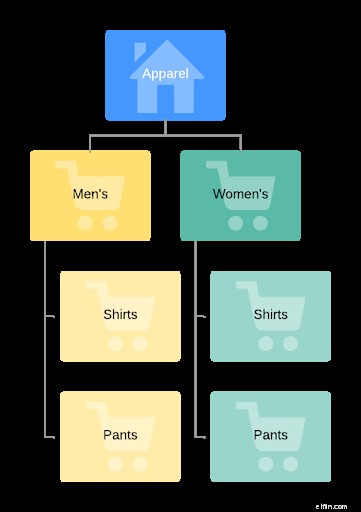
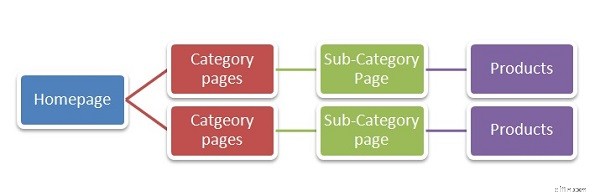
Image via GetFriday
How Product Taxonomy Can Boost Sales
It is well known that visitors to your site fall into two categories (a taxonomy of visitors, as it were):
- Searchers.
- Browsers.
It is easy to understand how good product taxonomy benefits browsers.
These users are drawn to the header or hamburger menu, exploring categories and subcategories.

On the BonTon website, users are drawn to the easy-to-see navigation bar, featuring a number of categories of products.
It is also important to understand your customer base and provide a logical organization that reflects their shopping patterns.
To use our sample store above, why should your parent categories be Men’s and Women’s?
You can just as easily transform Shirts and Pants into the parents and Men’s and Women’s into the children.
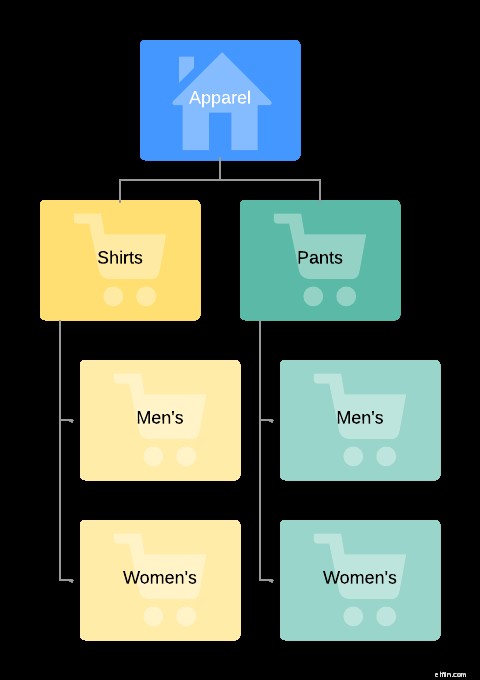
In a vacuum, each of these is a reasonable choice, but by understanding the way your customers shop (through a careful study of site analytics, for instance), you can categorize your products in such a way that makes the most sense to them and leads to conversions.
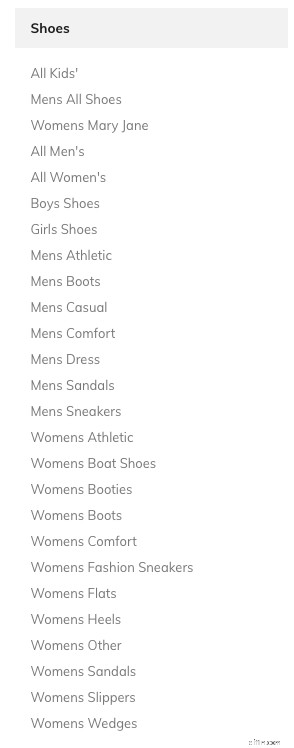
Once a user visits the BonTon website and selects the “women” category, they’re given the menu option of all subcategories.
This does not just benefit browsers, though.
“Searchers” are not going to sift through levels and levels of listing pages. These customers go directly for the search bar as soon as they land on your homepage and arrive knowing what they want to find.
They will use keywords like “men’s shirts” or “women’s sweaters”.
Proper taxonomy empowers your internal search provider to return the right results. As technology becomes more powerful, it even encourages recommendations.
If you do not carry specifically what the searcher has typed in, the search provider can use the taxonomy to display related products, helping you get that conversion by offering something else.
Searchers are customers who go directly for the search bar as soon as they land on your homepage and arrive knowing what they want to find.
-

Find & Vet Manufacturers: Reduce Product Development Costs by 65%
Steve Jobs is – without doubt – one of the greatest founders and entrepreneurs of the past century. Heck, probably ever. His strategic influence and design-first culture helped build Apple into
-

Boost Ecommerce Sales: 10+ Expert Strategies for Rapid Growth
The western genre, and its modern-day equivalent space exploration, captures our imaginations because to be an explorer, adventurer embarking out into the unknown and creating our own path is wh
Business
- Leverage Social Proof: Boost E-commerce Sales & Conversions
- Top 50 Ways to Earn an Extra $1000/Month: Side Hustles & Part-Time Jobs
- Top 30 Shopify Apps for Sales Growth & Profit Maximization (Part 3: Selling)
- Boost Amazon Sales: 10 Proven Strategies for 2024
- Boost Print-on-Demand Sales with Customization: A Comprehensive Guide
- Video Advertising for Ecommerce: Boost Sales in 2024
- Boost Holiday Sales: Ecommerce Strategies for 2021
- Boost Online Sales: The Ultimate Guide to Product Descriptions
- Boost Ecommerce Success: Why Product Protection is Essential
-
 Grow Your Wealth: A Guide to Understanding and Increasing Net Worth
Your net worth is a great measure of your personal wealth and you want that number to g...
-
 Increase Your Credit Limit: A Comprehensive Guide
Credit cards allow you to borrow money from a card issuer for purchases you wouldn’t be able to afford on your own. But having a credit card doesn’t mean you have unlimited access to funds. When you o...