
Understanding Bank Statements: A Comprehensive Guide
A bank statement is a monthly financial document that provides a summary of the account holder’s activity. Bank statements are generally prepared by the bank for the account holder at the end of each month.
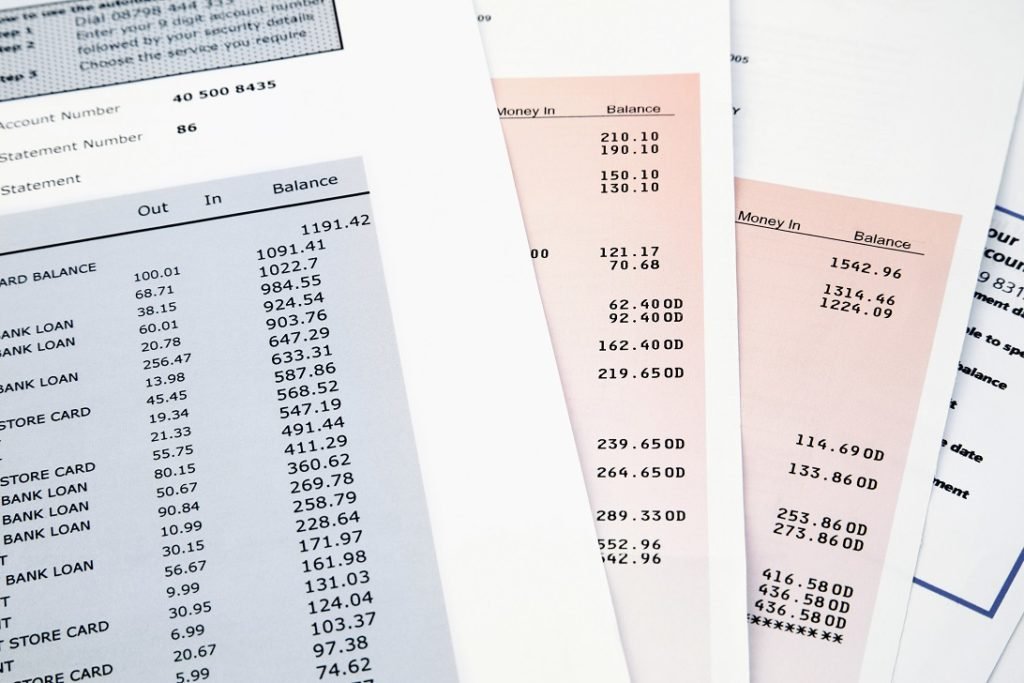
Bank statements can be found online via online banking or be obtained from a branch of the bank. They are also commonly known as account statements or transaction summary statements.
Breaking Down a Bank Statement
The top of a bank statement generally shows the name of the account holder along with sensitive information such as bank account number and branch number. It also contains a summary table that shows the time period, opening balance, deposits, withdrawals, and closing balance.
The closing balance is calculated as Opening Balance + Deposits – Withdrawals.
Below the account summary, the bank statement shows every transaction the account holder engaged in, along with the corresponding payees, dates, and amounts of the transactions. Most bank statements show transactions in chronological order.
By looking at a bank statement, one can see exactly how much, where, and when the account holder spent money. Account holders can get a good estimate of monthly revenuesRevenueRevenue is the value of all sales of goods and services recognized by a company in a period. Revenue (also referred to as Sales or Income) and expenses by analyzing their bank statements for the last few months. It can help with financial planning and budgeting.
What is an e-Statement?
An e-statement is the electronic equivalent of a bank statement. As mentioned above, account holders are given several options to access bank statements. Bank statements can be accessed in print form at a physical branch location or via the bank’s online banking system/email.
Due to their ease of accessibility and storage, e-statements are more common than print statements.
Why are Bank Statements Important?
Budgeting and Financial Planning
A bank statement is like a personal P&L statementProfit and Loss Statement (P&L)A profit and loss statement (P&L), or income statement or statement of operations, is a financial report that provides a summary of a. It allows account holders to keep track of their finances and plan for future expenditures. Bank statements are also extremely helpful for budgeting, as they allow account holders to decipher how much they are spending on different categories.
For example, an account holder can calculate their monthly expenditure on food by adding up individual transactions.
Reconciliation and Identification of Fraudulent Activities
Once the bank prepares a bank statement or e-statement at the end of the month, account holders are usually given 30-60 days to analyze the charges and reconcile their cash balance.
Since the bank statement contains all charges, along with the corresponding dates and payees, it can help account holders identify any fraudulent activity. For example, if the bank statement shows a charge for a transaction that the account holder did not engage in, they can contact the bank and request that they look at the fraudulent transaction.
Credit Verification
Bank statements can also be useful to analyze the creditworthiness of the account holder. Most banks and financial institutions require verification of bank statements for the last 2-5 years before giving loans to individual clients.
Banks use the individual’s bank statements and other credit documents to analyze the creditworthiness of the borrower. It applies to most types of loans, including residential mortgagesMortgageA mortgage is a loan – provided by a mortgage lender or a bank – that enables an individual to purchase a home. While it’s possible to take out loans to cover the entire cost of a home, it’s more common to secure a loan for about 80% of the home’s value., student loans, and loans for small businesses.
Additional Resources
CFI is the official provider of the global Financial Modeling & Valuation Analyst (FMVA)™Become a Certified Financial Modeling & Valuation Analyst (FMVA)®CFI's Financial Modeling and Valuation Analyst (FMVA)® certification will help you gain the confidence you need in your finance career. Enroll today! certification program, designed to help anyone become a world-class financial analyst. To keep learning and advancing your career, the additional CFI resources below will be useful:
- Bank ReconciliationBank ReconciliationA bank reconciliation statement is a document that compares the cash balance on a company’s balance sheet to the corresponding amount on its
- BudgetingBudgetingBudgeting is the tactical implementation of a business plan. To achieve the goals in a business’s strategic plan, we need some type of budget that finances the business plan and sets measures and indicators of performance.
- Financial Statement NotesFinancial Statement NotesFinancial statement notes are the supplemental notes that are included with the published financial statements of a company. The notes are
- Bank Account OverdraftBank Account OverdraftA bank account overdraft happens when an individual’s bank account balance goes down to below zero, resulting in a negative balance. It usually happens when there are no more funds in the account in question, but an outstanding transaction is processed through the account, leading to the account holder incurring a debt.
-

Understanding Appropriation Accounts: Distribution of Funds & Profits
An appropriation account shows how an organization’s funds are distributed among partners, shareholders, and departments. For companies, an appropriation account shows how the company’s pr
-

Bank Drafts: Definition, How They Work & Usage
A bank draft is a convenient and secure instrument for making large payments without having to withdraw cash from one’s account. Bank drafts are guaranteed by financial institutions and can be u
finance
- Understanding Bank Adjustments: What They Are & Why They Happen
- Original Bank Statement: Definition & How to Obtain
- Understanding Payable-on-Death (POD) Bank Accounts: A Comprehensive Guide
- Understanding Bank Statements: A Comprehensive Guide
- Understanding Account Statements: A Comprehensive Guide
- Understanding Bank Overdrafts: Causes, Costs & Solutions
- Nostro Accounts Explained: A Comprehensive Guide
- Understanding Vostro Accounts: Correspondent Banking Explained
- Understanding Bank Statements: A Comprehensive Guide
-
 Understanding Account Balances: A Comprehensive Guide
An account balance is the amount of money present in a financial repository during the current accounting period. It is the net difference between the credits and debits posted in any given accounting...
-
 Understanding Account Numbers: Your Key to Financial Records
An account number is a unique code composed of numbers, letters, or other characters, and is assigned to the account owner for ease of reference in a financial institution’s accounting records.&...