
Corporate Fraud: Definition, Types, and Detection
Corporate fraud consists of illegal or unethical and deceptive actions committed either by a company or an individual acting in their capacity as an employee of the company. Corporate fraud schemes are often extremely complicated and, therefore, difficult to identify. It often takes an office full of forensic accountants months to unravel a corporate fraud scheme in its entirety.
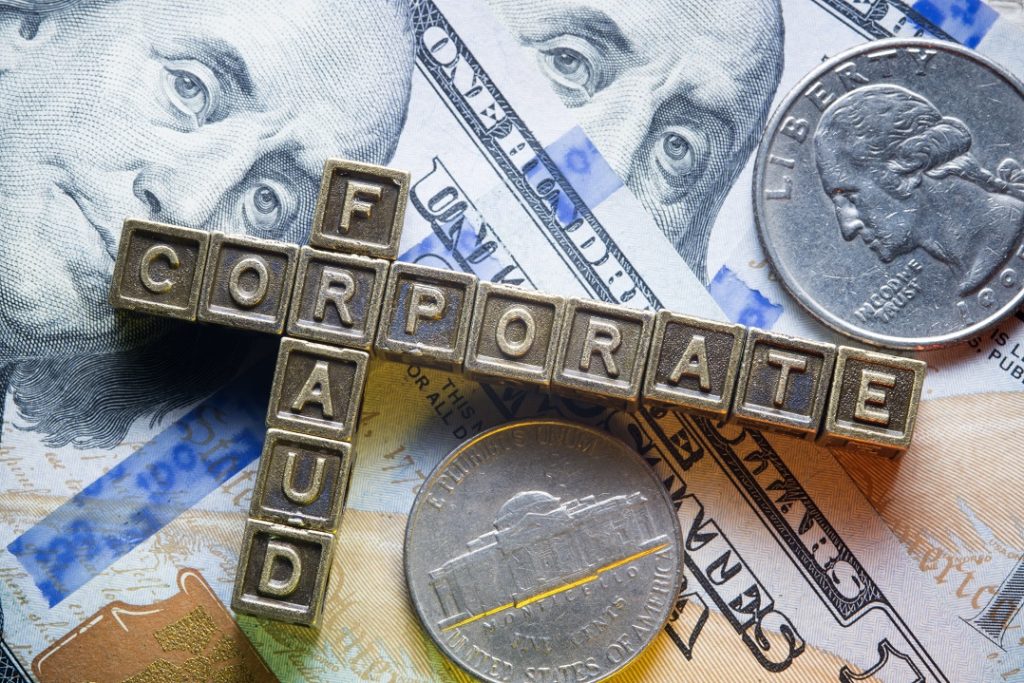
When corporate fraud is perpetrated by the top executives of a large corporation, the fraud often extends to billions of dollars in scale. The victims of corporate fraud are consumers or clients, creditors, investors, other businesses, and eventually, the company that is the source of the fraud and its employees. When it is finally discovered, the company committing the fraud is often left in ruins and forced to declare bankruptcyBankruptcyBankruptcy is the legal status of a human or a non-human entity (a firm or a government agency) that is unable to repay its outstanding debts.
Much of the money illegally obtained through corporate fraud is often never recovered, after being spent long ago by the perpetrators.
Summary
- Corporate fraud consists of illegal, deceptive actions committed either by a company or an individual who is an employee of the company.
- Many corporate fraud schemes are highly complicated accounting schemes used to inflate a company’s apparent profits and may take years to detect.
- When massive corporate fraud is eventually discovered, it can take down even huge multinational companies with billions in annual revenues.
Why Does Corporate Fraud Happen?
1. The desire or perceived need to attract or retain investors
Corporate fraud commonly occurs for the same reason as any other fraud scheme – greed. However, amid the highly competitive global business environment of the modern world, it may also occur for other reasons. Many corporate fraud schemes consist of fraudulent accounting schemes used to make a company appear more profitable than it actually is. The impetus behind such schemes is the desire or perceived need to attract or retain investors.
2. Problems or defects with a company’s products
Another cause of corporate fraud may be problems or defects with a company’s products, which it tries to hide. Several recent corporate fraud cases have occurred with pharmaceutical companies that attempted to hide certain side effects or dangers associated with using certain medicines they manufactured and sold.
Government regulatory authorities, such as the Securities and Exchange Commission (SEC) in the United States, use laws and regulations to try to prevent, detect, and punish corporate fraud. However, fraud may go undetected for many years before it becomes apparent to authorities, especially if the guilty company is a private company that is not required to publicly disclose its financial records.
Examples – Major Corporate Fraud Cases
Due to the rise of so many large, multinational corporations and conglomeratesConglomerateA conglomerate is one very large corporation or company, composed of several combined companies, that is formed by either takeovers or mergers. In most cases, a conglomerate supplies a variety of goods and services that are not necessarily related to one another., almost all of the largest corporate fraud cases have occurred within the past five decades. The following are some of the biggest incidences of corporate fraud on record:
Enron
One of the most notorious cases of corporate fraud is the Enron scandal. At its height, Enron, a major energy company, was raking in billions upon billions in profits. However, when the company began to face declining revenues and debt troubles, company executives hid the facts through massive accounting fraud.
In the end, both Enron and its accounting firm, Arthur Andersen, went under. Thousands of employees lost their jobs, and Enron’s creditors and investors lost billions.
The Enron accounting scandal is credited with resulting in the passage of the Sarbanes-Oxley ActSarbanes Oxley ActThe Sarbanes-Oxley Act is a U.S. federal law that aimed to protect investors by making corporate disclosures more reliable and accurate., which required more transparency in companies’ financial reporting and imposed significantly harsher penalties on any company caught committing accounting fraud.
Waste Management
Waste Management, the largest garbage and recyclables collector in the United States, appeared to be one of the most financially sound companies in the United States in the early 1990s. Investors eagerly bought up the company’s stock, driving its price steadily higher.
However, when a new CEO assumed the post in 1998, he eventually discovered that, like Enron, Waste Management previously perpetrated a multi-billion dollar accounting fraud in an attempt to pump up its profitability numbers.
Unlike Enron, Waste Management was able, under its new leadership, to survive the resulting scandal, penalties from the Securities and Exchange Commission (SEC), and a multi-million dollar lawsuit by investors.
ZZZZ Best
The story of ZZZZ Best, a carpet cleaning company founded by a 15-year-old, is a rags-to-riches-to-rags story. Within six years of the company’s founding, its entrepreneur owner was able to take the company public, with a valuation of approximately $300 million. There was just one problem – Barry Minkow, the founder and owner of ZZZZ Best, had totally made up out of thin air practically all of the company’s alleged “customers.”
Minkow was keeping the company afloat by using money acquired from new investors to pay off previous investors – in short, engaging in a classic Ponzi scheme. Before Minkow could generate enough business to cover his fraud tracks and hopefully right the company’s finances, his fraud scheme was discovered.
The result was that ZZZZ Best, once an inspiring success story, went completely bust just a few short months after the company’s initial public offering (IPO)Initial Public Offering (IPO)An Initial Public Offering (IPO) is the first sale of stocks issued by a company to the public. Prior to an IPO, a company is considered a private company, usually with a small number of investors (founders, friends, family, and business investors such as venture capitalists or angel investors). Learn what an IPO is.
Wirecard
One of the more recent corporate fraud cases is that of Wirecard, a payment transfer and processing company in Germany. In early 2020, accounting auditors discovered a whopping $2 billion discrepancy between the company’s books and the actual money it held.
Like many corporate fraud schemes, Wirecard’s cooking its books had apparently been going on for several years before it was detected. Wirecard was forced to declare bankruptcy, and its CEO was arrested by German authorities.
Wells Fargo
The fraud case of Wells Fargo revealed the danger of companies putting high-pressure sales quotas on employees. The result of such a practice at Wells Fargo Bank led hundreds of its employees to open fake accounts for Wells Fargo clients.
Short-term profits went up by millions, but when the widespread fraud was uncovered, the bank’s fine imposed by the SEC ran into the billions. In addition, the bank lost hundreds, if not thousands, of clients.
More Resources
CFI offers the Commercial Banking & Credit Analyst (CBCA)™Program Page - CBCAGet CFI's CBCA™ certification and become a Commercial Banking & Credit Analyst. Enroll and advance your career with our certification programs and courses. certification program for those looking to take their careers to the next level. To keep learning and advancing your career, the following resources will be helpful:
- Fraud in AuditsFraud in AuditsFraud in audits is when an entity is found to have illegally altered financial statements to manipulate the financial health or to hide profit
- Securities and Exchange Commission (SEC)Securities and Exchange Commission (SEC)The US Securities and Exchange Commission, or SEC, is an independent agency of the US federal government that is responsible for implementing federal securities laws and proposing securities rules. It is also in charge of maintaining the securities industry and stock and options exchanges
- Types of Due DiligenceTypes of Due DiligenceOne of the most important and lengthy processes in an M&A deal is Due Diligence. The process of due diligence is something which the buyer conducts to confirm the accuracy of the seller's claims. A potential M&A deal involves several types of due diligence.
- Top Accounting ScandalsTop Accounting ScandalsThe last two decades saw some of the worst accounting scandals in history. Billions of dollars were lost as a result of these financial disasters. In this
-
Corporate Performance Management (CPM): Definition & Key Concepts
Corporate Performance Management (CPM) refers to a tool used by corporations to formulate organizational strategiesCorporate StrategyCorporate Strategy focuses on how to manage resources, risk and ret
-

Understanding Corporate Reorganization Clauses: A Comprehensive Guide
A corporate reorganization clause is a provision contained in a company’s charter. The provision guides mergers and acquisitionsMergers Acquisitions M&A ProcessThis guide takes you through a
finance
- Corporate Mortgage Assignment: Understanding the Process
- Corporate Travel Management: A Comprehensive Guide
- Corporate Banking: Services, Loans & Financial Solutions
- Corporate Bonds: A Comprehensive Guide to Investing
- Understanding Corporate Structure: Types & Importance
- Understanding Wall Street Fraud: History, Types & Prevention
- Forensic Audit: Definition, Purpose & Legal Applications
- Understanding Unemployment Fraud: Risks and Prevention
- Fraud Alerts: Understanding Identity Theft Protection
-
 Understanding Corporate Finance Ratios: A Comprehensive Guide
Corporate Finance Ratios are quantitative measures that are used to assess businesses. These ratios are used by financial analysts, equity research analysts, investors, and asset managers to evaluate ...
-
 Supermajority Voting Provisions: Definition & Impact on Corporate Decisions
A supermajority voting provision, an amendment to a company’s corporate charter, is a provision that states that certain corporate actions require much more than a mere majority – typicall...