
Understanding Corporate Finance Ratios: A Comprehensive Guide
Corporate Finance Ratios are quantitative measures that are used to assess businesses. These ratios are used by financial analysts, equity research analysts, investors, and asset managers to evaluate the overall financial health of businesses, with the end goal of making better investment decisions. Corporate Finance Ratios are also heavily used by financial managers and C-suite officers to get a better understanding of how their business is performing.
Types of Corporate Finance Ratios
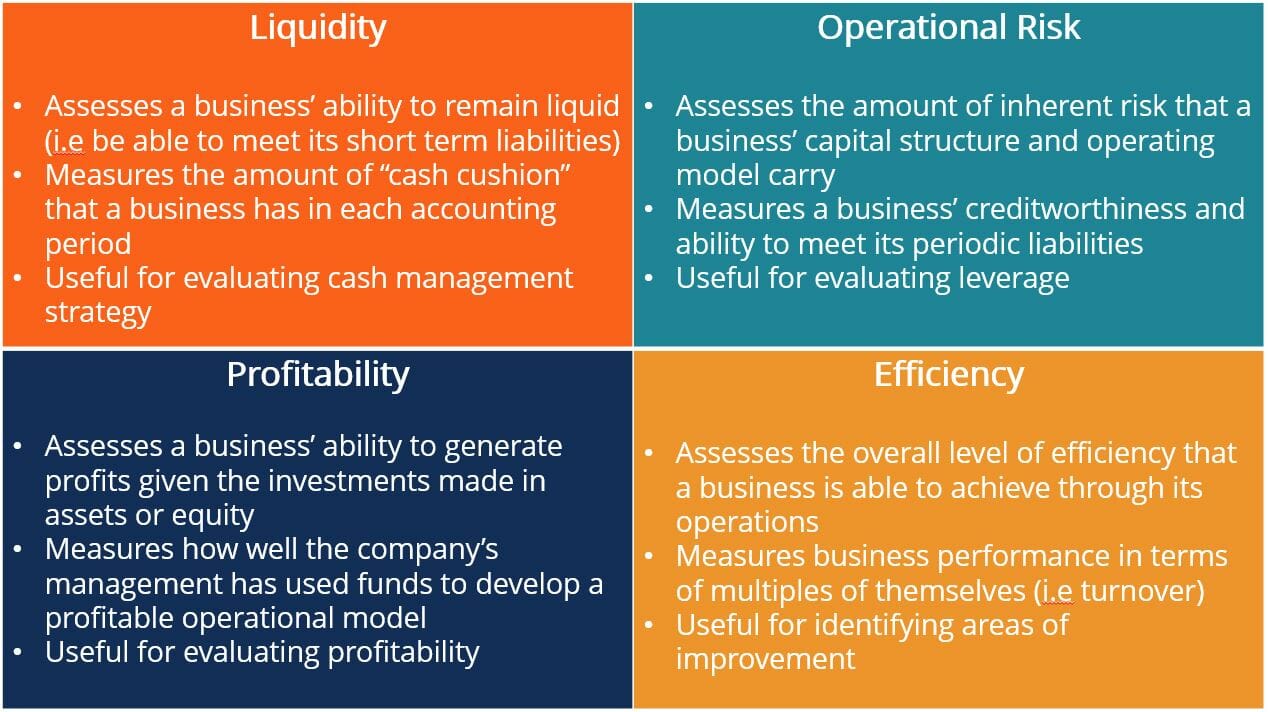
Corporate Finance Ratios can be broken down into four categories that measure different types of financial metrics for a business: Liquidity ratios, Operational Risk ratios, Profitability ratios, and Efficiency Ratios. The differences between these categories are explained in the following graphic:
How to Use Ratios?
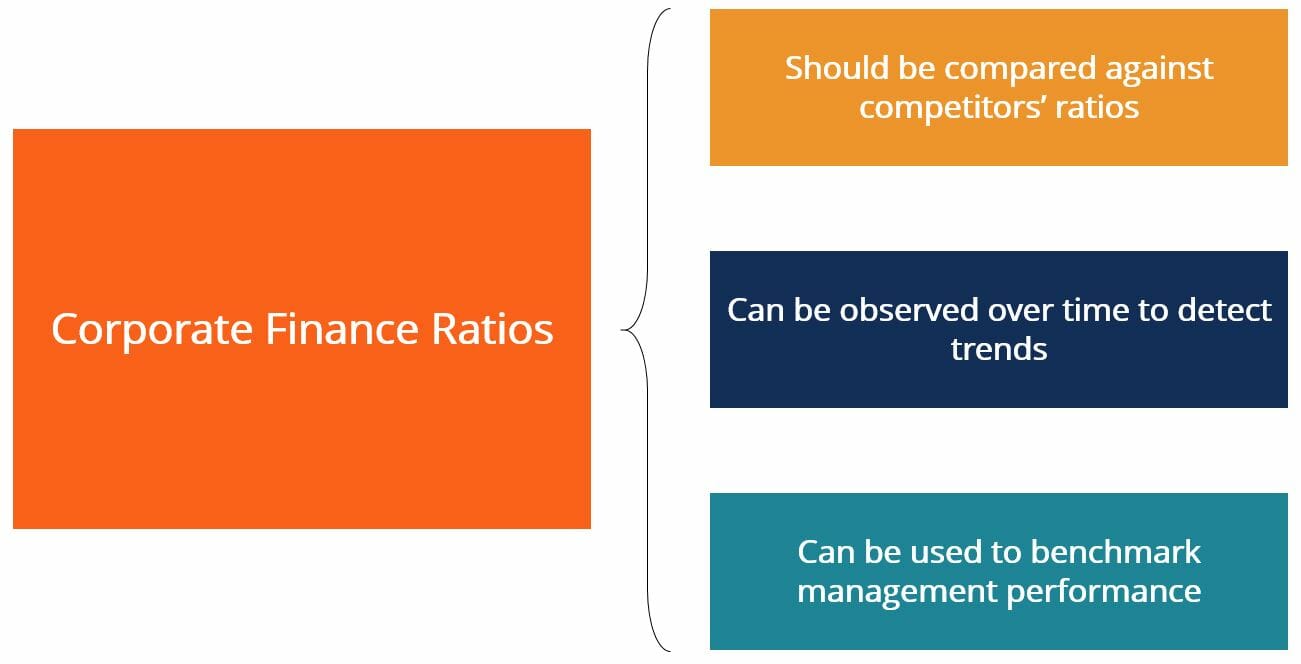
Corporate Finance Ratios enable analysts, management, and investors to assess the financial performance of a company by ranking them against time-series data, competitor ratios, or performance targets.
Ratios are not very meaningful by themselves. To draw better insights from them, we should calculate the same ratios for a number of different companies that operate within the same industry (i.e., competitors). This will enable us to better understand how well a company is performing within the context of the industry. Ratios can also be computed at various periods in time in order to see how they have evolved over time. This can be done for an individual company, or for a number of companies operating in the same industry in order to observe how specific metrics have changed.
Lastly, ratios can be used to benchmark the performance of a company’s management team against targets that were set out earlier. Some companies compensate their management teams when certain specific ratio targets are achieved. For example, a CEO may receive a special bonus if, under his tenure, the company is able to increase its return on equity by 10%.
Corporate Finance Ratios
Liquidity Ratios
CAPEX to Operating Cash RatioMeasuring how much of a company’s operating cash flow is funnelled into capital expenditure projectsCash Flow from Operations / CAPEX Cash RatioA liquidity ratio that measures a company’s ability to pay off short-term liabilities with highly liquid assetsCash and Cash Equivalents / Current Liabilities
  Current RatioMeasures a business' ability to meet its obligations that are due in less than 1 yearCurrent Assets / Current Liabilities
  Defensive Interval RatioCompares a business' current assets to its daily cash expendituresCurrent Assets / Daily Expenditures
  Operating Cash Flow RatioEvaluates a business' ability to pay off short term liabilities using the cash flow from operationsCash Flow from Operations / Current Liabilities
  Quick RatioDo the company’s current assets easily cover its current liabilities?(Cash & Equivalents + Marketable Securities + Accounts Receivable) / Current liabilities
  Times Interest Earned (Cash Basis) RatioEvaluating a company's ability to meet its debt obligations with cashAdjusted Operating Cash Flow / Interest Expense
Operational Risk Ratios
Asset Coverage RatioMeasures a business' abiliy to cover debt obligations with assets[(Total Assets - Intangible Assets) - (Current Liabilities - Short Term Debt)] / Interest Expense Cash Coverage RatioMeasures a business' abiliy to cover debt obligations with cashTotal Cash / Interest Expense
  Cash Flow to Debt RatioCalculates the percentage of debt that could be paid off using cash generated from operationsCash Flow from Operations / Total Business Debt
  Debt Service Coverage RatioEvaluates a company’s ability to use its operating income to repay its debt obligations (including interest)Operating Income / Total Debt Service
  Debt to Assets RatioEnvisioning a company's debt load in relation to its assetsTotal Debt / Total Assets
  Interest Coverage RatioMeasures a business' abiliy to cover debt obligations with operating incomeOperating Income / Interest Expense
  Times Interest Earned RatioCalculates how many times over a company could pay its interest expenses with its earnings before interest and taxesEBIT / Interest Expense
Profitability Ratios
Gross Margin RatioCalculates the percentage of revenues that are left over after COGS(Revenue - COGS) / Revenue Net Profit MarginCalculates the percentage of revenues that are left over after all expenses and taxesNet Profit / Revenue
  Operating MarginCalculates the percentage of revenues that are left over after all expensesOperating Income / Revenue
  Pretax Margin RatioDisplays Earnings Before Taxes (EBT) relative to revenuesEBT / Revenue
  Return on Assets (ROA)Quantifies how much profit the business has generated given its available assetsNet Income / Average Assets
  Return on Equity (ROE)Quantifies how much profit the business has generated given its available equity financingNet Income / Shareholder's Equity
  Return on Investment (ROI)Represents a general return figure that investors can utilize to quantify investment performanceChange in Value of Investment / Investment Cost
Efficiency Ratios
Accounts Payable Turnover RatioExpresses credit purchases as a multiple of accounts payableNet Credit Purchases / Average Accounts Payable Accounts Receivable Turnover RatioExpresses credit sales as a multiple of accounts receivableNet Credit Sales / Average Accounts Receivable
  Asset Turnover RatioExpresses net sales as a multiple of the company's total assetsNet Sales / Average Total Assets
  Contribution Margin RatioShows the percentage of earnings retained after variable costs(Total Revenue - Variable Costs) / Total Revenue
  Employee TurnoverShows the percentage of employees that have left the company (voluntarily or involuntarily)Number of Employees Separated / Average Number of Employees
  Fixed Asset TurnoverExpresses net sales as a multiple of the company's fixed assetsNet Sales / Average Fixed Assets
  Inventory TurnoverExpresses COGS as a multiple of the company's average inventoryCOGS / Average Inventory
Additional Resources
Thank you for reading this article on Corporate Finance Ratios! CFI offers the Financial Modeling & Valuation Analyst (FMVA)™Become a Certified Financial Modeling & Valuation Analyst (FMVA)®CFI's Financial Modeling and Valuation Analyst (FMVA)® certification will help you gain the confidence you need in your finance career. Enroll today! certification program for those looking to take their careers to the next level. To learn more about related topics, check out the following CFI resources:
- How to Calculate Debt Service Coverage RatioHow to Calculate Debt Service Coverage RatioThis guide will describe how to calculate the Debt Service Coverage Ratio. First, we will go over a brief description of the Debt Service Coverage Ratio, why it is important, and then go over step-by-step solutions to several examples of Debt Service Coverage Ratio Calculations.
- Current Portion of Long-Term DebtCurrent Portion of Long-Term DebtThe current portion of long-term debt is the portion of long-term debt due that is due within a year’s time. Long-term debt has a maturity of
- Accounting Fundamentals Course – CFI
- Defensive Interval RatioDefensive Interval RatioThe defensive interval ratio (DIR) is a financial liquidity ratio that indicates how many days a company can operate without needing to tap into capital sources other than its current assets. It is also known as the basic defense interval ratio (BDIR) or the defensive interval period ratio (DIPR).
-

Understanding Cash Finance Charges: What You Need to Know
Amongst the mysterious charges and fees on your credit card statement, may have noticed a "cash finance charge." If you first become aware of the cash finance charge at the end of the month,
-
![Cash Budget: Benefits & How to Limit Expenses - [Year]](https://www.etffin.com/article/uploadfiles/202109/2021092517342195_S.jpg)
Cash Budget: Benefits & How to Limit Expenses - [Year]
A cash budget is based on the money your business actually earns A cash budget is a finance tool geared toward limiting a company's expenditures to the amount of cash it actually has avai
finance
- Activity Ratios: A Comprehensive Guide to Operational Efficiency
- Understanding Key Bank Ratios: A Comprehensive Guide
- Cash Reserves: Definition, Benefits & Short-Term Needs
- Corporate Bonds: A Comprehensive Guide to Investing
- Corporate Finance: Definition, Importance & Key Concepts
- Understanding Efficiency Ratios: A Key to Business Performance
- Understanding Financial Ratios: A Comprehensive Guide
- Understanding Corporate Liquidity: Sources and Types
- Understanding Accounting Ratios: A Comprehensive Guide
-
 Understanding Cash Equivalents: Definition & Examples
Cash includes legal tender, bills, coins, checks received but not deposited, and checking and savings accounts. Cash equivalents are any short-term investment securities with maturity periods of 90 da...
-
Liquid Assets: Definition, Importance & Examples | [Your Brand Name]
Having ready access to cash is a huge component of one’s financial health. Cash and cash equivalents offer a level of financial flexibility that’s important for both individuals and businesses. So liq...