
Understanding the Cost of Preferred Stock: A Key Capital Metric
The cost of preferred stock to a company is effectively the price it pays in return for the income it gets from issuing and selling the stock. In other words, it’s the amount of money the company pays out in a year, divided by the lump sum they got from issuing the stock.
Management often uses this metric to determine what way of raising capital is most effective and cost-efficient. Corporations can issue debt, common shares, preferred shares, and a number of different instruments in order to raise funds for expansions or continuing operations. They calculate the cost of preferred stock by dividing the annual preferred dividend by the market price per share. Once they have determined that rate, they can compare it to other financing options. The cost of preferred stock is also used to calculate the Weighted Average Cost of Capital.WACCWACC is a firm’s Weighted Average Cost of Capital and represents its blended cost of capital including equity and debt.

What is Preferred Stock?
Preferred stock is a form of equity that may be used to fund expansion projects or developments that firms seek to engage in. Like other equity capital, selling preferred stock enables companies to raise funds. Preferred stock has the benefit of not diluting the ownership stake of common shareholders, as preferred shares do not hold the same voting rights that common shares do.
Preferred stock lies in between common equity and debt instruments, in terms of flexibility. It shares most of the characteristics that equity has and is commonly known as equity. However, preferred stock also shares a few characteristics of bonds, such as having a par value. Common equity does not have a par value.
Preferred vs Common Stock vs Debt
Preferred stock differs from common equity in several ways. A beneficial distinction is that preferred shareholders are first in line to receive any dividend payments. In the event of liquidation, preferred shareholders are also the first to receive payments after bondholders, but before common equity holders.
Because of the nature of preferred stock dividends, it is also sometimes known as a perpetuityPerpetuityPerpetuity is a cash flow payment which continues indefinitely. An example of a perpetuity is the UK’s government bond called a Consol.. For this reason, the cost of preferred stock formula mimics the perpetuity formula closely.
The cost of preferred stock formula:
Rp = D (dividend)/ P0 (price)
For example:
A company has preferred stock that has an annual dividend of $3. If the current share price is $25, what is the cost of preferred stock?
Rp = D / P0
Rp = 3 / 25 = 12%
It is the job of a company’s management to analyze the costs of all financing options and pick the best one. Since preferred shareholders are entitled to dividends each year, management must include this in the price of raising capitalInvestment BankingInvestment banking is the division of a bank or financial institution that serves governments, corporations, and institutions by providing underwriting (capital raising) and mergers and acquisitions (M&A) advisory services. Investment banks act as intermediaries with preferred stock.
For investors, the cost of preferred stock, once it has been issued, will vary like any other stock price. That means it will be subject to supply and demand forces in the market. In theory, preferred stock may be seen as more valuable than common stock, as it has a greater likelihood of paying a dividend and offers a greater amount of security if the company folds.
Cost of Preferred Stock Calculator
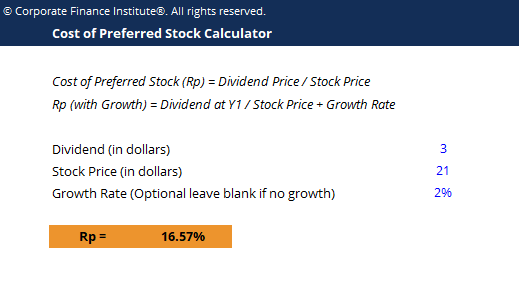
This Excel file can be used for calculating the cost of preferred stock. Simply enter the dividend (annual), the stock price (most recent) and the growth rate or the dividend payments (this is an optional field).
Download the Free Template
Enter your name and email in the form below and download the free template now!
Learn more
Thank you for reading CFI’s explanation of the cost of preferred stock. CFI is the official global provider of the Financial Modeling and Valuation Analyst (FMVA)™Become a Certified Financial Modeling & Valuation Analyst (FMVA)®CFI's Financial Modeling and Valuation Analyst (FMVA)® certification will help you gain the confidence you need in your finance career. Enroll today! certification, designed to transform anyone into a world-class financial analyst.
Check out these additional CFI resources to help you along your finance career path:
- Unlevered Cost of CapitalUnlevered Cost of CapitalUnlevered cost of capital is the theoretical cost of a company financing itself for implementation of a capital project, assuming no debt. Formula, examples. The unlevered cost of capital is the implied rate of return a company expects to earn on its assets, without the effect of debt. WACC assumes the current capital
- Unlevered BetaUnlevered Beta / Asset BetaUnlevered Beta (Asset Beta) is the volatility of returns for a business, without considering its financial leverage. It only takes into account its assets.
- CAPMCapital Asset Pricing Model (CAPM)The Capital Asset Pricing Model (CAPM) is a model that describes the relationship between expected return and risk of a security. CAPM formula shows the return of a security is equal to the risk-free return plus a risk premium, based on the beta of that security
- Debt ScheduleDebt ScheduleA debt schedule lays out all of the debt a business has in a schedule based on its maturity and interest rate. In financial modeling, interest expense flows
-

Preferred Stock: Understanding Investor Rights & Benefits
What Is a Preferred Stock? The term stock refers to ownership or equity in a firm. There are two types of equity—common stock and preferred stock. Preferred stockholders have a higher claim to
-
Average Vacation Cost: A Comprehensive Breakdown for 2024
We all love traveling. If we have the money, of course. What is the average cost of a vacation? Costs vary greatly depending on a lot of different factors — transportation
finance
- Calculating the Cost of Preferred Stock: A Comprehensive Guide
- Understanding Stock Market Proxies: A Comprehensive Guide
- Understanding Stock Market Volume: A Comprehensive Guide
- Bitcoin Mining Costs: A Comprehensive Breakdown (2024)
- Levelized Cost of Energy (LCOE): Definition & Calculation
- Participating Preferred Stock: Definition & Benefits
- Understanding Half Stocks: A Comprehensive Guide
- Non-Callable Preferred Stock: A Comprehensive Guide
- Zero-Dividend Preferred Stock: Benefits & Investor Insights
-
Understanding Participating Preferred Stock: A Comprehensive Guide
Participating preferred stock is a type of stock that is issued by a company where shareholders can receive a regular dividend payment from the company. This type of stock is issued in addition ...
-
 Preferred Stock: Understanding Rights & Benefits
...