
Levelized Cost of Energy (LCOE): Definition & Calculation
The levelized cost of energy (LCOE), also referred to as the levelized cost of electricity or the levelized energy cost (LEC), is a measurement used to assess and compare alternative methods of energy production. The LCOE of an energy-generating assetTypes of AssetsCommon types of assets include current, non-current, physical, intangible, operating, and non-operating. Correctly identifying and can be thought of as the average total cost of building and operating the asset per unit of total electricity generated over an assumed lifetime.

Alternatively, the levelized cost of energy can be thought of as the average minimum price at which the electricity generated by the asset is required to be sold in order to offset the total costs of production over its lifetime. Calculating the LCOE is related to the concept of assessing a project’s net present valueNet Present Value (NPV)Net Present Value (NPV) is the value of all future cash flows (positive and negative) over the entire life of an investment discounted to the present.. Similar to using NPV, the LCOE can be used to determine whether a project will be a worthwhile venture.
Summary
- The LCOE is a fundamental calculation used in the preliminary assessment of an energy-producing project.
- The LCOE can be used to determine whether to move forward with a project or as a means to compare different energy-producing projects.
- The formula to calculate the LCOE is (Present Value of Total Cost Over the Lifetime)/(Present Value of All Electricity Generated Over the Lifetime).
Why is the Levelized Cost of Energy Important?
The levelized cost of energy is a very important metric in determining whether or not to move forward with a project. The LCOE will determine if a project will break evenBreak Even AnalysisBreak Even Analysis in economics, financial modeling, and cost accounting refers to the point in which total cost and total revenue are equal. or be profitable. If not, then the firm will not go ahead with building the power-generating asset and will look for an alternative. Using the LCOE to assess a project is one of the first fundamental steps taken in analyzing projects of this nature.
The LCOE is also an important calculation to allow financial analystsFinancial Analyst Job DescriptionThe financial analyst job description below gives a typical example of all the skills, education, and experience required to be hired for an analyst job at a bank, institution, or corporation. Perform financial forecasting, reporting, and operational metrics tracking, analyze financial data, create financial models to compare different energy-producing technologies, such as wind, solar, and nuclear power sources. It allows for these comparisons regardless of unequal life spans, differing capital costs, size of the projects, and the differing risk associated with each project. This is because the LCOE reflects a per-unit cost of electricity generated, and the risk of each project is an implication of the specific discount rateDiscount RateIn corporate finance, a discount rate is the rate of return used to discount future cash flows back to their present value. This rate is often a company’s Weighted Average Cost of Capital (WACC), required rate of return, or the hurdle rate that investors expect to earn relative to the risk of the investment. used for each power-generating asset.
How to Calculate the LCOE?
The LCOE can be calculated by first taking the net present value of the total cost of building and operating the power generating asset. This number is then divided by the total electricity generation over its lifetime. The total costs associated with the project generally will include:
- The initial cost of investment expendituresCapital ExpenditureA capital expenditure (“CapEx” for short) is the payment with either cash or credit to purchase long term physical or fixed assets used in a (I)
- Maintenance and operations expenditures (M)
- Fuel expenditures (if applicable) (F)
The total output of the power-generating asset will include:
- The sum of all electricity generated (E)
The last two important factors to be considered in the equation are:
- The discount rateDiscount RateIn corporate finance, a discount rate is the rate of return used to discount future cash flows back to their present value. This rate is often a company’s Weighted Average Cost of Capital (WACC), required rate of return, or the hurdle rate that investors expect to earn relative to the risk of the investment. of the project (r)
- The life of the system (n)

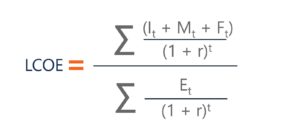
LCOE = Σ[(It + Mt + Ft) / (1 + r)t] / Σ[(Et/(1 + r)t]
Levelized Cost of Energy – Worked Example
Let us take a look at a simple levelized cost of energy example. A hypothetical wind turbine takes one year to build and costs $1.5 million. The operating and maintenance costs are $300,000 per year, with an associated growth rate of 2% annually. There are no associated fuel costs. The wind turbine’s lifespan is 10 years, and it is estimated to produce 3 million kWh each year. Finally, the associated discount rateDiscount RateIn corporate finance, a discount rate is the rate of return used to discount future cash flows back to their present value. This rate is often a company’s Weighted Average Cost of Capital (WACC), required rate of return, or the hurdle rate that investors expect to earn relative to the risk of the investment. for the project is 8%.
The following image shows the calculation of the LCOE for this project. In a comparative analysis, the figure would be calculated for numerous energy sources to be compared against one another.
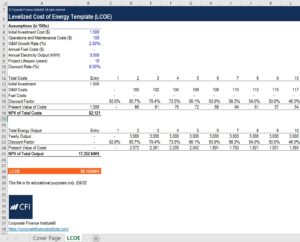
To download this free Excel calculator, check out the CFI Marketplace: Levelized Cost of Energy (LCOE) Calculator.
Lazard’s Levelized Cost of Energy Analysis
Lazard Ltd is a financial advisory and asset management firm. Near the end of each year, Lazard releases a levelized cost of energy analysis. As of 2019, they are currently on their twelfth edition. Their comparative analysis assesses several forms of energy generation, including:
- Various Solar Technologies
- Fuel Cells
- Geothermal
- Wind
- Gas
- Nuclear
- Coal
If you would like to read Lazard’s analysis, check out Lazard’s Levelized Cost of Energy Analysis – Version 12.0
Additional Resources
CFI offers the Financial Modeling & Valuation Analyst (FMVA)®Become a Certified Financial Modeling & Valuation Analyst (FMVA)®CFI's Financial Modeling and Valuation Analyst (FMVA)® certification will help you gain the confidence you need in your finance career. Enroll today! certification program for those looking to take their careers to the next level. To keep learning and developing your knowledge base, please explore the additional relevant CFI resources below:
- Net Present ValueNet Present Value (NPV)Net Present Value (NPV) is the value of all future cash flows (positive and negative) over the entire life of an investment discounted to the present.
- Discount RateDiscount RateIn corporate finance, a discount rate is the rate of return used to discount future cash flows back to their present value. This rate is often a company’s Weighted Average Cost of Capital (WACC), required rate of return, or the hurdle rate that investors expect to earn relative to the risk of the investment.
- Discounted Payback PeriodDiscounted Payback PeriodThe discounted payback period is a modified version of the payback period that accounts for the time value of money. Both metrics are used to calculate the
- Financial Modeling of a Wind ProjectFinancial Modeling Wind ProjectFinancial modeling a wind power project is a long-life energy infrastructure model that requires various assumptions and inputs. Key assumptions, examples
-

Activity-Based Budgeting (ABB): A Comprehensive Guide
Activity-based budgeting (ABB) is a budgeting method where activities are thoroughly analyzed to predict costs. ABB does not take historical costs into account when creating a budget. Summa
-

Cost of Equity: Definition, Calculation & Importance
Cost of Equity is the rate of return a company pays out to equity investors. A firm uses cost of equity to assess the relative attractiveness of investments, including both internal projects and exter
finance
- Pool Heating Costs: A Comprehensive Guide to Average Expenses & Savings
- Room Addition Costs: A Comprehensive Cost Breakdown
- Bitcoin Mining Costs: A Comprehensive Breakdown (2024)
- Understanding the Cost of Preferred Stock: A Key Capital Metric
- Understanding Long-Run Supply: Definition & Market Dynamics
- Minimum Efficient Scale (MES): Definition & Importance
- Cost Recovery Method: Understanding Revenue Recognition
- Variable Cost Ratio: Definition, Calculation & Importance
- Average Vacation Cost: A Comprehensive Breakdown for 2024
-
 Understanding Acquisition Cost: Definitions & Applications
Acquisition cost is the cost of purchasing an asset. It is generally used in three different contexts in business, which include the following:Mergers and acquisitionsFixed assetsCustomer acquisition&...
-
 Cost Principle Explained: Importance for Small Businesses | GAAP
The cost principle states that any asset should b...