
EBIT vs. EBITDA: Understanding the Key Differences
The difference between EBITEBIT GuideEBIT stands for Earnings Before Interest and Taxes and is one of the last subtotals in the income statement before net income. EBIT is also sometimes referred to as operating income and is called this because it's found by deducting all operating expenses (production and non-production costs) from sales revenue. and EBITDAEBITDAEBITDA or Earnings Before Interest, Tax, Depreciation, Amortization is a company's profits before any of these net deductions are made. EBITDA focuses on the operating decisions of a business because it looks at the business’ profitability from core operations before the impact of capital structure. Formula, examples is that Depreciation and AmortizationDepreciation ExpenseWhen a long-term asset is purchased, it should be capitalized instead of being expensed in the accounting period it is purchased in. have been added back to Earnings in EBITDA, while they are not backed out of EBIT. This guide on EBIT vs EBITDA will explain everything you need to know!
EBIT stands for: Earnings Before Interest and Taxes.
EBITDA stands for: Earnings Before Interest, Taxes, Depreciation, and Amortization.

Analyzing EBIT
As noted above, EBIT represents earnings (or net incomeNet IncomeNet Income is a key line item, not only in the income statement, but in all three core financial statements. While it is arrived at through/profit, which is the same thing) that have interest and taxes added back to them. On an income statement, EBIT can be easily calculated by starting at the Earnings Before TaxEarnings Before Tax (EBT)Earnings before tax, or pre-tax income, is the last subtotal found in the income statement before the net income line item. EBT is found line and adding back to that figure any interest expenses the company may have incurred.
Analyzing EBITDA
To spell it out one more time, EBITDA stands for Earnings Before Interest, Taxes, Depreciation, and Amortization. The additional adding back of Depreciation and Amortization is the only difference between EBIT vs EBITDA.
EBITDA can be harder to calculate from the income statementIncome StatementThe Income Statement is one of a company's core financial statements that shows their profit and loss over a period of time. The profit or. Depreciation and Amortization can be included in several spots on the income statement (in Cost of Goods Sold and as part of General & AdministrativeSG&ASG&A includes all non-production expenses incurred by a company in any given period. It includes expenses such as rent, advertising, marketing expenses, for example) and, therefore, require special focus.
The easiest way to ensure that you have the full depreciation and amortization numbers is by checking the Cash Flow StatementCash Flow StatementA cash flow Statement contains information on how much cash a company generated and used during a given period., where they will be fully broken out.
Example of EBIT vs EBITDA
The example below shows how to calculate EBIT and EBITDA on a typical income statement.
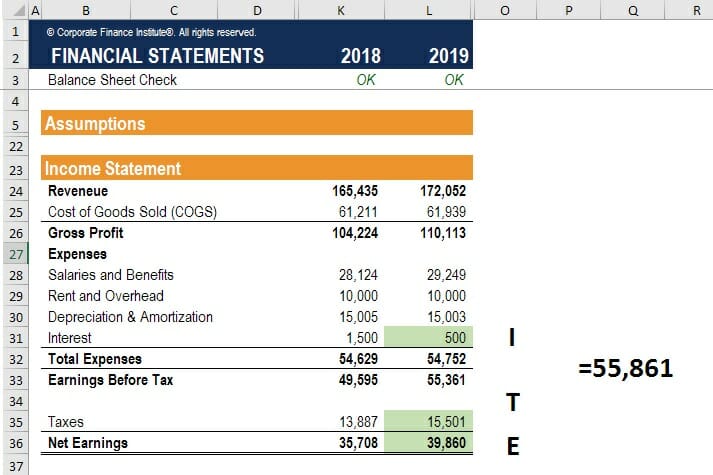
We will take you through this example step by step, so you can see how to calculate each of these metrics on your own.
For the EBIT example, let’s take the numbers in 2019, starting with Earnings, and then add back Taxes and Interest.
The EBIT formula is:
EBIT = 39,860 + 15,501 + 500 = 55,861
In the EBITDA example, let’s continue to use the 2019 data and now take everything from the EBIT example and also add back 15,003 of Depreciation.
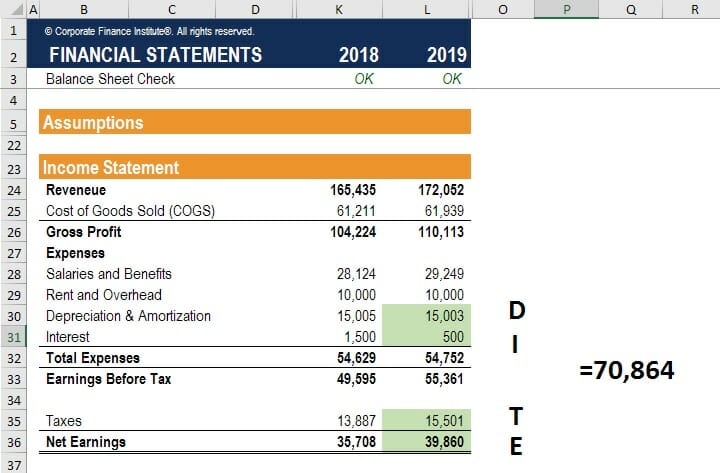
The EBITDA formula is:
EBITDA = 39,860 + 15,501 + 500 + 15,003 = 70,864
Excel Template
Download CFI’s free Excel template that compares EBITDA vs EBIT calculations. Try rebuilding the formulas and changing the numbers around to fully understand the differences.
Download the Free Template
Just enter your name and email in the form below and you can download the free template now!
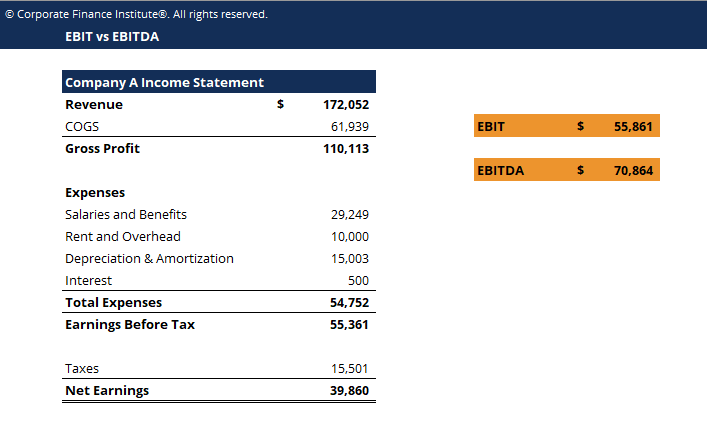
The above example of EBIT vs EBITDA shows how you can calculate the numbers by starting with earnings before tax and then adding back the appropriate line items on the income statementIncome StatementThe Income Statement is one of a company's core financial statements that shows their profit and loss over a period of time. The profit or.
When to use EBIT vs EBITDA
There is a lot of debate about which metric is better, and there are good arguments on both sides of the fence.
For a company or industry with relatively low capital expenditures required to maintain its operations, EBITDA can be a good proxy for cash flowCash FlowCash Flow (CF) is the increase or decrease in the amount of money a business, institution, or individual has. In finance, the term is used to describe the amount of cash (currency) that is generated or consumed in a given time period. There are many types of CF.
However, for companies in capital-intensive industries such as oil and gas, mining, and infrastructure, EBITDA is a near meaningless metric. The extensive amount of capital spending required means that EBITDA and cash flow will often be very far apart. In such a case, EBIT may be more appropriate, as the Depreciation and Amortization captures a portion of past capital expenditures.
To see more on the topic, we’ve outlined why Warren Buffett does not like to use EBITDAWarren Buffett - EBITDAWarren Buffett is well known for disliking EBITDA. Warren Buffett is credited for saying “Does management think the tooth fairy pays for CapEx?". As he put it, “Do people think the Tooth Fairy pays for capital expenditures?”
Depreciation vs Capital Expenditures
Depreciation doesn’t perfectly correspond to capital expenditures, but it is analogous and represents a smoothed-out version of such expenditures over time.
People who favor using EBIT explain that, over time, depreciationDepreciation ExpenseWhen a long-term asset is purchased, it should be capitalized instead of being expensed in the accounting period it is purchased in. is relatively representative of capital expenditures (Capex), and Capex is required to run the business, so it makes sense to look at earnings after depreciation.
On the other hand, capital expenditures can be extremely lumpy, and sometimes are discretionary (i.e., the money is spent on growth as opposed to sustaining the business).
People who favor using EBITDA view Capex as largely discretionary and therefore think it should be excluded.
Impact on Valuation
Capital-intensive industries will trade at very low EV/EBITDAEBITDA MultipleThe EBITDA multiple is a financial ratio that compares a company's Enterprise Value to its annual EBITDA. This multiple is used to determine the value of a company and compare it to the value of other, similar businesses. A company's EBITDA multiple provides a normalized ratio for differences in capital structure, multiples because their depreciation expense and capital requirements are so high. This means they could be a “value trap” to the untrained eye (i.e., they appear undervalued but actually are not).
EBIT multiples will always be higher than EBITDA multiples and may be more appropriate for comparing companies across different industries.
The key is to know your industry and which metrics are most commonly used and most appropriate for it.
For true intrinsic value analysis, such as in financial modeling, EBITDA is not even relevant, as we rely entirely on unlevered free cash flow to value the business.
Additional CFI Resources
We hope the above helped shed some light on the major differences of EBIT vs EBITDA. CFI is the official provider of the Financial Modeling and Valuation Analyst (FMVA)®Become a Certified Financial Modeling & Valuation Analyst (FMVA)®CFI's Financial Modeling and Valuation Analyst (FMVA)® certification will help you gain the confidence you need in your finance career. Enroll today! certification. If you want to keep exploring topics to help advance your career, we offer the following range of free resourcesCorporate Finance ResourcesFree resources to advance your corporate finance career. CFI's resource library includes Excel templates, interview prep, technical knowledge, modeling, that we believe will be extremely valuable to you.
- EV/EBITDA multiplesTypes of Valuation MultiplesThere are many types of valuation multiples used in financial analysis. They can be categorized as equity multiples and enterprise value multiples.
- Comparable company analysisComparable Company AnalysisThis guide shows you step-by-step how to build comparable company analysis ("Comps") and includes a free template and many examples.
- Financial modeling guideWhat is Financial ModelingFinancial modeling is performed in Excel to forecast a company's financial performance. Overview of what is financial modeling, how & why to build a model.
- Free accounting coursesFree Finance Courses
-

Strategic Planning vs. Financial Planning: Key Differences Explained
To be successful at chess requires strategy. The same is true of business. Strategic planning helps an organization define where it is going so it can succeed. In order to succeed in its indus
-

Credit Card vs. Debit Card: Understanding the Key Differences
Consumers today can make purchases in various ways: Debit cards, credit cards, mobile wallet payments (like Apple Pay and Google Pay), and even cash or old-style paper checks. It’s not surpris
finance
- Collateral vs. Guaranteed Loans: Understanding the Key Differences
- Personal Check vs. Bank Check: Key Differences Explained
- Executor vs. Personal Representative: Understanding the Terms
- Blend Funds vs. Balanced Funds: Understanding the Key Differences
- ETFs vs. Index Funds: A Comprehensive Comparison for Investors
- Stocks vs. ETFs: Understanding the Key Differences
- 401(k) vs. IRA: Understanding Retirement Savings Options
- Blockchain ETFs vs. Bitcoin ETFs: Understanding the Key Differences
- SIP vs. Mutual Fund: Understanding the Key Differences
-
 Bull vs. Bear Market: Understanding Market Cycles
A couple of stock market terms that might be familiar even to newer investors are “bull market” and “bear market.” These terms actually have nothing to do with the sale of red capes or wholesale ho...
-
 Pre-Qualified vs. Pre-Approved Loans: Understanding the Difference
Highlights: Both pre-qualified and pre-approved mean that a lender has reviewed your financial situation and determined that you meet at least some of their requirements to be approved for...