
EBIT Explained: Understanding Earnings Before Interest & Taxes
EBIT stands for Earnings Before Interest and Taxes and is one of the last subtotals in the income statementIncome StatementThe Income Statement is one of a company's core financial statements that shows their profit and loss over a period of time. The profit or before net income. EBIT is also sometimes referred to as operating income and is called this because it’s found by deducting all operating expenses (production and non-production costs) from sales revenueSales RevenueSales revenue is the income received by a company from its sales of goods or the provision of services. In accounting, the terms "sales" and.
Dividing EBIT by sales revenue shows you the operating margin, expressed as a percentage (e.g., 15% operating margin). The margin can be compared to the firm’s past operating margins, the firm’s current net profit margin and gross margin, or to the margins of other, similar firms operating in the same industry.
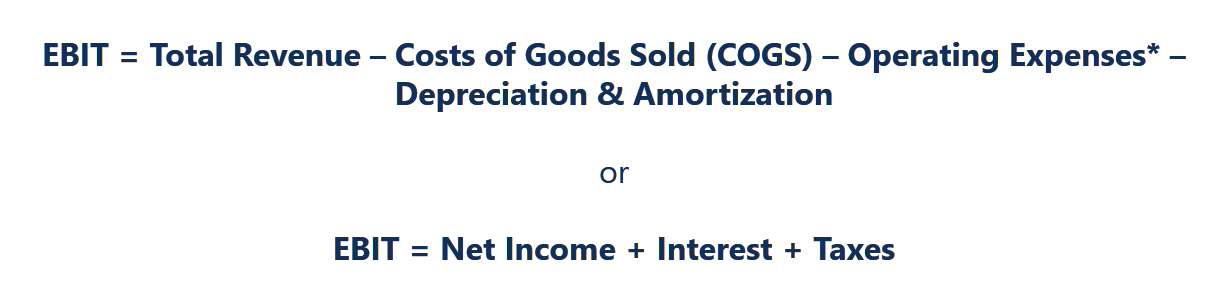
EBIT Formula
Earnings Before Interest and Taxes can be calculated in two ways. The first is by starting with EBITDA and then deducting depreciation and amortization. Alternatively, if a company does not use the EBITDA metric, operating income can be found by subtracting SG&ASG&ASG&A includes all non-production expenses incurred by a company in any given period. It includes expenses such as rent, advertising, marketing (excluding interestInterest ExpenseInterest expense arises out of a company that finances through debt or capital leases. Interest is found in the income statement, but can also but including depreciation) from gross profit.
Here are the two EBIT formulas:
EBIT = Net Income + Interest + Taxes
EBIT = EBITDA – Depreciation and Amortization Expense
Starting with net income and adding back interest and taxes is the most straightforward, as these items will always be displayed on the income statement. Depreciation and amortization may only be shown on the cash flow statement for some businesses.
Proxy for Free Cash Flow
Earnings Before Interest and Taxes can be used as a proxy for free cash flow in some industries – it works well as long as it’s applied to stable, mature companies with relatively consistent capital expenditures. The EBIT metric is closely tied to free cash flowFree Cash Flow (FCF)Free Cash Flow (FCF) measures a company’s ability to produce what investors care most about: cash that's available be distributed in a discretionary way. (FCF).
FCF can be found through the following formula:
FCF = EBIT (1 – T) + D&A + Δ NWC – CapEx
Where:
FCF = Free Cash Flow
T = Average Tax Rate
Δ NWC = Change in Non-Cash Working Capital
CapEx = Capital Expenditures
To learn more, see our guides to Cash FlowCash FlowCash Flow (CF) is the increase or decrease in the amount of money a business, institution, or individual has. In finance, the term is used to describe the amount of cash (currency) that is generated or consumed in a given time period. There are many types of CF and Free Cash FlowFree Cash Flow (FCF)Free Cash Flow (FCF) measures a company’s ability to produce what investors care most about: cash that's available be distributed in a discretionary way..
EV/EBIT Multiple
The EV/EBITDA multiple is often used in comparable company analysisComparable Company AnalysisThis guide shows you step-by-step how to build comparable company analysis ("Comps") and includes a free template and many examples. to value a business. By taking the company’s Enterprise Value (EV) and dividing it by the company’s annual operating income, we can determine how much investors are willing to pay for each unit of EBIT.
Example:
A company reported a market capitalization of $50M, a debt of $20M, and cash of $10M. The company also posted a 2017 net income of $4M, taxes of $1M, and interest expense of $1M. What is it’s 2017 EV/EBIT multiple?
Solution:
EV = $50M + $20M – $10M = $60M
EBIT = $4M + $1M + $1M = $6M
2017 EV/EBIT = 10.0x
Download the Free Template
Enter your name and email in the form below and download the free template now!
Why Use EBIT
Investors use Earnings Before Interest and Taxes for two reasons: (1) it’s easy to calculate, and (2) it makes companies easily comparable.
#1 – It’s very easy to calculate using the income statement, as net income, interest, and taxes are always broken out.
#2 – It normalizes earnings for the company’s capital structure (by adding back interest expense) and the tax regime that it falls under. The logic here is that an owner of the business could change its capital structure (hence normalizing for that) and move its head office to a location under a different tax regime. Whether or not these are realistic assumptions is a separate issue but, in theory, they are both possible.
More Resources
We hope this has been a helpful guide to Earnings Before Interest and Taxes, including, how to calculate it, what it’s used for, and why it matters to investors. To continue building your corporate finance knowledge base we highly recommend these related CFI articles and guides:
- EBIT vs EBITDAEBIT vs EBITDAEBIT vs EBITDA - two very common metrics used in finance and company valuation. There are important differences, pros/cons to understand.
- Valuation MultiplesMultiples AnalysisThe multiples analysis is a valuation technique that utilizes different financial metrics from comparable companies to value a target company.
- Analysis of Financial StatementsAnalysis of Financial StatementsHow to perform Analysis of Financial Statements. This guide will teach you to perform financial statement analysis of the income statement,
- How to be a World-class Financial AnalystThe Analyst Trifecta® GuideThe ultimate guide on how to be a world-class financial analyst. Do you want to be a world-class financial analyst? Are you looking to follow industry-leading best practices and stand out from the crowd? Our process, called The Analyst Trifecta® consists of analytics, presentation & soft skills
-

Bitcoin Cash (BCH): A Comprehensive Overview - Features, History & Future
Bitcoin Cash (BCH) is a cryptocurrency created from a hard fork of Bitcoin. It is meant to have quicker transactions than Bitcoin. The fork occurred at block 478,559. At that block the Bitcoin bl
-

Synthetic Cash: Understanding Simulated Financial Instruments
Synthetic cash is a financial instrument that is created to function like other financial instruments, but certain characteristics of the simulated financial instrument are altered. The simulated inst
finance
- Understanding Cash Consideration in Mergers & Acquisitions
- Understanding Cash Flow: A Comprehensive Guide
- Cash Management: A Comprehensive Guide to Financial Stability
- Cash-on-Cash Return: Definition, Calculation & Importance
- Cash Ratio: Understanding Your Company's Short-Term Liquidity
- Cash Sweep: Reduce Debt & Maximize Earnings | [Your Company Name]
- Disbursement Explained: Definition, Impact & Accounting Implications
- Understanding Discretionary Income: Definition & Examples
- EBITDA Explained: Understanding Earnings Before Interest, Taxes, Depreciation & Amortization
-
 Understanding Cash Flow from Operations: A Comprehensive Guide
Cash flow from operations is the section of a company’s cash flow statementCash Flow StatementA cash flow Statement contains information on how much cash a company generated and used duri...
-
Net Income Explained: A Comprehensive Guide for Businesses & Individuals
Net income is revenue minus expenses, interest, and taxes. Here’s what you need to know about net income and why businesses and individuals pay close attention to it.What is net income?Net income is a...