
HELOC: Understanding Home Equity Lines of Credit
A Home Equity Line of Credit (HELOC) is a line of creditBank LineA bank line or a line of credit (LOC) is a kind of financing that is extended to an individual, corporation, or government entity, by a bank or other given to a person using their house as collateralCollateralCollateral is an asset or property that an individual or entity offers to a lender as security for a loan. It is used as a way to obtain a loan, acting as a protection against potential loss for the lender should the borrower default in his payments.. It is a type of loan in which a bank or financial institution authorizes the borrower to access loan funds as needed, up to a specified maximum amount. Since the collateral is a house, a HELOC is mostly used for large expenditures, such as major home renovations, the purchase of property, payment of medical bills, or education.

Summary
- A home equity line of credit (HELOC) is a loan using a house as collateral.
- As a line of credit, the borrower can use any amount up to the approved maximum.
- There are traditional and hybrid HELOCs. The payment schedule and amount depend on the type.
HELOC vs. Mortgage
The structure of a HELOC is different from a mortgageMortgageA mortgage is a loan – provided by a mortgage lender or a bank – that enables an individual to purchase a home. While it’s possible to take out loans to cover the entire cost of a home, it’s more common to secure a loan for about 80% of the home’s value., but both use a home as collateral. When a person decides to use a mortgage to purchase a house, they get the entire sum of the mortgage up front. On the other hand, a HELOC is more like revolving credit card debt. The person with the HELOC can borrow up to a certain maximum amount at whatever time they choose.
The second difference is the interest rate attached to the loans. For most mortgages, there is a fixed interest rate that is decided at the time the mortgage is signed. For a HELOC, there is usually a floating rate that is based on the prime lending ratePrime RateThe term “prime rate” (also known as the prime lending rate or prime interest rate) refers to the interest rate that large commercial banks charge on loans and products held by their customers with the highest credit rating.. This makes a HELOC riskier as the borrower may have to deal with volatile interest rates. If the prime lending rate suddenly increases, then the borrower will have to shoulder the increased payments.
The third difference is the payment of the loans. For a mortgage, there are fixed interest and principal paymentsPrincipal PaymentA principal payment is a payment toward the original amount of a loan that is owed. In other words, a principal payment is a payment made on a loan that reduces the remaining loan amount due, rather than applying to the payment of interest charged on the loan.. They are often paid on a monthly basis and are decided when the mortgage is signed. A HELOC only requires interest payments. This, again, is similar to a credit card in which only a minimum payment is required and the principal payments can be pushed back. If a borrower uses $10,000 of the HELOC on a 2% interest rate, the borrower only needs to pay back $200 in interest and not the principal amount of $10,000. The principal is only required at the specified end of the draw period.
Different Types of HELOC
HELOCs are separated into traditional and hybrid categories. A traditional HELOC is as described above. The interest rate is floating and is subject to change, and there are no fixed payment requirements. The requirements for a traditional HELOC are more stringent. They typically enable the homeowner to borrow up to 65% of their home’s value. To qualify for a HELOC, the borrower usually needs to have at least 20% home equity.
A hybrid HELOC allows homeowners to borrow up to 80% of the home’s value. Hybrid HELOCs are more like mortgages, as a portion amortizes, which means it requires payments of both principal and interest.
Traditional HELOCs are considered riskier for lenders. This is due to the fact that borrowers only need to pay the interest payment, which is based on a floating rate. If the interest rate suddenly rises, then homeowners may find themselves in a situation in which they can not make the required payments.
Also, as with a mortgage loan, falling home prices may leave borrowers with “negative equity.” This means they owe more debt on their home than what their property is worth.
HELOC Example
Below is the information for homeowner A:
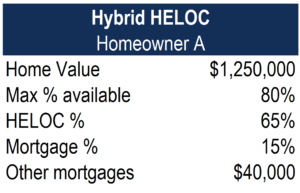
The appraised home value is $1,250,000. Since the homeowner is applying for a hybrid HELOC, the maximum amount available for the line of credit is 80% of the home value. For this hybrid product, the HELOC portion is 65%, while the amortizing mortgage portion is 15%.
Below is the calculation for Homeowner A’s maximum HELOC credit limit:
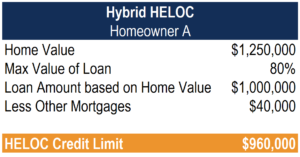
The HELOC credit limit can be calculated by taking the maximum amount available for the line of credit and subtracting the outstanding mortgage amount. The HELOC available for Homeowner A is $960,000.
Below is the information for homeowner B:
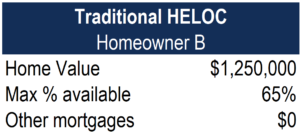
The appraised home value is $1,250,000, and the homeowner does not have other loans that use the house as collateral. For a traditional HELOC, the maximum amount available is 65% of home value.
Below is the calculation for Homeowner B’s maximum HELOC credit limit:
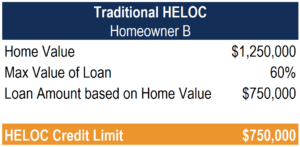
To arrive at the HELOC credit limit, multiply the home value with the max value of the loan percentage. Since this homeowner does not have other outstanding loans, the max HELOC limit is $750,000.
Additional Resources
Thank you for reading CFI’s article on the home equity line of credit (HELOC). To keep learning and advancing your career, these additional CFI resources will be helpful:
- Amortization AmortizationAmortization refers to the process of paying off a debt through scheduled, pre-determined installments that include principal and interest
- Revolving DebtRevolving DebtA revolving debt (a "revolver", also sometimes known as a line of credit, or LOC) does not feature fixed monthly payments. It differs from a fixed payment or term loan that has a guaranteed balance and payment structure. Instead, the payments of revolving debt are based on the balance of credit every month.
- Short Term LoanShort Term LoanA short term loan is a type of loan that is obtained to support a temporary personal or business capital need.
- Asset Based LoansAsset-Based LoansAsset-based loans involve something physical (an asset) that is used as collateral for a loan. For most companies, it is inventory or accounts receivable that act as the collateral. However, any asset whose value can be accurately quantified may potentially be used as collateral.
-

Cashback Credit Cards: A Comprehensive Guide
Cashback is a credit card perk where a percentage of eligible purchases made on the credit card is paid back to the cardholder. The concept of cashback gained mainstream traction in 1986 whe
-

Credit Analysis: A Comprehensive Guide to Assessing Credit Risk
Credit analysis is the process of determining the ability of a company or person to repay their debt obligations. In other words, it is a process that determines a potential borrower’s credit ri
finance
- Home Equity Line of Credit (HELOC): Understanding How It Works
- Mortgage Interest Credit: Tax Benefits & Eligibility
- Closing a Home Equity Line of Credit: A Step-by-Step Guide
- Bank Line of Credit (LOC): Definition & How It Works
- Cash Credit (CC): A Comprehensive Guide for Businesses
- Home Equity Line of Credit (HELOC): Understanding and Benefits
- HELOCs Explained: Flexible Home Equity Financing
- Understanding Home Equity: A Comprehensive Guide
- Personal Line of Credit (PLOC): Understanding and Benefits
-
 Understanding Add-On Interest: How It Works & Loan Payments
Add-on interest refers to the calculation method of determining the total interest to be paid on a loan. Once the interest’s been added to the principal, the amount is divided by the number of m...
-
 Backstop: Understanding Financial Safety Nets and Contingency Funding
A backstop is a financial arrangement that creates a secondary source of funds in case the primary source is not enough to meet current needs. It can also be thought of as an insurance policy that cov...