
Backstop: Understanding Financial Safety Nets and Contingency Funding
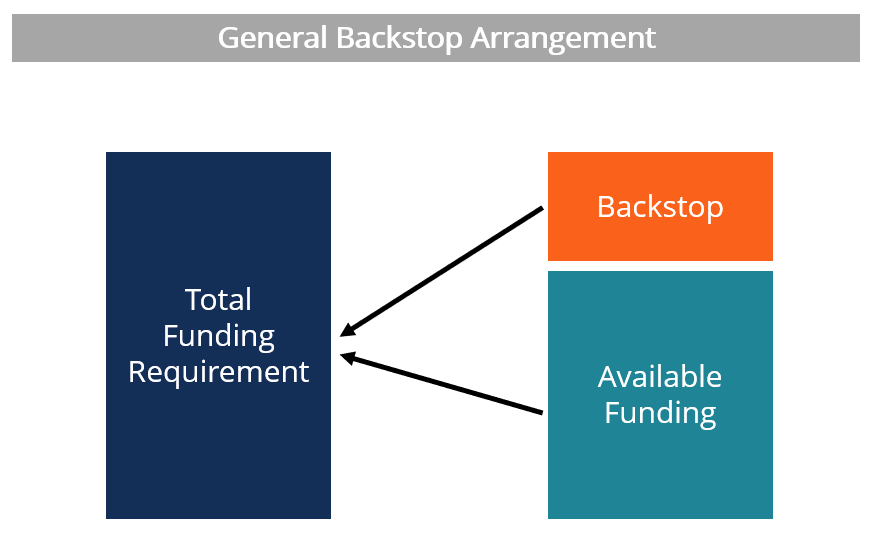
A backstop is a financial arrangement that creates a secondary source of funds in case the primary source is not enough to meet current needs. It can also be thought of as an insurance policy that covers the inadequacy of a source of funds.
The backstop can take various forms in different contexts. The following are three applications that will be discussed in some detail in later sections:
- Backstop in underwriting
- Private equity backstop
- Backstop in financial management
Backstop in Underwriting
The most common use of a backstop is seen in underwriting share issues or initial public offerings (IPOs)Initial Public Offering (IPO)An Initial Public Offering (IPO) is the first sale of stocks issued by a company to the public. Prior to an IPO, a company is considered a private company, usually with a small number of investors (founders, friends, family, and business investors such as venture capitalists or angel investors). Learn what an IPO is. In an IPO, a company wishing to raise equity capital issues its shares to the public. The issues are underwritten by an investment bank or a group of investment banks.
If a company is unable to sell all its shares to the public, then the underwriter provides a backstop provision. Under the provision, the underwriter will buy the remaining shares that were not bought by the public.
Such an arrangement is provided in exchange for a backstop fee, which is typically calculated as a percentage of the total issue.
Example
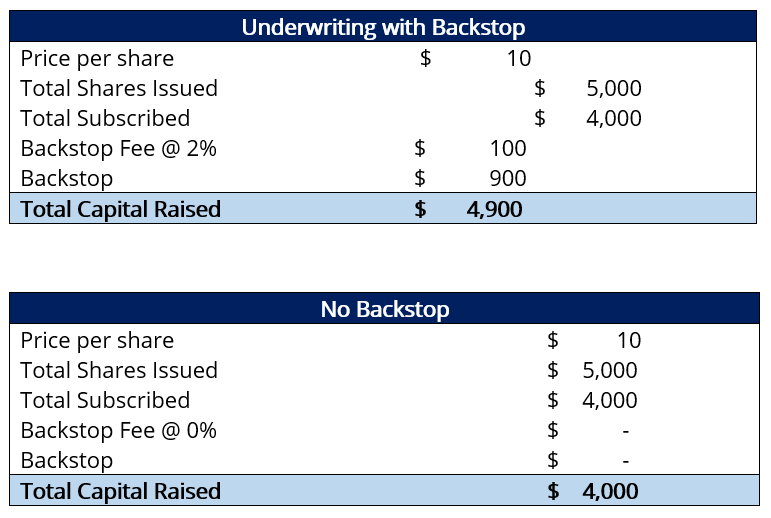
Consider a company that wishes to raise equity capital and issues 500 shares. Of the 500, only 400 shares are bought by the public. If the company did not enter into a backstop arrangement, then it must work with a lesser amount.
On the other hand, the company can pay a small fee and sell the remaining shares to the underwriters. Hence, they will be able to meet their funding requirements more closely. The following tables illustrate the two scenarios:
Private Equity Backstop
A private equity firm typically uses the leveraged buyout (LBO)Leveraged Buyout (LBO)A leveraged buyout (LBO) is a transaction where a business is acquired using debt as the main source of consideration. method to acquire target companies. Under the LBO method, the firm finances the purchase of the target using mostly debt and contributes the remainder in the form of equity.
A private equity backstop, also known as the full equity backstop, is an arrangement in which a private equity firm agrees to buy the target company by contributing equity up to 100% in case it fails to raise the required debt to fund the purchase.
The private equity firm employs such a strategy with a significant potential loss to itself. It is significant because it essential to use a larger portion of debt compared to equity in an LBO strategy. Hence, a full equity backstop mostly uses an aggressive posturing tool in negotiationsNegotiation TacticsNegotiation is a dialogue between two or more people with the aim of reaching a consensus over an issue or issues where conflict exists. Good negotiation tactics are important for negotiating parties to know in order for their side to win or to create a win-win situation for both parties. to make the deal more attractive to the target company and raise the stakes for the competition.
Backstop in Financial Management
Another important application of the backstop is in the day-to-day financial management of a company. The backstop typically takes the form of a revolving credit facility. A revolving credit facility is a simple short-term lending arrangement where the borrower is allowed to borrow a certain amount up to a maximum every year or a shorter period.
A revolving credit facilityRevolving Credit FacilityA revolving credit facility is a line of credit that is arranged between a bank and a business. It comes with an established maximum amount, and the can be used as a backstop to fulfill any shortage of funds that might arise in the short term.
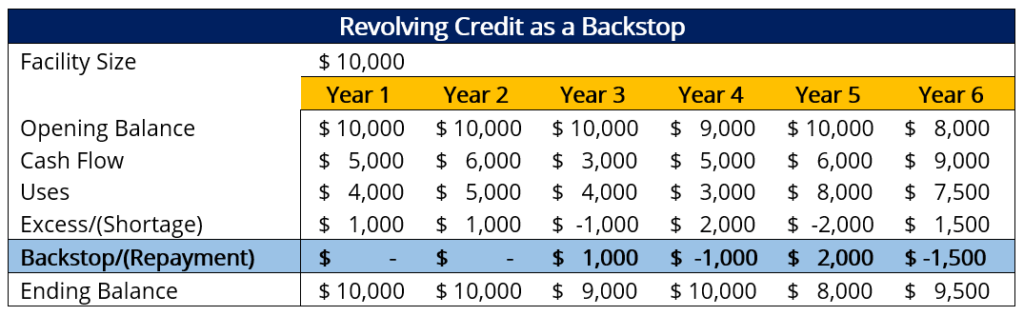
For example, in the table below, the company faces a shortage of $1,000 in Year 3. The company can use the revolving credit facility as a secondary source of financing to borrow $1,000 and meet all its financial obligations for the year. Hence, a revolving credit facility acts as a backstop for the short-term financing needs of the business.
Additional Resources
CFI is the official provider of the global Commercial Banking & Credit Analyst (CBCA)™Program Page - CBCAGet CFI's CBCA™ certification and become a Commercial Banking & Credit Analyst. Enroll and advance your career with our certification programs and courses. certification program, designed to help anyone become a world-class financial analyst. To keep advancing your career, the additional CFI resources below will be useful:
- Bridge FinancingBridge FinancingBridge financing is a form of temporary financing intended to cover a company’s short-term costs until regular long-term financing is secured.
- Bullet LoanBullet LoanA bullet loan is a type of loan in which the principal that is borrowed is paid back at the end of the loan term. In some cases, the interest expense is
- Commercial Loan AgreementCommercial Loan AgreementA commercial loan agreement refers to an agreement between a borrower and a lender when the loan is for business purposes. Every time a substantial amount of money is borrowed, an individual or organization must enter into a loan agreement. The lender provides the money, provided the borrower agrees to all the loan stipulations
- Debt CovenantDebt CovenantsDebt covenants are restrictions that lenders (creditors, debt holders, investors) put on lending agreements to limit the actions of the borrower (debtor).
-

Understanding Deficit Equity: Causes, Impacts & Solutions
Deficit equity, more commonly referred to as negative owners' equity, results when the total value of an organization's assets is less than the sum total of its liabilities. In any company, &q
-
Equity Co-Investment: Definition & How It Works
An equity co-investment (or co-investment) is a minority investment Minority InterestMinority interest refers to having a stake in a company that is less than 50% of the total shares in terms of votin
finance
- Cost of Equity: Definition, Calculation & Importance
- Understanding Equity: A Comprehensive Guide for Investors
- Equity Crowdfunding: A Comprehensive Guide for Startups & Investors
- Equity Multiplier: Definition, Calculation & Financial Significance
- Equity Ratio: Understanding Financial Leverage & Risk
- Understanding Negative Equity: Causes, Risks & Solutions
- Growth Equity: Investing in Expanding Businesses | [Your Company Name]
- Understanding Equity Statements: A Comprehensive Guide
- Understanding Home Equity: A Comprehensive Guide
-
 Margin Equity Percentage: Understanding Your Brokerage Loan Limits
A brokerage margin account allows an investor to buy stocks and other securities with a portion of the purchase price paid with a margin loan from the broker. A brokerage margin account allow...
-
 Understanding Liquid Equity: A Guide to Company Stock
Liquid equities can be bought and sold quickly. Equity is another name for a company stock. When you buy shares in company stock, you take an ownership interest in the company and each share ...