
Calculating Free Cash Flow to Equity (FCFE): A Comprehensive Guide
Free Cash Flow to Equity (FCFE)Free Cash Flow to Equity (FCFE)Free cash flow to equity (FCFE) is the amount of cash a business generates that is available to be potentially distributed to shareholders. It is calculated as Cash from Operations less Capital Expenditures. This guide will provide a detailed explanation of why it’s important and how to calculate it and several is the amount of cash generated by a company that can be potentially distributed to its shareholders. FCFE is a crucial metric in one of the methods in the Discounted Cash Flow (DCF) valuation modelSum Of The Parts (SOTP) ValuationSum Of The Parts (SOTP) valuation is an approach to valuing a firm by separately assessing the value of each business segment or subsidiary and adding them. Using the FCFE, an analyst can determine the Net Present Value (NPV)Net Present Value (NPV)Net Present Value (NPV) is the value of all future cash flows (positive and negative) over the entire life of an investment discounted to the present. of a company’s equity, which can be subsequently used to calculate the theoretical share price of the company.
The FCFE is different from the Free Cash Flow to Firm (FCFF)Free Cash Flow to Firm (FCFF)FCFF, or Free Cash Flow to Firm, is cash flow available to all funding providers in a business. debt holders, preferred stockholders, common shareholders, which indicates the amount of cash generated to all holders of the company’s securities (both investors and lenders).
FCFE from EBIT Formula
Earnings before interest and taxes (EBIT)EBIT GuideEBIT stands for Earnings Before Interest and Taxes and is one of the last subtotals in the income statement before net income. EBIT is also sometimes referred to as operating income and is called this because it's found by deducting all operating expenses (production and non-production costs) from sales revenue. is one of the most crucial metrics of a company’s profitability. It assesses all the company’s incomes and expenses, excluding interest and tax expenses.
One of the methods of calculating the free cash flow to equity (FCFE) involves the use of EBIT. Recall that the company’s net income is related to EBIT through the following equation:
Net Income = EBIT – Interest – Taxes
Thus, we can substitute net income in the FCFE from net income formula with the equation above:
FCFE = EBIT – Interest – Taxes + Depreciation & Amortization – ΔWorking Capital – CapEx + Net Borrowing
Where:
- FCFE – Free Cash Flow to Equity
- EBIT – Earnings Before Interest and Taxes
- ΔWorking Capital – Change in the Working Capital
- CapEx – Capital Expenditure
The abovementioned approach to calculating the FCFE provides a more detailed overview of the composition of the free cash flows to equity (FCFE). Note that this level of granularity is not always required in a financial model.
In some cases, it can result in negative effects, as it complicates the comprehension of a model. However, it is acceptable to apply this variation of FCFE calculation when the assessment of the company’s profitability from its regular business activities is essential.
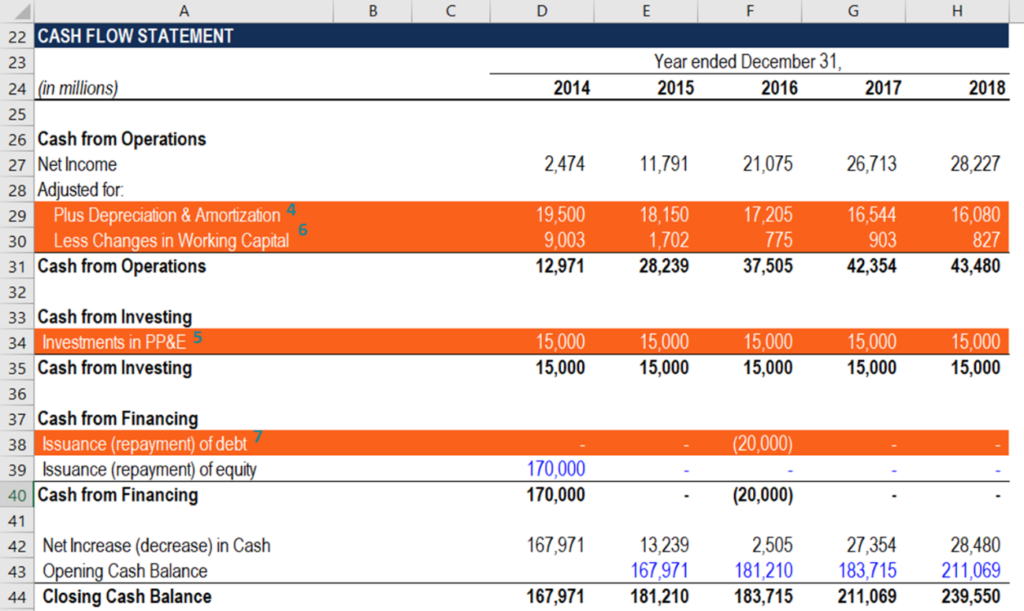
FCFE from CFO Formula and Financial Statements
An analyst who calculates the free cash flows to equity in a financial model must be able to quickly navigate through financial statements. The primary reason is that all the inputs required for the calculation of the metric are taken from the financial statements. The guidance below will help you to quickly and correctly incorporate the FCFE from EBIT calculation into a financial model.
- EBIT: The company’s earnings before interests and taxes (EBIT) are recorded on the company’s income statement.
- Interest: The company’s interest expenses are located on the income statement after EBIT.
- Taxes: The tax payments can also be found on the income statement after the earnings before taxes (EBT).
- Depreciation & Amortization: The depreciation and amortization expense is recorded on the company’s income statement under the Expenses section. The section follows the company’s gross profit. Similar to net income, the depreciation and amortization expense is also listed on the cash flow statement, in the Cash from Operations section.
- CapEx: The capital expenditure (CapEx) can be found on the cash flow statement within the Cash from Investing section.
- Change in Working Capital (can also be denoted as ΔWorking Capital) is calculated in the company’s cash flow statement within the Cash from Operations section.
- Net Debt: The net debt amount is also located on the cash flow statement, under the Cash from Investing section.
Additional Resources
CFI offers the Financial Modeling & Valuation Analyst (FMVA)™Become a Certified Financial Modeling & Valuation Analyst (FMVA)®CFI's Financial Modeling and Valuation Analyst (FMVA)® certification will help you gain the confidence you need in your finance career. Enroll today! certification program for those looking to take their careers to the next level. To keep learning and advancing your career, the following CFI resources will be helpful:
- Cost of EquityCost of EquityCost of Equity is the rate of return a shareholder requires for investing in a business. The rate of return required is based on the level of risk associated with the investment
- EBIT vs EBITDAEBIT vs EBITDAEBIT vs EBITDA - two very common metrics used in finance and company valuation. There are important differences, pros/cons to understand.
- Operating IncomeOperating IncomeOperating income is the amount of revenue left after deducting the operational direct and indirect costs from sales revenue.
- Valuation MethodsValuation MethodsWhen valuing a company as a going concern there are three main valuation methods used: DCF analysis, comparable companies, and precedent transactions
-

Visa Cash Advance: Understanding Fees, Rates & How to Access Funds
A pocket book holding credit cards and cash. Many credit cards offer the ability to secure a cash advance against your credit line. While this can be convenient if you're desperate for mo
-

Calculate Your Monthly Interest Rate: A Simple Guide
Some banks compound interest on a monthly basis. APR stands for annual percentage rate, which equals the periodic rate times the number of periods per year. The APR does not take into conside
finance
- Credit Card Cash Advances: How They Work & Associated Costs
- Cashing a PayPal Check: A Step-by-Step Guide
- Calculate Operating Cash Flow: A Step-by-Step Guide
- Calculating Cash Inflow: A Guide for Businesses
- EBIT Calculation: A Simple Guide for Investors
- Net Advantage to Leasing (NAL): A Comprehensive Calculation Guide
- Calculating Free Cash Flow to Equity (FCFE) from EBITDA: A Step-by-Step Guide
- Calculate Free Cash Flow to Equity (FCFE) from Net Income: A Step-by-Step Guide
- Calculating Cash Flow from Investing Activities: A Step-by-Step Guide
-
 Credit Card Cash Advance: How to Withdraw Cash & Fees
You can get cash from credit cards. Most general purpose credit cards such as MasterCard, Visa and Discover come with a cash advance capability. The cardholder is usually entitled to obtain a...
-
 Understanding and Calculating Financial Risk: A Comprehensive Guide
Financial risk in the investment world is measured in terms of debt. Those companies which issue more debt are said to have higher financial risk. This is in contrast to companies which are primarily ...