
Monetization Explained: Turning Assets into Revenue
The word “monetize” is used to refer to the process of converting an item into cash. In the banking sector, monetize may be used to mean the process of turning an asset into legal tender. It can also be used informally to mean the exchange of possession for a cash equivalent – such as charging fees for intellectual property or selling a security interest.
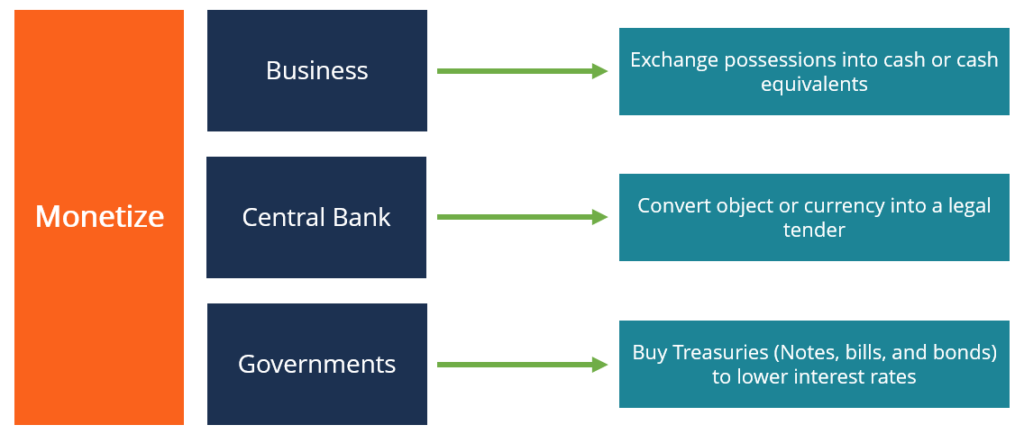
In technology, “to monetize data” means converting information assets into economic value. In the U.S., the phrase “to monetize debts” is a process where the Federal ReserveFederal Reserve (The Fed)The Federal Reserve is the central bank of the United States and is the financial authority behind the world’s largest free market economy. purchases government debts following the liquidation of individual holdings. The purchases increase the banking system’s reserves, and eventually, the money stock.
Summary
- Monetization is the process of changing something that does not generate revenue into cash.
- Monetization is a significant aspect of a company’s business strategy for generating a profit and ensuring sustainability.
- In the U.S., the Federal Reserve monetizes debt to curb a potential financial crisis.
Understanding Monetization
The term “monetize” comes with different meanings, depending on the context. Governments can issue debt to finance deficit spending or keep interest rates on borrowed money low. The concept is referred to as debt monetization. On the other hand, businesses monetize products to generate profit.
Economic processes characteristics of monetization represent a milestone in the development of capitalismCapitalismCapitalism is an economic system that allows for and encourages the private ownership of businesses that operate to generate profit. Also, and they are just about as old. The process of monetizing is crucial to strategic planning; hence, it plays a significant role in the growth of businesses or other entities.
As with most other central banks, the Fed’s primary goal is to promote price stability and maximize sustainable economic growth. In the process of attaining its goal, the needs of a growing economy lead to the expansion of the money supply.
How the Fed Monetizes the Debt
The Federal Reserve monetizes U.S. debt by purchasing government securities. The securities are issued by the Treasury – hence, collectively called Treasuries. The US Treasury pays interest on the securities to the Federal Reserve, which can also return the interest income to the Treasury.
The Fed monetizes government debt by the simple act of exchanging money for government debt, which the government uses to finance its deficit spending without printing more money. When the Fed buys the Treasuries, the high-powered money increases and decreases when it sells the securities. The process puts money back into the system while putting the government’s debt on the Fed’s books.
The government can also buy its own debt by printing excess money. Such an option is considered less desirable because it can result in a financial crisis by increasing the money supply and causing inflationInflationInflation is an economic concept that refers to increases in the price level of goods over a set period of time. The rise in the price level signifies that the currency in a given economy loses purchasing power (i.e., less can be bought with the same amount of money).. Monetizing the nation’s debt by the Fed is based on its motive for increasing the money supply.
Challenge of Finding Evidence on Debt Monetization
Comparing deviations between the desired and actual monetary targets with debt growth is often used to determine the evidence on the monetization of debt. However, since the Fed does not establish target rates for the growth of money, such a comparison is practically difficult.
The Fed rarely focused on money aggregate targets even during the post-accord experience with countercyclical monetary policy. Instead, the main intermediate policy target is interest ratesInterest RateAn interest rate refers to the amount charged by a lender to a borrower for any form of debt given, generally expressed as a percentage of the principal.. Drawing inference on whether the Fed monetized the debt is a tall order, given that the weight given to various monetary aggregates changed over a period when the growth of the aggregates was emphasized even more.
Example of Government Debt Monetization
To understand this concept, assume that the government needs to finance a social program at the cost of $50,000. It manages to raise $45,000 through taxation, leaving it with a deficit of $5,000. The government can use several approaches to raise the balance, including raising taxes, reducing spending, or printing more money.
Suppose it decides to sell bonds worth $5,000 to the public at a fair interest rate. The total amount required to finance a social program is now available, with bond issuance raising $5,000 and taxes raising $45,000.
Example of Financial Monetization
Website owners earn money when users click on ads and affiliate links displayed on their website. The website may be monetized based on the site traffic that views the advertisement even without engaging them. Such a type of payment is a substantial source of income, especially if a website attracts significant visitors.
Some companies may even pay more to place commercial messages on a site that attracts large traffic. Businesses also monetize content by selling apps or creating multimedia content, such as podcasts.
Special Considerations
In relation to e-commerce activities and online content, monetization’s become a common concept among average citizens. Monetization enables website owners to allow commercial messages to be displayed on their websites. It varies from past advertising practices, where the boundary between advertising and online generated content was clearly defined.
More Resources
CFI is the official provider of the global Commercial Banking & Credit Analyst (CBCA)™Program Page - CBCAGet CFI's CBCA™ certification and become a Commercial Banking & Credit Analyst. Enroll and advance your career with our certification programs and courses. certification program, designed to help anyone become a world-class financial analyst. To keep advancing your career, the additional resources below will be useful:
- Definitions of MoneyDefinitions of MoneyThe definitions of money vary by country but generally include at least a measure for narrow money and one for broad money. Money is a medium of exchange
- Monetary PolicyMonetary PolicyMonetary policy is an economic policy that manages the size and growth rate of the money supply in an economy. It is a powerful tool to
- Affiliate MarketingAffiliate MarketingAffiliate marketing occurs when an individual or company markets another entity's or company’s products or services.
- Pay-Per-Click (PPC)Pay-Per-Click (PPC)Pay-per-click (PPC) is an online advertising model in which an advertiser pays a publisher every time an advertisement link is clicked on.
-

In-House vs. Outsourcing: A Comprehensive Guide
In-house, or insourcing, is a term used in business to describe the utilization of internal sources rather than outsourcing for activities such as hiringHiringHiring is the most significant decision y
-

Understanding Opportunity Cost: A Guide for Investors
Opportunity cost is a term that is regularly used in the investment world. As an investor, you will need to evaluate the opportunity cost of many different scenarios when making a decision. Here
finance
- Understanding Discharged Loans: What You Need to Know
- Understanding Prorated Payments: Definition & Calculation
- Understanding a $9,000 Salary: Annual Income Explained
- Understanding the Memo Field on Money Orders: A Comprehensive Guide
- Mortgage Cancellation: Understanding the Implications & Options
- HODL Explained: The Origin and Meaning of a Bitcoin Term
- Understanding 'Incurred': Accounting Definitions & Implications
- Negotiable: Understanding Flexibility in Contracts and Agreements
- Pay Yourself First: A Simple Strategy for Financial Success
-
 Understanding 'At Par': Definition & Implications in Finance
The term “at par” means “at face value.” Bonds, preferred stocksPreferred SharesPreferred shares (preferred stock, preference shares) are the class of stock ownership in a corp...
-
 Understanding Multi-Asset Class Investing: Diversification Explained
Multi-asset class is a phrase used to signal that an investment is made up of a combination of asset classes (such as cash equivalentsCash EquivalentsCash and cash equivalents are the most liquid of a...