
Understanding Your Notice of Assessment (NOA) - CRA Explained
A Notice of Assessment (NOA) is a statement issued by the Canada Revenue Agency (CRA) to Canadian taxpayers at the end of a tax year. The statement details the amount of income taxIncome Tax PayableIncome tax payable is a term given to a business organization’s tax liability to the government where it operates. The amount of liability will be based on its profitability during a given period and the applicable tax rates. Tax payable is not considered a long-term liability, but rather a current liability, that the taxpayer owes the CRA, the amount of tax refund, tax credits, tax deductions, and income tax already paid.
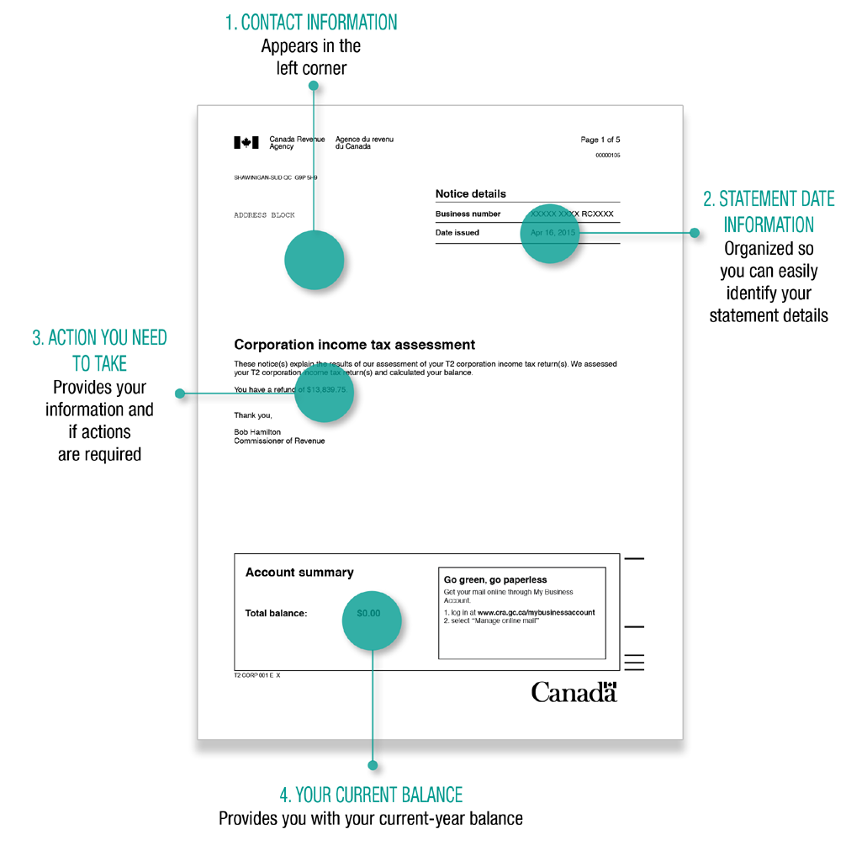
The NOA also includes corrections to the income tax form, important updates for the following tax yearFiscal Year (FY)A fiscal year (FY) is a 12-month or 52-week period of time used by governments and businesses for accounting purposes to formulate annual, reminders about installment payments, and other issues relevant to a taxpayer’s tax report.
Summary
- A Notice of Assessment (NOA) is a tax form issued to taxpayers by the Canada Revenue Agency after processing income tax returns.
- An NOA includes a summary of income taxes to be paid or refunded during the current tax year.
- The NOA also summarizes the Registered Retirement Savings Plan contributions during the tax year and any unused contributions.
Understanding the Notice of Assessment
The Notice of Assessment is calculated based on the tax returns submitted by a taxpayer. It is a two-page document, and it indicates the name of the taxpayer, insurance number, the tax year, and the tax center.
If a taxpayer finds errors in the NOA, they are allowed to submit an adjustment request, highlighting the errors to be fixed. The Canada Revenue Agency allows up to 90 days from the date the NOA is issued to appeal the information if there is information they do not agree with.
For example, if a taxpayer expects to receive tax refunds of $8,000, but the NOA indicates that the taxpayer owes the CRA $3,000, a taxpayer can appeal the error within 90 days. When appealing, the taxpayer is required to attach any supporting documentation that explains their objection to the assessed income tax.
After submitting an appeal, the taxpayer is not required to pay the amount in dispute until the review is completed. Any appeals after the 90 days have elapsed are not considered, and the taxpayer information will be sent to collections.
Registered Retirement Savings Plan (RRSP)
One of the important items included in the Notice of Assessment is the Registered Retirement Savings Plan (RRSP). The section lists the RRSP contributions that a taxpayer made during the tax year, any unused contributions during the tax year, and the contribution limits for the following tax year. The CRA uses the information included in the tax returns for the relevant tax year to determine the maximum contributions that individuals can contribute towards their RRSP for the following year.
Taxpayers can claim the RRSP contributions as a deduction from the taxable incomeTaxable IncomeTaxable income refers to any individual's or business’ compensation that is used to determine tax liability. The total income amount or gross income is used as the basis to calculate how much the individual or organization owes the government for the specific tax period.. The taxpayer is not required to claim the deductions during the tax year, and the deductions are carried forward to the following tax year if they expect to receive increased incomes. It allows them to claim a bigger deduction from the tax bill for the following year.
However, if a taxpayer accumulates unused contributions where previous contributions and the current year’s contributions exceed the RRSP deduction limit, a taxpayer may be penalized by the CRA. The taxpayer will be required to pay a penalty at the rate of 1% per month for the excess RRSP contribution amount.
How to Get a Notice of Assessment
After submitting tax returns for the year, a taxpayer can expect to receive the Notice of Assessment in two to eight weeks, depending on whether they submitted the tax return electronically or through paper-based returns. A taxpayer can receive the NOA in the following two ways:
1. Snail mail
If a person has not registered for online mail, the NOA is sent through regular mail.
2. Online mail service (by CRA)
Taxpayers can register to receive the NOA through online mail when filing tax returns electronically. The option is enabled under the CRA “My Account” service. Taxpayers can also check their return status and the NOA under the “My Account” tab. If the NOA is available, you can download the statement as a PDF.
CRA Audits
The Canada Revenue Agency may conduct an audit of the business or personal incomeRemunerationRemuneration is any type of compensation or payment that an individual or employee receives as payment for their services or the work that they do for an organization or company. It includes whatever base salary an employee receives, along with other types of payment that accrue during the course of their work, which of taxpayers, especially when the agency suspects that a taxpayer has under-reported the annual income or over-reported the annual expenses to reduce the tax liability.
The tax audit involves cross-examination of all revenues and expenses incurred during the tax year by the taxpayer, and sometimes the spouse. A tax audit may also be conducted randomly for a select number of taxpayers or members of a tax group.
Once an auditor has sent a request for a tax audit, a taxpayer is required to furnish the auditor with all the requested information, such as evidence of expenses incurred during the year, financial statements for the current and previous tax years, etc.
For tax purposes, taxpayers are required to maintain a record of the tax records and relevant documents for the past six years, including the current year. If the outcome of the audit reveals discrepancies in the incomes and expenses reported, the CRA may order a reassessment of the current and previous years’ income taxes.
More Resources
CFI offers the Commercial Banking & Credit Analyst (CBCA)™Program Page - CBCAGet CFI's CBCA™ certification and become a Commercial Banking & Credit Analyst. Enroll and advance your career with our certification programs and courses. certification program for those looking to take their careers to the next level. To keep learning and developing your knowledge base, please explore the additional relevant resources below:
- Canadian Income Tax BracketsCanadian Income Tax BracketsThis article will outline how Canadian tax brackets function. The income taxation system in Canada is a progressive system, meaning that individuals who earn more are generally taxed more. By contrast, in a flat taxation system, everyone pays the same percentage
- Permanent/Temporary Differences in Tax AccountingPermanent/Temporary Differences in Tax AccountingPermanent differences are created when there's a discrepancy between pre-tax book income and taxable income under tax returns and tax
- Progressive TaxProgressive TaxA progressive tax is a tax rate that increases as the taxable value goes up. It is usually segmented into tax brackets that progress to
- Corporate vs Personal Income TaxCorporate vs Personal Income TaxIn this article, we will discuss corporate vs personal income tax. Corporate tax is an expense of a business (cash outflow) levied by the government
-
Corporate vs. Personal Income Tax: Key Differences Explained
In this article, we will discuss corporate vs personal income tax. Corporate tax is an expense of a business (cash outflow) levied by the government that represents a country’s main source of in
-

Understanding Foreign Tax Credits: A Comprehensive Guide
Foreign tax credits are non-refundable tax credits for income taxes that were paid to a foreign government as a result of income taxation. The foreign tax credit is available to those who work interna
finance
- Understanding Notice of Probate: Executor Responsibilities & Requirements
- Accelerated Dividends: Understanding Early Dividend Payments
- Understanding Capital Gains Tax: A Comprehensive Guide
- Understanding Exemptions: Definitions and Applications in Finance
- Understanding Federal Income Tax: A Comprehensive Guide
- Franchise Tax Explained: What It Is & Who Pays
- Understanding Horizontal Equity in Taxation
- Understanding Income Tax: A Comprehensive Guide for Individuals & Businesses
- Understanding Taxation: A Comprehensive Guide to Government Revenue
-
 IRA Explained: Your Guide to Individual Retirement Accounts & Tax Benefits
If you’ve ever read anything about personal finance, you’ve probably heard of an IRA or Individual Retirement Account. But it’s easy to get scared off by what can seem like technical jargon – what is ...
-
 Understanding Regressive Taxes: Definition & Examples
Regressive tax is one of two main types of tax systems utilized by a country. Under a regressive tax system, taxes are assessed uniformly on everyone regardless of their income. Most nations, includin...