
Variance Calculation: Formula, Analysis & Financial Planning
The variance formula is used to calculate the difference between a forecast and the actual result. The variance can be expressed as a percentage or as an integer (dollar value or the number of units). Variance analysis and the variance formula play an important role in corporate financial planning and analysisJobsBrowse job descriptions: requirements and skills for job postings in investment banking, equity research, treasury, FP&A, corporate finance, accounting and other areas of finance. These job descriptions have been compiled by taking the most common lists of skills, requirement, education, experience and other (FP&A) to help evaluate results and make informed decisions for a business going forward.
What is the Variance Formula?
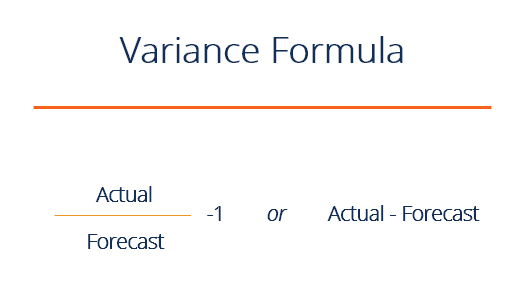
There are two formulas to calculate variance:
Variance % = Actual / Forecast – 1
or
Variance $ = Actual – Forecast
In the following paragraphs, we will break down each of the formulas in more detail.
Percent Variance Formula
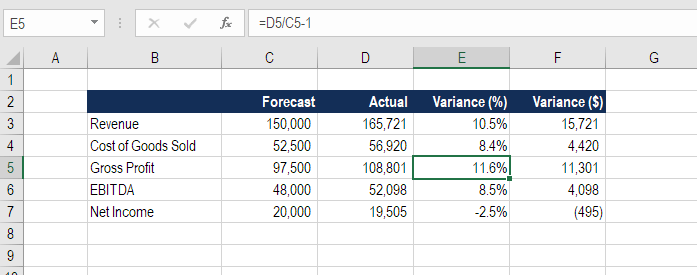
As the name implies, the percent variance formula calculates the percentage difference between a forecast and an actual result.
In the example analysis above we see that the revenue forecast was $150,000 and the actual result was $165,721. Therefore, we take $165,721 divided by $150,000, less one, and express that number as a percentage, which is 10.5%.
This is an example of outperformance, a positive variance, or a favorable variance.
Dollar Variance Formula
The formula for dollar variance is even simpler. It’s equal to the actual result subtracted from the forecast number. If the units are dollars, this gives us the dollar variance. This formula can also work for the number of units or any other type of integer.
In the same example as above, the revenue forecast was $150,000 and the actual result was $165,721. We now take $165,721 and subtract $150,000, to get a variance of $15,721.
Download the Free Template
Enter your name and email in the form below and download the free template now!
Favorable vs. Unfavorable Variance
Since variance analysis is performed on both revenues and expenses, it’s important to carefully distinguish between a positive or negative impact. For this reason, instead of saying positive, negative, over or under, the terms favorable and unfavorable are used, as they clearly make the point.
For example, if a cost has a negative difference to the forecast (lower than expected), that’s a favorable variance since it’s better to have costs lower rather than higher.
Variance in Budgeting and Forecasting
The variance formula is useful in budgeting and forecasting when analyzing results. The job of a financial analyst is to measure results, compare them to the budget/forecast, and explain what caused any difference.
In the Financial Planning & Analysis department at a company, the role of FP&AJobsBrowse job descriptions: requirements and skills for job postings in investment banking, equity research, treasury, FP&A, corporate finance, accounting and other areas of finance. These job descriptions have been compiled by taking the most common lists of skills, requirement, education, experience and other is to present management with accurate, timely, and insightful information so they can make effective decisions about the business going forward.
Using the variance formula and presenting this type of information is critical in FP&A.
Additional resources
At CFI, our mission is to help you advance your career. With that goal in mind, we highly recommend these additional free CFI resources:
- Marginal cost formulaMarginal Cost FormulaThe marginal cost formula represents the incremental costs incurred when producing additional units of a good or service. The marginal cost
- Analysis of financial statementsAnalysis of Financial StatementsHow to perform Analysis of Financial Statements. This guide will teach you to perform financial statement analysis of the income statement,
- Waterfall chart templateExcel Waterfall Chart TemplateDownload our free Excel Waterfall Chart Template .xls file and follow our instructions to create your own cash flow waterfall chart in Excel.
- Types of graphs in ExcelTypes of GraphsTop 10 types of graphs for data presentation you must use - examples, tips, formatting, how to use them for effective communication and in presentations.
-

Accurate Yield Loss Calculation for Farmers: A Comprehensive Guide
Yield loss is an important part of agricultural economics. Yield loss is the loss of a crop due to insects, bad weather and other natural factors. These are factors that apply to the entire c
-

Calculating Flotation Costs: A Comprehensive Guide
How to Calculate Flotation Costs When a publicly traded company issues new securities, such as stock, it hopes to profit from the investors who purchase these securities. But the company incu
finance
- Understanding Effective Cost: Beyond Interest Rates
- Understanding LIBOR: Calculation, Impact & Key Factors
- Interest Calculation: Simple vs. Compound - A Clear Guide
- Understanding and Calculating Year-to-Date (YTD) Change
- Calculate Net Proceeds: A Simple Guide for Homeowners & Asset Sellers
- ROI Calculation: A Simple Formula for Investment Returns
- Net Income: Definition, Calculation & Importance for Business
- Dividend Yield Explained: Calculation & Importance for Investors
- Profit Margin Calculation: Formula, Examples & Business Insights
-
 Understanding Real Estate Appreciation: A Simple Calculation
Appreciation can describe the rising value of homes. Appreciation describes the increasing value of an asset over time, and is commonly used in reference to increased values of real estate. C...
-
 Understanding Capital Value: Definition & Calculation
An assets capital value is an expression of market value at a given point in time. Capital value essentially refers to the market value of a given asset or group of assets at a specific point...