
Understanding Vendors: Definition, Role & Supply Chain Importance
A vendor refers to an individual or company that sells something to another individual or entity. Vendors can be utilized at different spots in the supply chainSupply ChainSupply chain is the entire system of producing and delivering a product or service, from the very beginning stage of sourcing the raw materials to the final, and with multiple occurrences throughout. The term vendor can encompass retailers or suppliers broadly with what is often a component in a larger product.

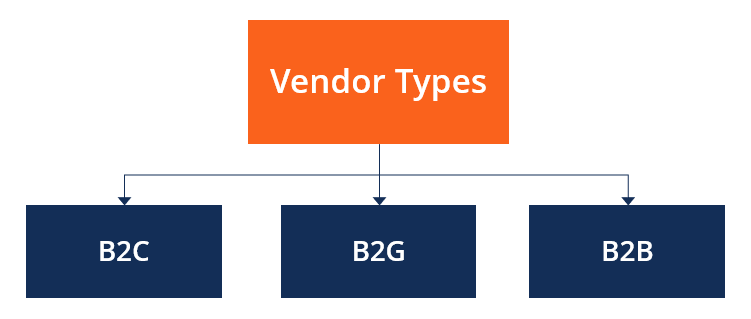
Below, we will look at some different types of vendors and the different customer bases they serve in the market. Through examples, we can better contextualize the different ways vendors operate and their purpose within the supply chain.
Different Types of Vendors
1. B2C (Business to Consumer)
The B2C type of vendor sells directly to the consumerTypes of CustomersCustomers play a significant role in any business. By better understanding the different types of customers, businesses can be better equipped to develop. They sell generally completed products to the end-user or even product components. It can be a retail store, such as the Gap that sells clothing, or, it can also be a retailer like the now-defunct Radio Shack that sold electronic components, acting as a specialty vendor for the end consumer.
A vendor can be an online retailerFinancial Statements Examples – Amazon Case StudyFinancial statements show the financial performance and strength of a company. The three core financial statements are the income statement, or even someone selling hot dogs at a ballpark. Some vendors even specialize in providing consumer services. Vendors provide a wide-ranging volume of products to the end consumer. But how else do they operate?
2. B2G (Business to Government)
The B2G type of vendor sells to the government. In the defense industry, there are many vendors that sell different types of equipment through government contracts. Some examples of B2G vendors include Raytheon and Lockheed Martin, which sells defense products and components to the Army.
Another type of B2G vendor can be a government consultant. They are individuals who might have built a successful career for themselves in the private sector and have begun contracting out their expertise to the public sector.
3. B2B (Business to Business)
A B2B vendor is one that sells primarily to other vendors. An example of a B2B vendor is Panasonic, which sells batteries to Tesla, or microchip manufacturers, such as Intel or Advanced Micro Devices, which sell components to personal computer manufacturers. The items are being sold to businesses and will, in turn, generally be stored in inventory either for a short or long period of time (depending on the product).
For the purposes of our computer hardware example, they are likely to be stored in inventoryInventoryInventory is a current asset account found on the balance sheet, consisting of all raw materials, work-in-progress, and finished goods that a for a short period because of the short refresh lifecycle of flagship electronic components like Intel microprocessors.
Vendor Strategy
When an entrepreneur is looking at starting a business, they are not only limited to trying to solve a problem a consumer is facing, but they can expand the scope of their customer discovery to determine the type of supply chain vendor problem they can solve for businesses or the government.
Understanding the different ways a vendor can insert themselves in the supply chain allows companies to identify new opportunities to compete and gives room for new competitors and companies to emerge and enter the market. After all, the more vendors compete, the lower the cost of production on our favorite items will be, and the more money we can save as consumers.
Vertical Integration?
Understanding the role of the vendor in the supply chain can also help business consultants or executives spot deficiencies or find new ways to vertically integrate to perhaps even manufacture their own components and become a vendor for their own products.
Tech giant Apple is an example of a company that follows a similar strategy with regards to microprocessors, as they now manufacture many of the chips found within their highly popular iPhone.
The Vendor, the Supply Chain, and You!
When we, as consumers, understand how supply chain management works, we can better understand and contextualize product pricing and understand why certain types of products command a premium. The movement of a product in the process of development down a supply chain sometimes necessitates many vendors that provide the manufactured, and sometimes specialty, components to create a complex product.
Becoming a vendor of a specialty component can be a niche and lucrative business opportunity that may not be obvious at first glance. Vendors are everywhere, and the more we learn about what goes into making a product, the more we understand their importance.
More Resources
CFI is the official provider of the global Commercial Banking & Credit Analyst (CBCA)™Program Page - CBCAGet CFI's CBCA™ certification and become a Commercial Banking & Credit Analyst. Enroll and advance your career with our certification programs and courses. certification program, designed to help anyone become a world-class financial analyst. To keep advancing your career, the additional CFI resources below will be useful:
- FranchiseFranchiseA franchise refers to a contractual arrangement whereby one party (the franchisor) allows another party (the franchisee) to use its trademarks
- Total Addressable Market (TAM)Total Addressable Market (TAM)Total Addressable Market (TAM), also referred to as total available market, is the overall revenue opportunity that is available to a product or service if
- Vertical IntegrationVertical IntegrationA vertical integration is when a firm extends its operations within its supply chain. It means that a vertically integrated company will bring in previously
- Warranty ExpenseWarranty ExpenseWarranty expense is an expense related to the repair, replacement, or compensation to a user for any product defects. In other words, a
-

Understanding Alpha: A Guide to Investment Performance
Alpha is a measure of the performance of an investment as compared to a suitable benchmark index, such as the S&P 500S&P – Standard and PoorsStandard & Poor’s is an American fi
-
Annuity Due Explained: Payments at the Beginning of Each Period
Annuity due refers to a series of equal payments made at the same interval at the beginning of each period. Periods can be monthly, quarterly, semi-annually, annually, or any other defined period. Exa
finance
- PC Banking: A Comprehensive Guide to Online Banking Security & Features
- IRA CDs: Secure Retirement Savings with FDIC Insurance
- Vendor's Lien Deed: Definition, Function & Purpose
- Understanding the DU: Your Mortgage Approval Explained
- Decentralized Finance (DeFi): A Comprehensive Overview
- Jumbo CDs: Higher Rates & Deposits Explained
- Vendor Financing: A Comprehensive Guide for Businesses
- Understanding Regulation Z: Your Rights as a Borrower
- Annuities Explained: A Simple Guide to Retirement Income
-
 Acquirer Definition: Understanding Corporate Acquisitions
An acquirer is a registered company that purchases a portion of, or all the rights to, another company. The acquiring company takes over the management of another company by obtaining a majority stake...
-
 Understanding Add-On Interest: How It Works & Loan Payments
Add-on interest refers to the calculation method of determining the total interest to be paid on a loan. Once the interest’s been added to the principal, the amount is divided by the number of m...