
Your Blockchain Address
But then the Bitcoin developers were reminded of the cybersecurity threats that would soon follow, making this method of sending coins vulnerable to third-party intermediary attacks. Upon this realization, the option to send payments to an IP-address.
The purpose behind a blockchain address is simply to serve as a secure identifier for transactions--specifically, sending payments to an entity that has unique information.
New Standard for Bitcoin Addresses
After the Pay to IP mechanism was left behind, the “Pay to Public Key Hash”, or P2PKH, became the new standard format for sending payments to bitcoin addresses.
To the plain eye, it looks like this:
1K31KZXjcochXpRhjH9g5MxFFTHPi2zEXb
When you are sending payments to another P2PKH address, make sure it has 34 characters and begins with a “1”.
How To Get a Bitcoin (or other Blockchain Address)
For beginners, it’s very easy to create your own P2PKH address. All it requires is choosing a particular “wallet” (or software).
Once you have a wallet, the back-end (nothing you need to do) automatically collects entropy and uses it to generate an ECDSA private key. “ECDSA” is the cryptographic algorithm in the core of bitcoin addresses.
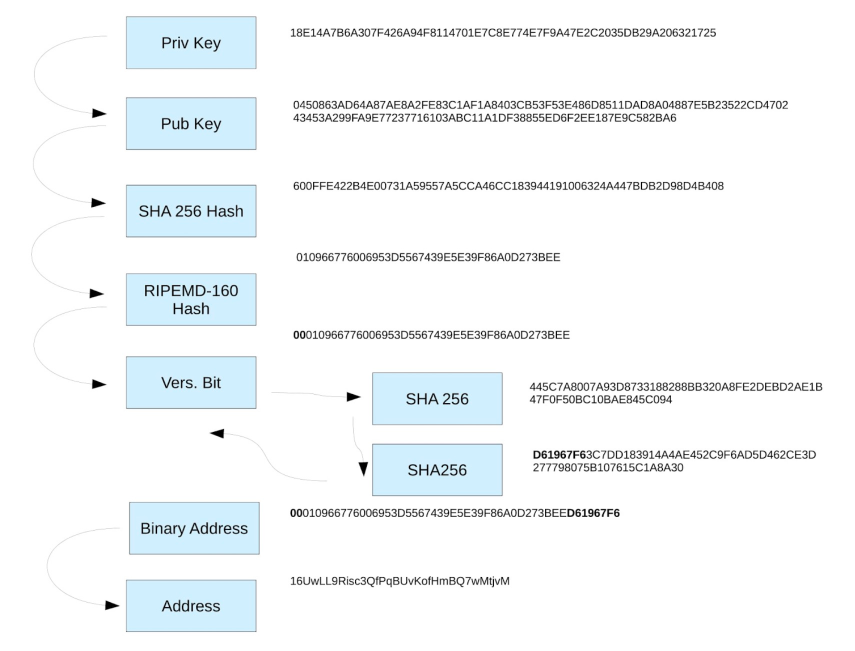
The wallet essentially pushes the public key through a series of cryptographic algorithms, eventually converting all the bytes and code into the final product: the bitcoin address.
The purpose of the asymmetric signature platform allows you to sign messages with the PRIVATE key (rather than the “public” key) and verify the signature with the PUBLIC ley.
This solidifies your ownership over the address, as it’s very similar to you physically signing a letter or document.
The Public Key
Once the private key with entropy is created, the wallet generates the public key from that information by picking random coordinates on a certain elliptic curve and doing some calculations.
For your benefit, all you need to worry about is the public key, which allows you to send and receive payments.
‘65’ Too Long
However, the length of characters which comprise the public key were very long and inconvenient, running at 65 characters long. The potential for an individual to type it out wrong was enough of a reason for the bitcoin developers to create a method for deriving an address from the public key.
Are You Using the Right Key?
For beginners or even those conducting regular transactions, whenever you paste a blockchain address in your bitcoin wallet, it immediately checks the prefix and calculates the “checksum”.
A checksum address is a quick way to verify if a number, or set of data, has been altered, either intentionally or unintentionally. This prevents you from accidentally sending your crypto to a non-existent address. In other words, it solves the “clerical” or typographical error.
The checksum address is created by running the algorithm on a piece of data, generating a checksum number, or hash, which can then be sent along with the original set of data. The data recipient can then use the hash to determine whether the data has been altered or corrupted. A safeguard. If the checksum doesn’t match, it rejects the address, making it impossible to (inadvertently) send funds to a wrong address due to a clerical or typographical error.
If however, you have the private key for an address, only you can sign a transaction with the cryptocurrency token assigned to that address. In turn, everyone who knows your address can verify the validity of your signature.
In plain, all that’s happening is signing a transaction and verifying the transaction, using public and private keys.
Bitcoin’s Advanced Addresses
Source: Blockgeeks
Seeing that Bitcoin is the premiere cryptocurrency, it is fair to assume it’s a bit more advanced and sophisticated, which is why it has more advanced addresses, known as the P2SH addresses, or “Pay to Script Hash”.
P2SH addresses means the individual doesn’t pay to the hash of a public key, but rather to the hash of a script. In layman’s terms, all this means is that when signing a transaction, you don’t have to provide the signature matching a certain public key--instead a script matching a certain hash.
The purpose of this is simply to allow for more feasible and flexible means to verify yourself.
P2SH addresses use the prefix 05, beginning with a “3”. For more information on P2SH addresses, please click here.
-

Blockchain Wallet: Securely Store & Manage Your Crypto
A blockchain wallet is a digital wallet that allows users to store and manage their Bitcoin, Ether, and other cryptocurrencies. Blockchain Wallet can also refer to the wallet service provided by Blo
-
Monero (XMR): The Privacy-Focused Cryptocurrency Explained
What Is Monero? Monero is a digital currency that offers a high level of anonymity for users and their transactions. Like Bitcoin, Monero is a decentralized peer-to-peer cryptocurrency, but unl
Fund information
- Update Your Social Security Address: A Comprehensive Guide
- Life Insurance Questions: 5 Critical Questions to Re-evaluate Your Coverage
- Retirement Planning: 5 Often-Overlooked Factors for Financial Security
- Financial Literacy for Adults: Essential Skills & Strategies
- Unlock Financial Success: 5 Proven Strategies for a Wealthy Mindset
- Build Financial Security: 5 Essential Tips for a Rainy Day Fund
- Implementing Blockchain in Node.js: A Practical Guide
- Blockchain Explained: The Technology Powering Cryptocurrency
- Cryptography Explained: Secure Communication & Encryption Techniques
-
 Financial Organization: A Step-by-Step Guide to Get Started
Often what keeps many of us from getting our financial house in order is not knowing where to begin. Excel spreadsheets, budgeting apps, accounting software, budgets, sp...
-
 Maximize Your Salary: 10 Proven Tips for Smart Savings
You finally got a job that pays you consistently. No more wondering if it will be a slow tip day or wondering if you’ll receive a sales commission check this week. Welco...