
Bitcoin Cash (BCH): A Comprehensive Overview - What You Need to Know
When you hear the term ‘Bitcoin Cash’ thrown around, it’s because it uses the original Bitcoin Cash client, despite the two categories.
Wait, Isn’t There ‘Bitcoin?’
Yes. Bitcoin Cash is a spin-off cryptocurrency from Bitcoin. The main difference between Bitcoin and Bitcoin Cash is purely philosophical. To understand why Bitcoin Cash came around, we must look back to why Bitcoin came around. For more information on Bitcoin’s history, please click here.
When Bitcoin’s founder, Satoshi Nakamoto unveiled the concept in 2008, Bitcoin was meant to be a peer-to-peer (P2P) cryptocurrency that was to be used for daily transactions. As Bitcoin grew in popularity over the years, it became more mainstream, causing its price to surge astronomically.
Issue: Block Size
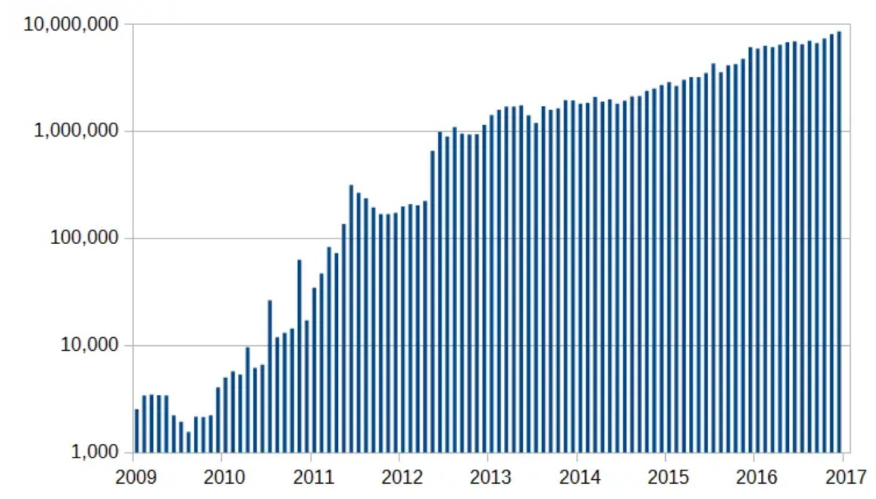
The number of Bitcoin transactions per month over eight years | Source: Wikipedia
Due to this surge, Bitcoin (accidentally) transformed into an investment vehicle, rather than a currency, despite Nakamoto’s vision. At this point, Bitcoin’s blockchain experienced scalability issues, because it simply couldn’t handle the increasing number of transactions that began to occur (thanks Silk Road).
As a result, the confirmation time and fees for a single transaction on Bitcoin’s blockchain surged, due to the 1MB block size limitation for bitcoin. But why have such a low size capacity?
Simple. The developers implemented the 1MB size limit because they wanted to reduce the number of spam transactions that could clog up the entire network. This design was done intentionally.
Due to this limitation, transactions were queued up, waiting for confirmation, because the blocks couldn’t handle the ongoing increase in transaction sizes.
Under this system, Bitcoin processes an average of 1,000 -1,500 transactions per block. Still too slow.
A Solution to ‘Block Size?’
Enter Bitcoin Cash.
Bitcoin Cash specifically addresses Bitcoin’s issue when it comes to block size. Bitcoin Cash’s system aims to remedy this by increasing the size of blocks (from 1MB) to 8 MB and 32 MB, allowing for more transactions to be processed per block.
Back in September 2018, a “stress test” was conducted where Bitcoin Cash’s blockchain increased the block size to process close to 25,000 transactions ber block. A huge increase.
Other proponents of Bitcoin Cash believe that by changing bitcoin’s block size, will allow for bitcoin to be used as a medium for daily transactions (closer to Nakamoto’s initial vision), helping it to compete against credit card processors like Visa, which already charge high transaction fees.
Every Bitcoin holder received an equivalent amount of Bitcoin Cash, which multiplied the number of coins in existence. When Bitcoin Cash first debuted in July 2017, it started at $900, but still wasn’t supported by major exchanges like Coinbase.
No SEGWIT
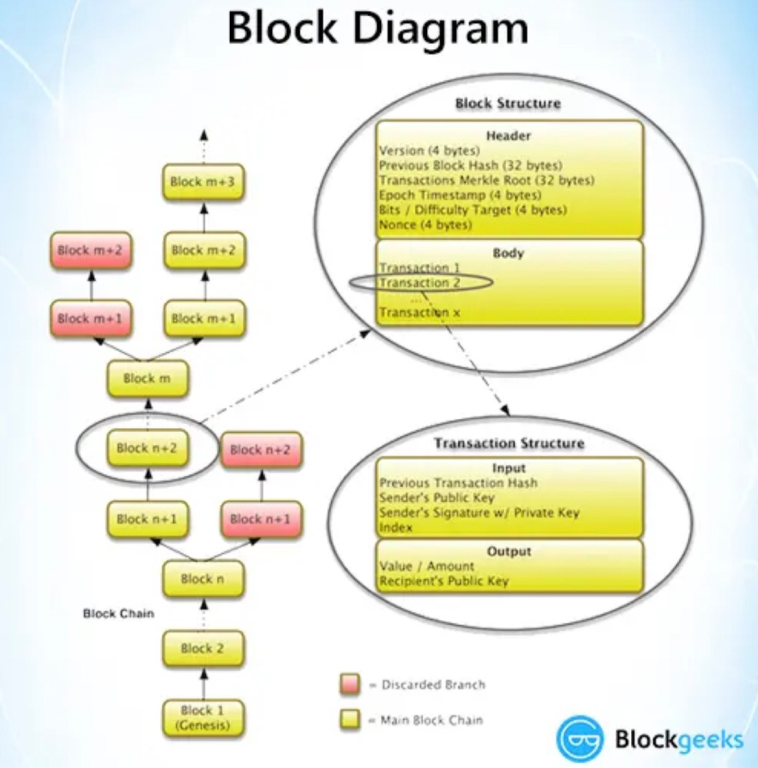
Unlike Bitcoin, Bitcoin Cash does not incorporate Segwit (Segregated Witness), which would ultimately create more space in the blocks for more transactions.
SegWit is the process by which block size is increased by removing signature data from Bitcoin transactions. By only retaining the information or metadata specifically related to a single transaction in a block, this frees up space or capacity to add more transactions to the chain.
When the developers first built SegWit, they added a special requirement: it could only be activated when it has 95% approval from the miners. Why? It’s a big change to the system.
But this requirement created problems for miners, because most miners don’t want SegWit to be activated. Understandably so, by increasing the available block space, this could have a large impact on the number of transaction fees they get (ultimately reducing them).
So, miners inevitably stalled the approval process, which upset both users and businesses who needed SegWit to be activated.
Which led to the birth of User Activated Soft Fork (UASF) called BIP 148, or Bitcoin Improvement Proposal 148. Specifically BIP 148 is a user activated soft fork which states that all the full nodes in the bitcoin networks will reject any and all blocks that are created without SegWit embedded in it--encouraging miners to put SegWit activation in the blocks they mine for it to be part of the network.
Bitcoin Improvement Proposals (BIPs) are design documents which introduce various designs and improvements to the bitcoin network. There are three categories of BIPs:
- Standards Track BIPs
- Informational BIPs
- Process BIPs
But of course contingencies were put into place in the event BIP 148 failed which would probably lead to a chain split. Thus, UAHF, or User Activated Hard Fork was born.
Created by Bitmain, UAHF was the escape route for those who didn’t want to be part of the BIP 148 proposal, offering a new chain to join. This eventually became Bitcoin ABC’s first release, Bitcoin Cash.
Even with this change, many still didn’t agree with the philosophy behind Bitcoin Cash in relation to its predecessor, Bitcoin.
-

Synthetic Cash: Understanding Simulated Financial Instruments
Synthetic cash is a financial instrument that is created to function like other financial instruments, but certain characteristics of the simulated financial instrument are altered. The simulated inst
-

Understanding Finance: A Comprehensive Overview
In financeFinance OverviewFinance is defined as the providing of funding and management of money for individuals, businesses, and governments. The financial system includes the circulation of money, m
Fund information
- Bitcoin Dominance Explained: Understanding BTC Market Share & Trends
- Bitcoin Cash (BCH): A Comprehensive Overview - Features, History & Future
- Blockchain Explained: A Beginner's Guide to Distributed Ledgers
- Bitcoin Explained: A Simple Guide to Digital Currency
- Bitcoin Explained: The History & Future of Cryptocurrency
- Litecoin (LTC): A Comprehensive Overview - History, Features & Purpose
- Tether (USDT): Understanding the Stablecoin & Its Role in Crypto
- Bitcoin Cash (BCH): A Comprehensive Overview - History, Features & Scalability
- Bitcoin Cash CFDs: A Comprehensive Guide for Traders
-
 Understanding Liquidity in Financial Markets: A Comprehensive Guide
In financial marketsFinancial MarketsFinancial markets, from the name itself, are a type of marketplace that provides an avenue for the sale and purchase of assets such as bonds, stocks, foreign excha...
-
 Profit vs. Cash Flow: Understanding the Key Difference
Understanding the difference between profit vs cash is very important in the finance industry. Profit is defined as revenue less all the expenses of a company in a certain period, while cash flow is c...