
HUD Housing Tenant Organization Guidelines: Rights & Regulations
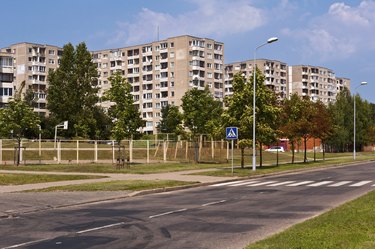
The U.S. Department of Housing and Urban Development has supervisory jurisdiction over many privately owned apartment complexes across the United States. Apartments that provide housing for low-income and special population groups almost always fall within HUD's jurisdiction and oversight. HUD's official policy encourages and protects tenant organizations in low-income and special population-type apartment complexes. An array of federal laws also implement and enforce applicable HUD policies regulating tenant organizations.
Legitimate Tenant Organizations
Federal regulations allow the formation and protection of tenant organizations at HUD housing complexes. Such organizations must be for the purpose of tenants having a voice in their living conditions, building rules and financial and legal issues regarding their apartments and complexes. HUD-recognized tenant organizations must be fully open to participation by all the residents and be democratic in nature and practice. Officially recognized HUD tenant organizations must also have regular meetings and be completely independent of the complex's owners, agents or employees.
Tenant Organizer Regulations
HUD's regulations require that landlords allow tenant organizers to freely operate on their properties. Tenant organizers can be volunteers or professionals, residents or nonresidents. Resident tenant organizers can distribute and post literature, hold meetings and canvass door to door free from permission or supervision of building management. Non-resident tenant organizers have the same rights as resident organizers if the complex doesn't have an official and public no soliciting policy. Nonresident tenant organizers must be accompanied by residents while in apartment complexes having anti-solicitation policies.
Organizer Activities and Actions
Tenant organizations have the right to freely distribute and appropriately post pamphlets, posters and other written literature on their properties. Members of tenant organizations can also hold tenant meetings and go door to door to talk to individual tenants. Tenant organizations are allowed to act as the official voice for residents by drafting and submitting written demands to building management and responses to management policies. HUD regulations specify that legitimate tenant organization activities do not require building management permission or supervision.
Tenant Organization Meetings
HUD regulations require subject properties' management to regularly provide tenant organizations with meeting rooms or space on their properties. Tenant organization meeting rooms or spaces must be handicap-accessible if at all possible. Property owners may charge HUD-approved 'reasonable and customary' fees for tenant organizations' meeting spaces. HUD regulations and federal law specifically prohibit the attendance of anyone from management at tenant organization meetings unless they're invited by the organizations themselves.
-

Section 8 Housing Guest Policies: Understanding Your Rights & Responsibilities
If you receive rent assistance under the Section 8 program, also known as the Housing Choice Voucher program, you are bound by two sets of rules. First, you must adhere to general Section 8 guidelines
-

Emergency Section 8 Housing Assistance: Application & Eligibility
Certain emergency situations allow applicants to receive priority placement in Section 8 housing programs. The Housing Choice Voucher Program gives participants rental assistance for private- or gover
home finance
- Section 8 Housing Choice Voucher Program: Eligibility & Application
- Understanding Homeowner Rights: Suing an HOA for Rule Violations
- Government Grants for Home Electrical Rewiring | [Year]
- HUD Assistance Eligibility: Who Qualifies for Housing Support?
- Section 8 Moving Guidelines: Tenant Rights & Regulations
- Section 8 Housing Rules: What Tenants Need to Know
- Section 8 & HUD Housing: Application Process & Eligibility
- Housing Grants & Financial Aid for Women: 2024 Guide
- Navigating Regulatory Compliance in Manufacturing: Avoid Costly Penalties
-
 Housing Assistance Programs for Single Mothers: Find Help & Resources
Single mothers can receive housing assistance through programs offered by federal and local agencies and nonprofit organizations. Housing assistance programs offer a range of benefits, including affor...
-
 Homelessness Grants & Resources: Funding for Housing & Support
Federal, state and local agencies are working together to help homeless individuals and families obtain housing. The U.S. Department of Housing and Urban Development, or HUD, and the U.S. Department o...